Rapid urbanization, rising electricity demand, and increasing focus on grid safety have pushed utilities and EPC contractors to rethink traditional overhead distribution systems. Conventional bare conductor networks are highly exposed to faults caused by tree contact, wind damage, short circuits, and theft.
To address these challenges, aerial bundle cable (ABC) systems have emerged as a highly efficient, safe, and cost-effective solution for low-voltage and medium-voltage power distribution. Designed with insulated phase conductors bundled together, ABC significantly improves reliability while reducing maintenance requirements.
As a global manufacturer of overhead conductors and power transmission solutions, HNBF Power plays a key role in supplying high-performance ABC systems tailored for modern grid infrastructure.
What is Aerial Bundle Cable?
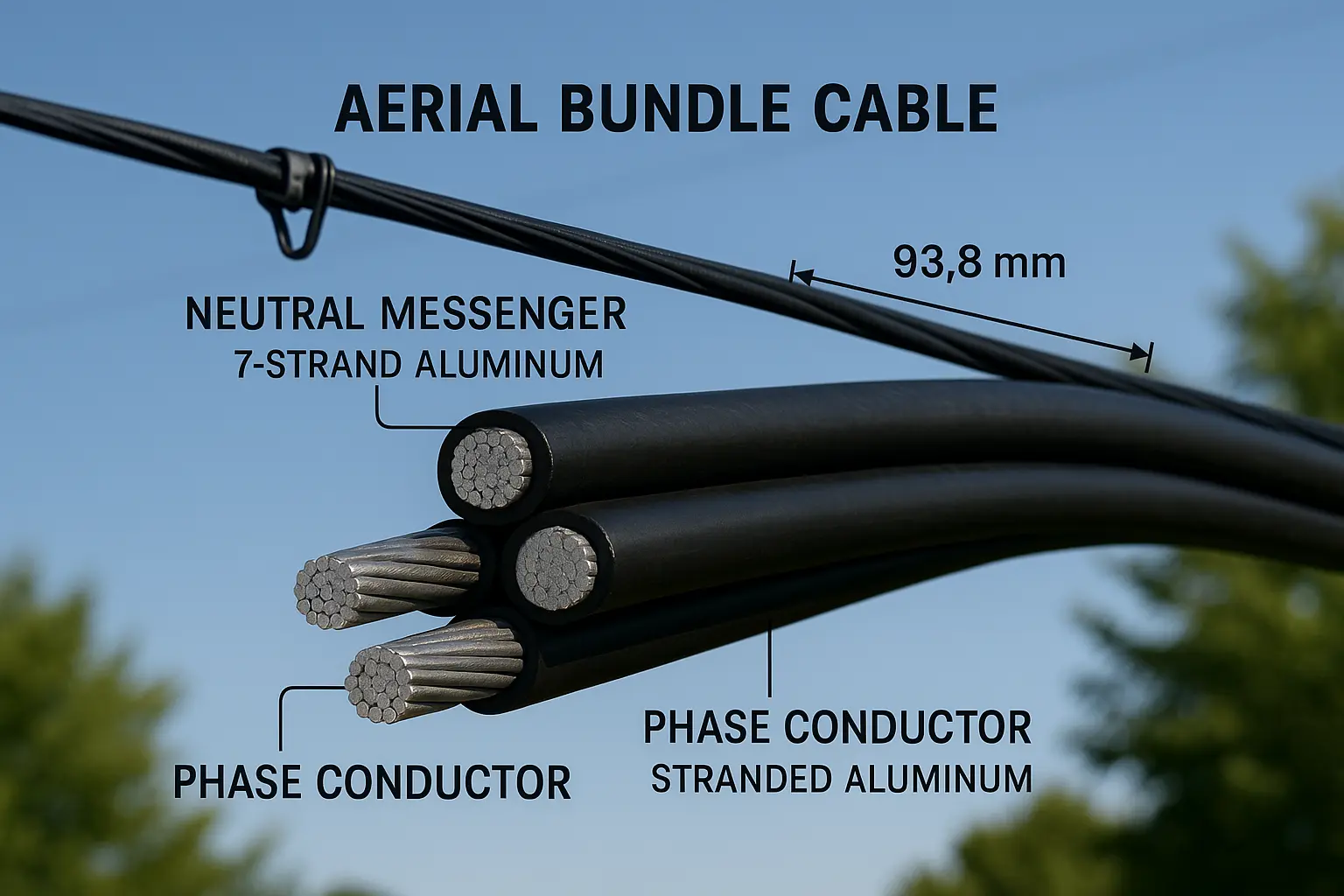
Aerial bundle cable is an overhead power distribution system where multiple insulated phase conductors are twisted or bundled together along with a neutral conductor. Unlike traditional bare conductors, each phase in ABC is individually insulated, typically using cross-linked polyethylene (XLPE), which enhances safety and reduces electrical faults.
ABC is primarily used for low-voltage (LV) and some medium-voltage (MV) distribution networks, especially in urban, semi-urban, and rural electrification projects.
Key Components of ABC:
- Insulated phase conductors (usually aluminum)
- Neutral conductor (bare or insulated messenger wire)
- XLPE insulation layer
- Optional street lighting and service drop conductors
Construction and Design Features
The design of aerial bundle cable is engineered to balance electrical performance, mechanical strength, and environmental resistance.
1. Conductor Material
Most ABC systems use aluminum conductors due to their excellent conductivity-to-weight ratio and corrosion resistance.
2. Insulation System
Each phase conductor is covered with weather-resistant XLPE insulation, which provides:
- UV resistance
- Moisture protection
- High dielectric strength
- Thermal stability under load
3. Messenger or Neutral Wire
The neutral conductor also acts as a supporting messenger wire, carrying mechanical tension and maintaining the structural integrity of the bundle.
4. Bundle Configuration
The conductors are helically twisted to ensure consistent spacing, reduce electromagnetic interference, and improve mechanical balance.
Types of Aerial Bundle Cables
Different configurations of ABC are used depending on system requirements:
1. Duplex ABC
Used for single-phase supply systems, commonly in rural electrification.
2. Triplex ABC
Used for single-phase service connections and secondary distribution lines.
3. Quadruplex ABC
Common in three-phase distribution networks with neutral conductor.
4. Multi-core ABC Systems
Used in complex distribution setups requiring additional service or lighting conductors.
Advantages of Aerial Bundle Cable
Aerial bundle cable has become a preferred solution for utilities worldwide due to its technical and economic advantages.
1. Enhanced Safety
Insulated conductors significantly reduce risks of electric shocks, short circuits, and accidental contact with trees or buildings.
2. Reduced Power Losses
ABC minimizes phase-to-phase faults and leakage currents, improving overall system efficiency.
3. Lower Maintenance Cost
Compared to bare conductor lines, ABC requires fewer inspections and repairs.
4. Theft Prevention
Insulated and bundled conductors reduce the risk of power theft, a major issue in many distribution networks.
5. Compact Installation
ABC requires less clearance than traditional overhead lines, making it suitable for congested urban areas.
6. Weather Resistance
It performs better under harsh environmental conditions such as storms, heavy rain, and high humidity.
Applications of Aerial Bundle Cable
ABC systems are widely adopted across various power distribution scenarios:
Urban Power Distribution
Ideal for densely populated cities where space and safety are critical concerns.
Rural Electrification Projects
Used to extend reliable electricity to remote and underdeveloped regions.
Industrial Zones
Supports stable power supply in manufacturing and processing industries.
Coastal and Forest Areas
Reduces faults caused by salt corrosion, vegetation contact, and wildlife interference.
Street Lighting Networks
Provides integrated solutions for public lighting systems.
Technical Considerations for Engineers and Procurement Teams
When selecting aerial bundle cable for a project, several technical parameters must be evaluated:
1. Voltage Rating
Typically designed for 0.6/1 kV systems, though higher configurations are available for specific applications.
2. Current Carrying Capacity
Depends on conductor size, ambient temperature, and installation conditions.
3. Sag and Tension Calculations
Proper mechanical design ensures optimal clearance and structural stability under wind and ice loading.
4. Insulation Thickness
Must comply with IEC or equivalent standards for safety and performance.
5. Environmental Conditions
UV exposure, temperature variation, and pollution levels influence cable selection.
Proper engineering design ensures that ABC systems deliver long-term performance with minimal operational risks.
Market Demand and Industry Trends
The global demand for aerial bundle cable is increasing rapidly due to several factors:
- Expansion of smart grid infrastructure
- Rising urban electricity consumption
- Government rural electrification programs
- Increasing focus on reducing distribution losses
- Need for safer and theft-resistant power systems
Utilities are gradually replacing bare conductor systems with insulated solutions, making ABC one of the fastest-growing segments in power distribution networks.
Why HNBF Power for Aerial Bundle Cable Solutions?
Selecting the right manufacturer is critical for ensuring long-term reliability and system efficiency. HNBF Power delivers engineered ABC solutions designed for modern power distribution challenges.
Key strengths include:
- High-quality aluminum conductor manufacturing
- Advanced XLPE insulation technology
- Strict quality control and testing standards
- Customizable cable designs for project-specific requirements
- Strong focus on utility and EPC contractor needs
HNBF Power’s aerial bundle cable solutions are designed to meet international standards, ensuring durability, safety, and high performance in diverse environmental conditions.
Frequently Asked Questions (FAQs)
1. What is the main purpose of aerial bundle cable?
Aerial bundle cable is used to safely transmit low-voltage electricity in overhead distribution networks while reducing faults, power losses, and safety risks.
2. How is ABC different from traditional overhead conductors?
Unlike bare conductors, ABC uses insulated phase wires bundled together, improving safety, reducing outages, and minimizing maintenance requirements.
3. Where is aerial bundle cable commonly used?
It is widely used in urban areas, rural electrification projects, industrial zones, and regions with harsh environmental conditions.
4. What materials are used in ABC systems?
Most ABC systems use aluminum conductors with XLPE insulation and a neutral messenger wire for mechanical support.
5. How do I choose the right ABC for my project?
Selection depends on voltage level, load requirements, environmental conditions, and installation design. Consulting with an experienced manufacturer is recommended.
Conclusion
Aerial bundle cable has become a cornerstone of modern power distribution systems, offering improved safety, reliability, and operational efficiency compared to traditional overhead lines. As utilities continue to modernize infrastructure, ABC will remain a key solution for both urban and rural electrification projects.
For engineered, high-performance aerial bundle cable solutions tailored to your project requirements, contact HNBF Power today. Their technical expertise and manufacturing capability ensure reliable support for power utilities, EPC contractors, and infrastructure developers worldwide.