10 Benefits of Earning a SAFe Agilist Certification in 2026
The global business landscape in 2026 is defined by rapid technological disruption, fluctuating market demands, and the critical integration of artificial intelligence into enterprise workflows. Organizations no longer have the luxury of slow, sequential project management. To survive and thrive, enterprises must achieve organizational agility at scale.
At the center of this transformation is the Scaled Agile Framework (SAFe), which remains the world’s most trusted framework for enterprise agility. Earning a SAFe Agilist certification this year is not merely a professional milestone; it is a strategic necessity for leaders aiming to steer their organizations through complex, fast-paced transformations. Below, we provide a comprehensive analysis of the top ten benefits of securing this credential in 2026.
1. Mastery over Enterprise-Scale Agile Transformations
Small-scale Agile practices like Scrum and Kanban work exceptionally well for isolated, independent teams. However, when an organization needs to align hundreds or thousands of practitioners toward a unified strategic vision, standard frameworks fall short. The SAFe Agilist certification equips professionals with the exact blueprints required to scale Agile across massive, multi-tiered enterprises.
Through this credential, leaders master the mechanics of the Agile Release Train (ART). We learn how to synchronize multiple teams, manage cross-team dependencies, and foster continuous value delivery. In 2026, as enterprises grow more complex, the ability to seamlessly orchestrate large-scale development efforts ensures that corporate strategy directly aligns with execution.
2. Navigating the Intersection of SAFe and Artificial Intelligence
The year 2026 marks a pivotal era where enterprise agility and AI maturity must converge. Organizations cannot leverage advanced machine learning models effectively if their operational frameworks are rigid and siloed. A SAFe Agilist certification provides the lean-agile mindset necessary to integrate data-driven workflows into continuous delivery pipelines.
Forward-thinking professionals recognize that true competitive advantage lies at the intersection of agile methodology and advanced technology. To successfully guide an enterprise through this evolution, pairing your agile credentials with a specialized ai course for working professionals is becoming the standard for modern leadership. Understanding how to manage AI-driven initiatives within a Lean-Agile framework ensures that technological investments yield measurable business outcomes rather than isolated experiments.
3. Acceleration of Time-to-Market
In today's hyper-competitive economy, the speed at which an organization can turn an idea into a production-ready feature dictates its market share. SAFe addresses this directly by optimizing the value stream and eliminating operational bottlenecks.
Certified SAFe Agilists learn to implement Lean User Experience (Lean UX), DevOps, and Continuous Delivery Pipelines. By emphasizing regular, incremental releases over massive, high-risk deployments, organizations can respond to market shifts almost instantly. We see that businesses employing SAFe principles drastically reduce their cycle times, allowing them to outpace competitors and capture emerging consumer demands ahead of the curve.
4. Enhanced Strategic Alignment via Lean Portfolio Management
One of the most pervasive challenges in large corporations is the disconnect between executive leadership and the teams executing the work. Strategic themes often get lost in translation as they cascade down the hierarchy.
SAFe solves this through Lean Portfolio Management (LPM). As certified individuals, we gain the capability to allocate funding to value streams rather than rigid projects. This ensures that every team on the ground is working on tasks that directly move the needle for the enterprise's overarching goals. In 2026, dynamic budgeting and rapid strategic pivoting are mandatory, making LPM expertise highly sought after by C-suite executives.
5. Cultivating a Culture of High-Performance and Continuous Learning
An organization is only as agile as its workforce. SAFe places immense emphasis on the Lean-Agile Leadership competency, which shifts the management paradigm from traditional command-and-control to servant leadership.
By earning this certification, we understand how to empower teams, encourage decentralized decision-making, and build a psychologically safe environment where innovation thrives. This cultural shift directly correlates with higher employee engagement, reduced burnout, and a significant drop in attrition rates. In an era where top-tier talent is highly selective, fostering a continuous learning culture is a powerful asset.
6. Future-Proofing Career Trajectories with AI-Agile Synergy
The job market in 2026 aggressively rewards multidisciplinary professionals. Holding a standard project management credential is no longer enough to stand out in a sea of applicants. Organizations want leaders who understand enterprise frameworks and cutting-edge operational tools.
To truly maximize the value of enterprise agility, leaders are increasingly pursuing an ai certification for professionals alongside their SAFe credentials. This dual expertise enables managers to oversee complex, cross-functional teams that deploy AI solutions safely and ethically at scale. Showing mastery in both scaled agile governance and artificial intelligence applications makes a professional indispensable to modern corporate recruiters.
7. Optimizing Value Streams Using Modern Analytics
Value Stream Mapping is a core component of the SAFe framework. It allows organizations to visualize the entire flow of value from concept to cash, identifying exactly where delays, handoffs, and redundancies occur.
Certified SAFe Agilists possess the analytical tools to dissect these value streams and ruthlessly eliminate non-value-adding activities. In 2026, where operational efficiency must be maximized due to tightening macroeconomic conditions, the ability to optimize workflows and maximize return on investment (ROI) without compromising quality is an invaluable skill set for any director or vice president.
8. Seamless Execution of Large-Scale PI Planning Sessions
Program Increment (PI) Planning is the heartbeat of the Agile Release Train. It is a highly structured event where all stakeholders, developers, and product managers align on a shared mission, identify risks, and map out dependencies for the upcoming increment.
Facilitating or actively participating in a PI Planning session requires a deep, nuanced understanding of SAFe dynamics. Certified individuals know how to navigate the complexities of these sessions, ensuring that hundreds of individuals walk away with a crystal-clear, realistic plan of execution. The ability to drive alignment across diverse business units during PI Planning is one of the most immediate, tangible benefits observed by employers.
9. Bridging Strategy with Execution via Applied Tech Competence
Enterprise transformation in 2026 is inherently digital. You cannot scale a business framework without scaling the technological architecture that supports it. SAFe emphasizes built-in quality, architectural runway, and technical agility to ensure that software and systems remain resilient over time.
To effectively manage these complex, tech-heavy backlogs, leaders often ground their strategic agile training with an applied ai course. This combination gives managers the technical fluency required to evaluate architectural runways that involve data pipelines, large language models, and cloud-native infrastructure. Bridging the gap between high-level agile governance and practical, applied technology ensures that engineering teams are never bottlenecked by non-technical leadership.
10. Global Recognition and Command of Premium Compensation
The Scaled Agile Framework is utilized by a vast majority of Fortune 100 companies and thousands of government agencies worldwide. Because the certification standards maintained by Scaled Agile, Inc. are rigorous, the credential serves as an immediate validation of an individual's capability to lead large-scale operations.
Consequently, ssm certification consistently command premium salaries compared to their non-certified peers. The market recognizes that the cost of an unsuccessful enterprise transformation is catastrophic; therefore, organizations are highly willing to invest in proven, certified professionals who possess the blueprint to guarantee a smooth transition to agility.
Core Components of the SAFe Agilist Curriculum
To understand why this certification holds such immense value, we must look closely at the core knowledge pillars that a candidate masters during their preparation:
|
Pillar |
Focus Area |
Enterprise Benefit |
|
Thriving in the Digital Age |
Recognizing market shifts and leveraging Lean, Agile, and DevOps values. |
Enables rapid pivoting in unstable economic conditions. |
|
Lean-Agile Leaders |
Applying Lean-Agile mindsets and principles to leadership behaviors. |
Shifts corporate culture from micromanagement to empowerment. |
|
Team and Technical Agility |
Creating high-performing, cross-functional Agile teams. |
Increases built-in quality and accelerates production cycles. |
|
Agile Product Delivery |
Utilizing customer-centricity and Design Thinking to build the right things. |
Ensures high customer satisfaction and precise market fit. |
Frequently Asked Questions
What is the validity of the SAFe Agilist certification?
The SAFe Agilist certification is valid for one year from the date of passing the exam. To maintain active status, professionals must renew their certification annually by paying the renewal fee and demonstrating ongoing professional development within the SAFe community.
How does SAFe differ from standard Scrum?
While standard Scrum focuses primarily on the team level (typically optimizing the performance of 5 to 9 team members), SAFe scales these principles to the entire enterprise level. It provides structured guidance on portfolio management, budgeting, governance, and the synchronization of multiple teams working toward a singular vision.
Is coding or technical knowledge required to pass the SAFe Agilist exam?
No, a background in software coding is not mandatory. The SAFe Agilist certification is designed for managers, executives, directors, and process owners. The focus is on business agility, lean portfolio management, and operational leadership rather than writing code.
Can I combine SAFe with other professional certifications?
Absolutely. Combining SAFe with an ai course for working professionals or an applied ai course is highly recommended in 2026. This dual-threat skill set enables you to manage both the human framework of enterprise agility and the advanced technical systems driving modern business automation.
What is the passing score for the SAFe Agilist certification exam?
The exam consists of multiple-choice questions, and the passing score typically hovers around 77% to 80% depending on the specific version of the framework being tested. Preparation through an authorized training partner is vital for success.
الأقسام
إقرأ المزيد
Executive Summary Agricultural Lubricants Market Opportunities by Size and Share Data Bridge Market Research analyses that the agricultural lubricants market which was USD 3.17 billion in 2022, would rocket up to USD 4.59 billion by 2030, and is expected to undergo a CAGR of 4.72% during the forecast period of 2023 to 2030. Agricultural Lubricants Market research report...

Natural Zeolite: A Sustainable Mineral Driving Industrial and Environmental Applications Natural zeolite is a group of microporous aluminosilicate minerals formed through volcanic activity and sedimentary processes over millions of years. Known for its unique crystalline structure, natural zeolite has become a highly valuable material in environmental management, agriculture, and industrial...
Coin Operated Laundries Market The Coin Operated Laundries Market serves urban populations and households without private laundry facilities. Demand is driven by apartment living, convenience, and time efficiency. Modern laundromats increasingly adopt digital payment systems and energy-efficient machines. Additional services such as wash-and-fold improve revenue streams. Location...
Medical Display Market to Witness Steady Growth Driven by Advanced Imaging Technologies The Medical Display Market is experiencing significant expansion due to the rising demand for high-quality imaging solutions in healthcare settings. The Medical Display Market size was valued at USD 2.81 billion in 2025 and is projected to reach USD 4.74 billion by 2035, growing at a CAGR of 5.37%...

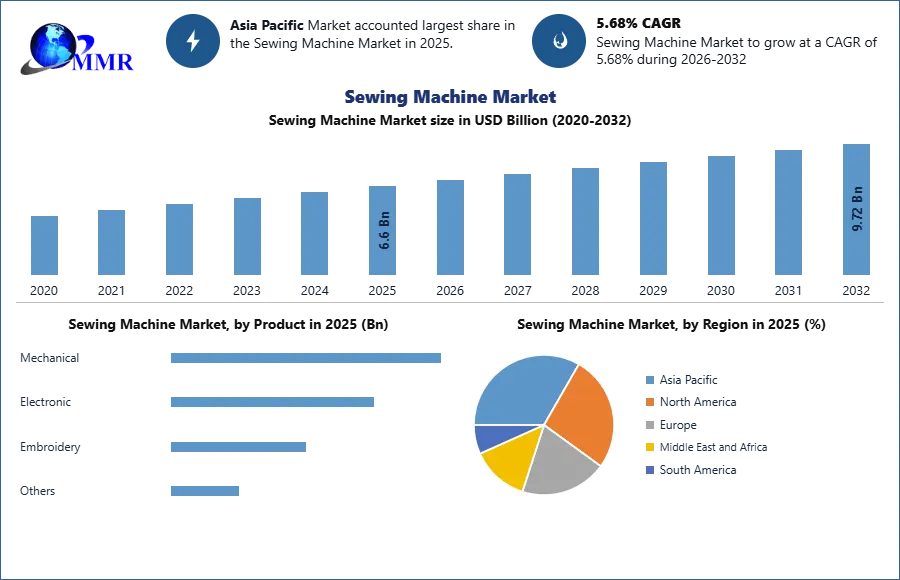
Market OverviewThe global Sewing Machine Market is witnessing steady expansion, driven by growing demand for efficient stitching solutions across industrial and domestic applications. The market is expected to grow at a strong CAGR during the forecast period, supported by increasing textile production, evolving fashion trends, and rising adoption of automated machinery.Sewing machines play a...