


Beginner’s Guide to SEM for Business Owners
Beginner’s Guide to SEM for Business Owners

In today’s competitive digital marketplace, businesses need strong online visibility to attract customers and grow successfully. Simply having a website is no longer enough because millions of businesses compete for attention on search engines every day. This is where Search Engine Marketing becomes one of the most effective digital marketing strategies for business growth.
SEM helps businesses appear directly in front of users searching for products, services, or information online. By combining paid advertising, audience targeting, SEO insights, and content marketing strategies, businesses can generate traffic, increase leads, and improve conversions faster than relying only on organic methods.
What Is Search Engine Marketing?
Search Engine Marketing is a digital marketing strategy that uses paid advertisements to increase visibility on search engines like Google and Bing. Businesses bid on keywords related to their products or services so their ads appear when users search online.
Key benefits of SEM include:
-
Instant online visibility
-
Faster website traffic generation
-
Better audience targeting
-
Increased lead generation
-
Measurable campaign performance
Unlike SEO, which focuses on long-term organic rankings, SEM provides immediate exposure and faster marketing results.
Why Is SEM Important for Business Owners?
Modern customers often search online before making purchasing decisions. SEM helps businesses appear at the top of search results exactly when users are actively looking for solutions.
Important reasons businesses use SEM include:
-
Reaching high-intent customers
-
Competing with larger brands
-
Driving targeted website traffic
-
Increasing sales and conversions
-
Improving overall digital marketing performance
Businesses that combine SEM with SEO and content marketing often achieve stronger long-term online growth.
How Does SEM Differ from SEO?
Many beginners confuse SEO and SEM because both involve search engines, but they work differently.
Major differences include:
-
SEM uses paid advertising campaigns
-
SEO focuses on organic search rankings
-
SEM delivers faster traffic results
-
SEO builds long-term website authority
-
SEM campaigns require advertising budgets
SEO and SEM work best together because one supports immediate visibility while the other builds sustainable organic growth.
How Does Keyword Research Improve SEM Campaigns?
Keyword research is one of the most important parts of Search Engine Marketing. Businesses must understand what users search for before creating campaigns.
Benefits of keyword research include:
-
Better audience targeting
-
Improved ad relevance
-
Higher click-through rates
-
Reduced advertising waste
-
Increased conversion opportunities
Using SEO tools and search data helps businesses identify profitable keywords and customer intent more effectively.
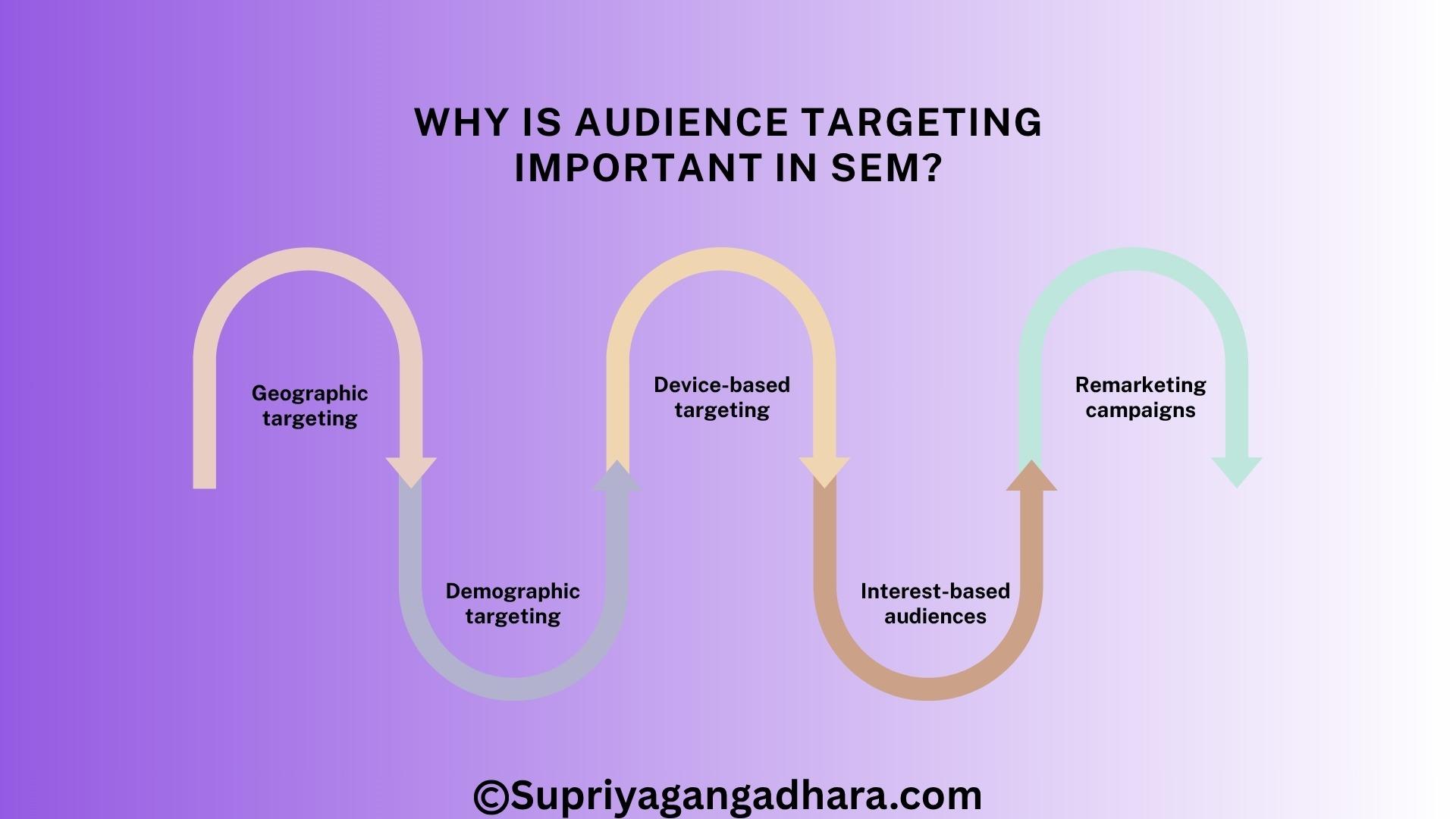
Why Is Audience Targeting Important in SEM?
Audience targeting helps businesses show ads to users most likely to become customers. Google Ads and other SEM platforms provide advanced targeting options based on demographics, interests, and online behavior.
Important targeting strategies include:
-
Geographic targeting
-
Demographic targeting
-
Device-based targeting
-
Interest-based audiences
-
Remarketing campaigns
Proper audience targeting improves campaign efficiency and reduces wasted ad spend.
How Does Content Marketing Support SEM?
Content marketing strengthens SEM campaigns by helping businesses build trust and educate potential customers before conversions happen.
Content marketing advantages include:
-
Better audience engagement
-
Improved landing page experiences
-
Higher website authority
-
Increased customer trust
-
Stronger SEO performance
Businesses that combine SEM with content marketing often create more effective digital marketing strategies.
Why Are Landing Pages Important for SEM Success?
Landing pages play a major role in converting ad traffic into leads or customers. Even the best ads can fail if landing pages provide poor user experiences.
Effective landing pages include:
-
Clear and compelling headlines
-
Fast website loading speed
-
Mobile-friendly design
-
Strong call-to-action buttons
-
SEO-optimized content
Optimized landing pages improve conversions and increase advertising efficiency.
How Can Businesses Measure SEM Performance?
Tracking performance metrics helps businesses understand whether campaigns are delivering results.
Important SEM metrics include:
-
Click-through rate (CTR)
-
Cost per click (CPC)
-
Conversion rate
-
Return on investment (ROI)
-
Bounce rate
Analyzing campaign data allows businesses to improve targeting, ad copy, and overall marketing performance.
Can AI Improve Search Engine Marketing?
Artificial Intelligence is transforming digital marketing and SEM campaign management. AI-powered tools help businesses automate optimization and improve performance faster.
AI-powered SEM benefits include:
-
Smart bidding automation
-
Audience behavior analysis
-
Predictive performance insights
-
Automated ad optimization
-
Better budget allocation
AI helps marketers make data-driven decisions while improving campaign efficiency and scalability.
What Common SEM Mistakes Should Beginners Avoid?
Many beginners waste budget because they launch campaigns without proper planning and optimization.
Common SEM mistakes include:
-
Targeting broad keywords only
-
Ignoring conversion tracking
-
Using weak ad copy
-
Poor landing page experiences
-
Failing to test campaigns regularly
Avoiding these mistakes improves campaign performance and increases profitability.
How Can Businesses Scale SEM Campaigns Successfully?
Scaling campaigns successfully requires continuous testing and gradual optimization instead of simply increasing budgets quickly.
Effective scaling strategies include:
-
Testing multiple ad variations
-
Monitoring audience behavior
-
Improving landing page performance
-
Increasing budgets gradually
-
Using data-driven optimization strategies
Businesses that scale strategically often achieve more stable long-term growth.
Conclusion
Search Engine Marketing is one of the most effective digital marketing strategies for business owners looking to increase visibility, attract targeted traffic, and grow online faster. However, successful SEM campaigns require more than simply running ads they require audience targeting, SEO insights, content marketing support, and continuous optimization.
Businesses that combine SEM with valuable content, strong landing pages, and AI-powered optimization can create sustainable marketing systems that generate long-term results. By understanding the fundamentals of Search Engine Marketing, business owners can make smarter decisions and build stronger online growth strategies in today’s competitive digital world.
Categorie
Leggi tutto
The excitement of IPL 2026 goes beyond big scores and thrilling finishes—it starts right at the toss. Understanding IPL 2026 Toss Prediction can give users an early advantage by analyzing how matches may unfold. Many online gaming users rely on platforms like Mahadev Book and Mahadev Book Online to stay updated with match insights and trends. With easy access through Mahadev Book Login...

The latest business intelligence report released by Polaris Market Research on Palletizer Market Size, Share, Trends, Industry Analysis Report: By Technology (Conventional Palletizers, Robotic Palletizers), By Product Type, By End-Use Industry, and By Region (North America, Europe, Asia Pacific, Latin America, and Middle East & Africa) – Market Forecast, 2024 - 2032. It covers...

Dental implants are one of the most reliable and natural-looking solutions for missing teeth. However, successful implant placement requires a healthy and strong jawbone. In the upper jaw, especially near the back teeth, there’s a unique challenge — the sinus cavity. If there isn’t enough bone height below the sinus, placing an implant safely can be difficult. That’s...

London is a global business hub where corporate environments face a wide range of security challenges. From safeguarding staff and assets to maintaining a secure reputation, professional protection has become a core operational requirement. A reliable Corporate Security Service London ensures businesses remain protected against theft, unauthorised access, internal risks, and public-facing...

Maintaining a healthy weight has become increasingly difficult in today’s fast-moving lifestyle. Many people spend long hours sitting at work, consume convenience foods, and face daily stress that can affect eating habits and overall health. Over time, these factors can lead to gradual weight gain and make it harder to lose excess body fat. Even individuals who follow structured...