


Contract Manufacturing Alcohol India: How Global Brands Produce Locally
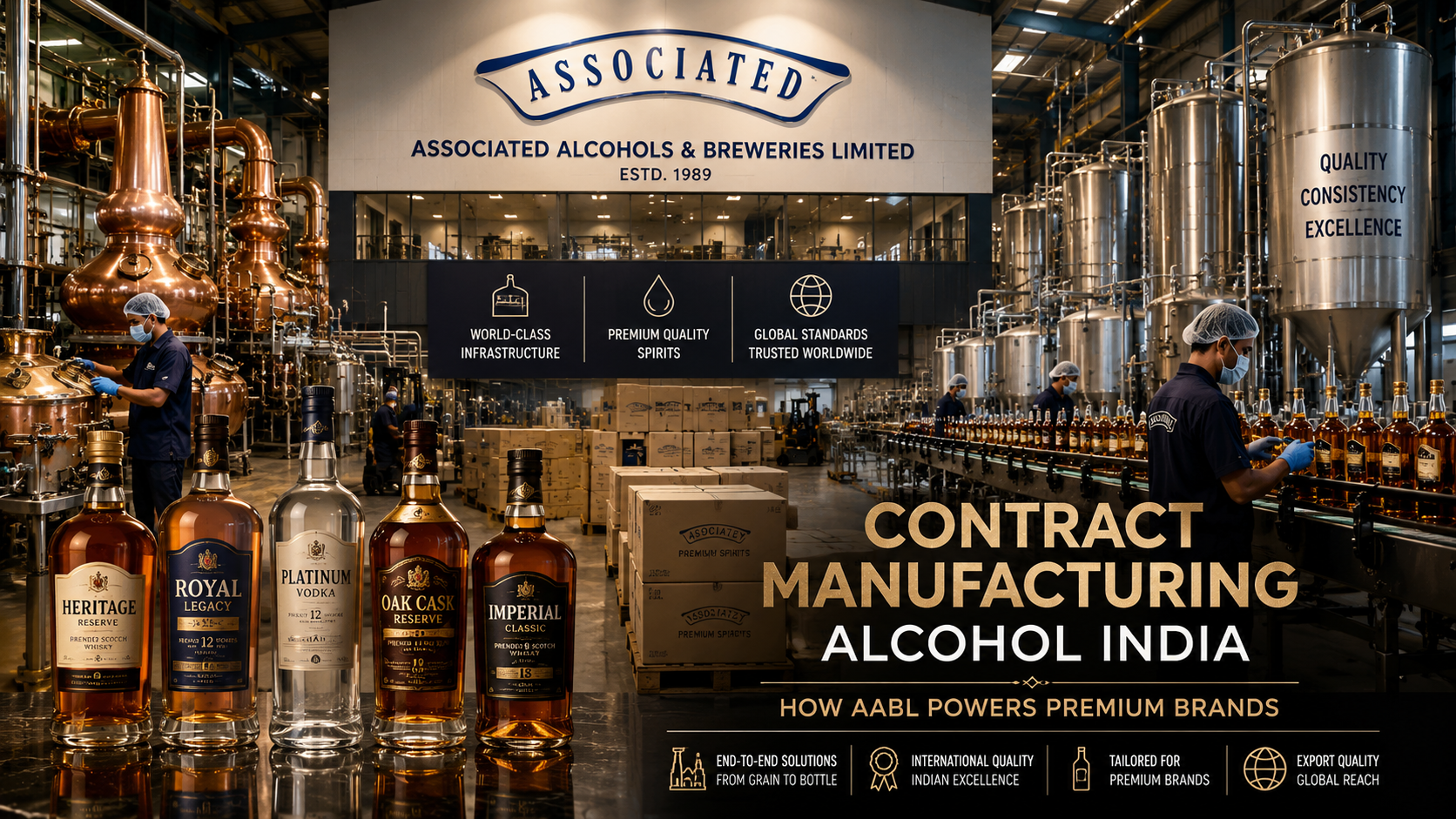
India is now the world's largest whisky market by volume, consuming over 200 million cases annually. For global spirits brands, that scale creates a clear question: do you import at high cost, or manufacture locally? Contract manufacturing alcohol in India answers that question. It lets international brands produce their products inside India using established distillery infrastructure without building their own plants. This post explains how the model works, what regulations govern it, and what makes a distillery partner capable of handling global brand standards.
What Is Contract Manufacturing in the Alcohol Industry?
Contract manufacturing in the alcohol industry is when a brand owner authorises a third-party distillery to produce, bottle, and distribute its products under a formal agreement. The brand retains its recipe, quality standards, and intellectual property. The manufacturer provides the facility, equipment, raw materials, and production expertise.
This model is common across FMCG sectors. In spirits, it is called a franchise agreement or a tolling arrangement, depending on who supplies the raw materials. The brand owner typically specifies the blend ratios, bottling specifications, and labelling requirements. The distillery executes production within those parameters.
How Does a Franchise Agreement Work in Liquor Manufacturing?
A franchise agreement in liquor manufacturing gives a licensed distillery the right to produce and sell specific branded products within a defined territory. The brand owner often a multinational grants this right for a fee or a royalty per case produced.
In India, these agreements are governed by state excise laws, which vary significantly. A distillery must secure separate approvals in each state where it intends to manufacture or sell. The brand owner also conducts periodic audits to verify that the product meets its global quality benchmarks.
What Is the Role of IMFL Classification?
IMFL, or Indian Made Foreign Liquor, is a regulatory category that includes all spirits manufactured in India that follow international-style recipes whiskies, rums, vodkas, and gins. Contract manufacturers producing global brands in India do so under the IMFL classification.
This classification determines excise duty rates, labelling requirements, and distribution channel eligibility. Distilleries working with international brand owners must comply with both FSSAI food safety standards and state excise regulations simultaneously. Meeting both is non-negotiable for any serious contract manufacturing arrangement.
How Do International Liquor Brands Manufacture in India?
International liquor brands manufacture in India by entering franchise or contract manufacturing agreements with established local distilleries. The brand ships concentrate or flavour compounds, or provides a detailed specification for local sourcing. The Indian distillery then produces, bottles, and distributes the product.
Brands like Vat 69, Black & White, Black Dog, Captain Morgan, and Smirnoff are manufactured this way across India.
Import duties on bottled spirits entering India run between 150% and 200%. That makes imported bottles roughly two to three times more expensive at retail than locally manufactured equivalents.
Local contract manufacturing eliminates that duty burden. It also reduces logistics costs, shortens delivery lead times, and allows brands to price competitively against domestic products. For volume brands targeting mass-market or mid-premium segments, local production is almost always the more viable route.
What Does a Distillery Need to Qualify as a Contract Manufacturer?
A distillery seeking to manufacture international brands needs more than just production capacity. Brand owners typically assess three things before signing: technical certifications, existing production scale, and track record with regulated blending and bottling.
State excise licences are a baseline requirement. Beyond that, international brand owners often require ISO certification for quality management systems. Distilleries must also demonstrate that they can maintain batch consistency across large production runs a requirement that smaller plants frequently cannot meet.
What Regulations Govern Alcohol Contract Manufacturing in India?
Alcohol regulation in India falls primarily under state jurisdiction. Each state has its own excise department that issues manufacturing licences, sets production quotas, and determines permitted distribution channels. This fragmented structure means a contract manufacturer must hold separate approvals for every state in which it operates.
At the central level, FSSAI governs food safety standards for potable alcohol. The Bureau of Indian Standards (BIS) sets specifications for certain product categories. And for publicly listed distilleries, SEBI disclosure requirements apply to franchise agreements that constitute material contracts.
How Do Quality Standards Apply to Contract Alcohol Production?
Quality standards in contract alcohol production flow from two directions: the regulatory minimum set by FSSAI and BIS, and the proprietary standards set by the brand owner. The brand owner's standards are almost always more stringent.
International spirits companies typically require pre-production sample approvals, in-line quality checks, and end-product testing before release. Some also mandate third-party laboratory verification. The contract distillery must build these steps into its production workflow and absorb the associated costs unless the agreement states otherwise.
What Is the Difference Between Contract Manufacturing and Licensed Brand Production?
Contract manufacturing and licensed brand production are related but not identical. In contract manufacturing, the third-party producer makes the product entirely from raw material sourcing to finished goods. The brand owner sets specifications but does not participate in production.
In licensed brand production, the arrangement is often closer to a joint process. The brand owner may supply proprietary concentrates, flavour compounds, or blending agents that cannot be sourced locally. The local producer blends and bottles these inputs to specification. Both models are used for international spirits brands in India, and the line between them can blur in practice.
Which Spirits Categories Use Contract Manufacturing Most in India?
Scotch-style whiskies, rums, and vodkas dominate contract manufacturing volumes in India. These are categories where international brands have strong consumer recognition but face import duty barriers. Producing locally under a franchise agreement preserves the brand's price positioning while capturing the cost advantage of domestic production.
Gin and ready-to-drink categories are growing in contract manufacturing share, driven by premiumisation trends in urban Indian markets. Craft and premium segments, however, are less common in contract arrangements because small batch production often makes full import more practical for niche products.
Conclusion
Contract manufacturing alcohol in India gives international brands a practical path into one of the world's highest-volume spirits markets without the capital cost of building their own distilleries. The model works through franchise agreements that transfer production rights to licensed local manufacturers, subject to both regulatory compliance and brand-specific quality standards. As India's spirits consumption grows and premium categories expand, the demand for qualified contract manufacturing partners will only increase. The question worth asking is whether existing distillery infrastructure can scale fast enough to meet it.
Categorias
Leia mais
Online betting can be exciting, but without a proper plan, it often leads to inconsistent results. Many users place bets based on emotions, quick guesses, or trends without a structured approach. Online betting can be exciting, but without a proper plan, it often leads to inconsistent results. Many users place bets based on emotions, quick guesses, or trends without a structured approach. While...

Benefits of Using Certification Exam Preparation Material Certification exams help people grow in their careers. They help you get better jobs. They also help you earn more money. Many students want to pass the CFA-Level-II exam on the first attempt. This exam is offered by CFA Institute. However, exam preparation can feel difficult. There are many books to read and many topics to cover. This...

Why It’s Important to Buy durable weatherproof outdoor junction box Units For any outdoor electrical installation, choosing to Buy durable weatherproof outdoor junction box products is essential for ensuring long-term safety and reliability. These boxes protect wiring connections from harsh weather elements such as rain, dust, and extreme temperatures, which can cause corrosion or short...

Donar plasma es una de las formas más importantes de contribuir al desarrollo de tratamientos médicos que ayudan a miles de personas en todo el mundo. En México, cada vez más personas buscan información sobre cómo donar plasma, cuáles son los beneficios y dónde pueden hacerlo de forma segura. Una opción confiable para quienes viven...

Businesses need high performance systems for events, design, training, and advanced workloads. Gaming Laptop Rental provides powerful devices with flexible plans, quick delivery, and expert support. Dubai Laptop Rental call us at +971507559892 offers reliable rental solutions across Dubai. Visit Us: https://www.dubailaptoprental.com/
