Healthy Weight Calculator Guide for Accurate Fitness and BMI Tracking
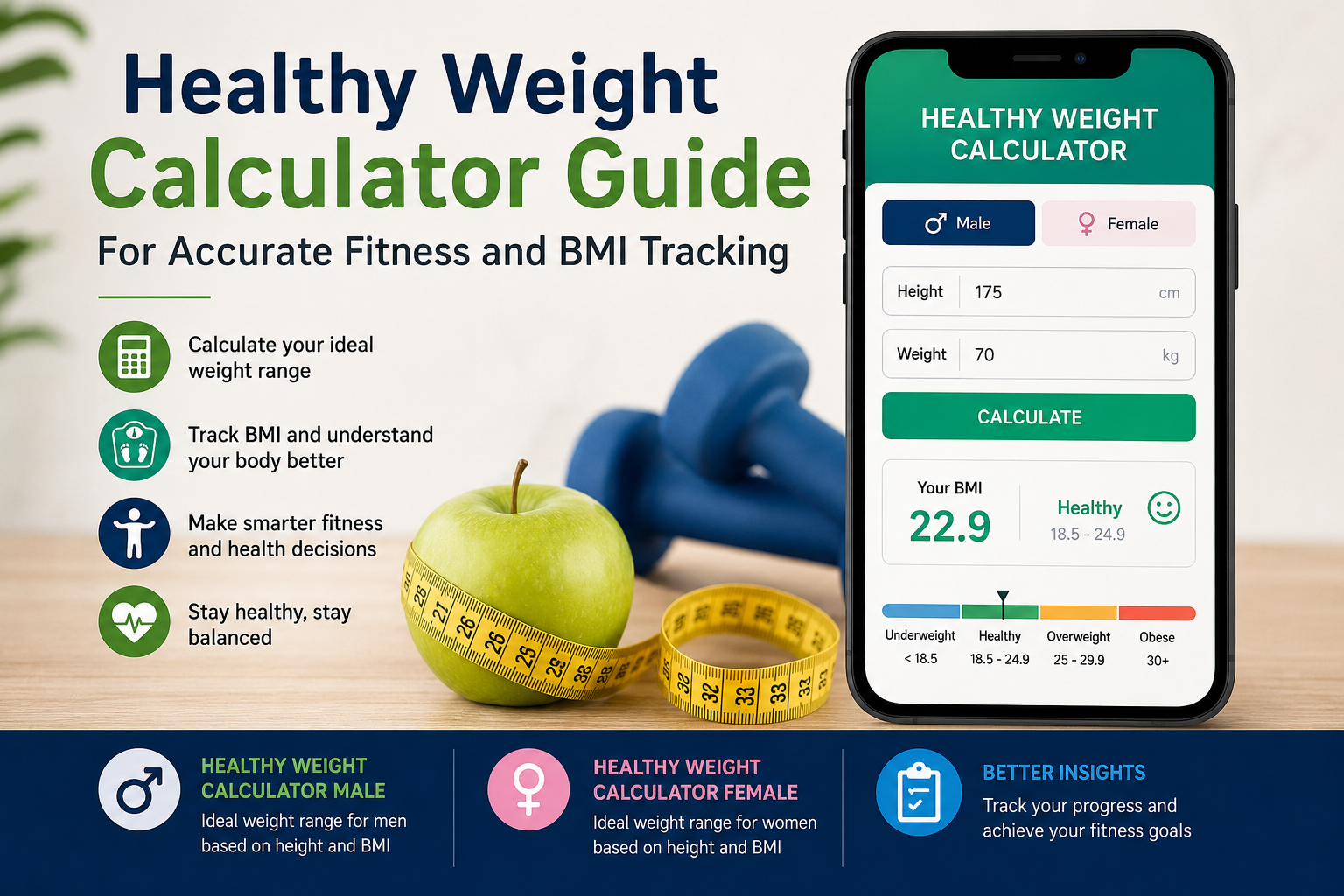
At some point, most people look in the mirror or step on a scale and wonder—“Am I actually in a healthy weight range or not?” The problem is, guessing rarely helps. Weight alone doesn’t tell the full story. That’s where a Healthy Weight Calculator becomes useful. It gives you a clearer idea of where your body stands based on your height, gender, and overall body structure.
It’s not about chasing a “perfect number.” It’s more about understanding your range so you can make smarter choices with food, fitness, and lifestyle.
So, what exactly is a Healthy Weight Calculator?
A Healthy Weight Calculator is basically a simple tool that estimates your ideal weight range. Most of them use BMI (Body Mass Index) as a reference point. You enter your height, sometimes age and gender, and it gives you a range instead of a single fixed number.
And that’s actually important—because healthy weight isn’t one exact figure. It’s a range your body can comfortably stay in without increasing health risks or feeling physically drained.
For example, someone who is 5’6” might have a healthy weight range instead of just one “ideal” number. That range is what really matters.
Why people even use it in the first place
Honestly, most people don’t think about BMI or healthy ranges until something feels off. Maybe clothes stop fitting the same way, or energy levels drop, or fitness progress stalls.
A Healthy Weight Calculator helps because it:
-
Gives a realistic picture instead of random guessing
-
Helps you set weight goals that actually make sense
-
Keeps you from extreme dieting or overthinking scale numbers
-
Supports better fitness planning without confusion
It’s not a medical diagnosis tool, but it’s a good starting point if you want clarity.
How the calculation actually works (in simple terms)
Most calculators use a basic BMI formula:
BMI = weight (kg) ÷ height² (m²)
Once the number is calculated, it usually falls into categories:
-
Below 18.5 → Underweight
-
18.5 to 24.9 → Healthy range
-
25 to 29.9 → Overweight
-
30+ → Obese range
Now, BMI isn’t perfect. It doesn’t know if your weight is muscle or fat. But it still works well as a general health indicator for most people.
Healthy Weight Calculator Male – why it can feel slightly different
When you use a healthy weight calculator male, you might notice the results sometimes feel a bit more flexible. That’s because men naturally carry more muscle mass compared to women.
So two men with the same height might still have different “healthy” ranges depending on body type, activity level, and muscle development.
For men, this calculator is often used for:
-
Gym progress tracking (bulk vs cut phases)
-
Checking if weight gain is healthy muscle gain
-
Understanding belly fat risk vs overall weight
-
Setting realistic fitness targets
It’s especially useful for people who train regularly and don’t want BMI to mislead them.
Healthy Weight Calculator Female – a more balanced perspective
With a healthy weight calculator female, the focus is slightly different because women naturally have higher body fat percentages, which is biologically normal and necessary for hormone balance and overall health.
This version helps in understanding:
-
Healthy weight ranges without extreme dieting pressure
-
Weight changes during hormonal cycles or life stages
-
Fitness goals that focus on tone and strength rather than just weight loss
-
Whether weight shifts are normal or need attention
For many women, it’s less about hitting a “target number” and more about maintaining a stable, healthy range where energy and well-being feel balanced.
What most people get wrong about healthy weight
One common mistake is treating the calculator like a final answer. It isn’t.
Two people can have the same BMI but look and feel completely different. One might be muscular and active, the other might have low muscle mass and higher fat percentage.
That’s why a Healthy Weight Calculator should be used as guidance—not a strict rulebook.
How to use it properly in real life
If you actually want results, don’t just calculate and forget it. Use it like a checkpoint:
-
Track your weight every few weeks, not every day
-
Combine it with waist measurement and energy levels
-
Focus on habits, not just numbers
-
Adjust diet and activity slowly instead of extreme changes
When used correctly, it becomes a tool for awareness—not stress.
Final thoughts
A Healthy Weight Calculator is not about chasing perfection. It’s about understanding your body a little better so you can make smarter, calmer health decisions.
Whether you’re checking a healthy weight calculator male range for fitness goals or using a healthy weight calculator female to maintain balance, the idea stays the same—stay within a range that supports your energy, strength, and long-term health.
At the end of the day, health isn’t a number on a screen. It’s how you feel living in your body every day.
Categorias
Leia mais
According to UnivDatos, rapid smart city investments, expansion of cellular LPWAN infrastructure by telecom operators, growing deployment of smart electricity, water, and gas meters, rising demand for low-power and long-battery-life IoT connectivity, increasing industrial IoT adoption for asset tracking and monitoring, strong government-backed digital transformation, and Industry 4.0...

In today’s competitive B2B environment, businesses need innovative ways to generate leads and engage decision-makers. One of the most effective strategies is leveraging B2B Podcasts. Podcasts provide a unique platform to connect with audiences authentically, share expertise, and nurture high-quality leads throughout the buyer journey. Unlike traditional marketing channels, podcasts create...

This has resulted in research that indicates that now the biggest business entities are spending much more cash, more than forty percent of their annual innovation funds, on high-tech software and automation, just to remain in the field. The digital world is growing at an extremely rapid rate where the old methods do not have the same big points as they used to do during the time. This is the...

Growing emphasis on practical learning and simulation-based training is significantly boosting the anatomical models market. Educational institutions and research centers are adopting detailed anatomical models to improve student engagement, enhance visualization of human organs, and support hands-on learning in healthcare programs. The Anatomical Models Market is expected to register a CAGR of...

In mining and metallurgical industries, managing wastewater effectively is essential to meet environmental regulations and protect water resources. One key solution is the use of Water treatment Polyacrylamide Chemicals which play a vital role in improving solid-liquid separation processes. These chemicals help in coagulation and flocculation, enabling faster sedimentation of suspended...