Ethernet Cable Color Order T568A T568B Complete Guide with Wiring Diagrams
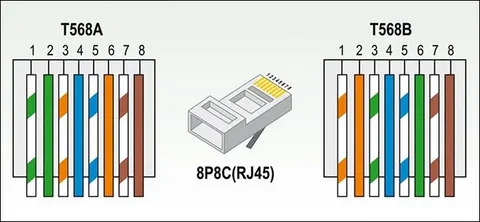
Understanding Ethernet wiring standards is essential for building reliable wired networks in homes, offices, and data centers. The ethernet cable color order T568A T568B complete guide helps technicians and beginners correctly terminate RJ45 connectors and avoid connectivity issues.
This guide explains both wiring standards in detail, shows how they differ, when to use each, and how proper wiring impacts network performance. By the end, you will clearly understand how Ethernet cable color order works and how to apply it correctly in real-world situations.
Understanding Ethernet Cable Color Code Standards
Ethernet cables use twisted pairs of copper wires, and each wire must follow a specific color order to ensure proper signal transmission. The two globally accepted standards for wiring are T568A and T568B. Both define how the eight wires inside an RJ45 connector are arranged.
The ethernet cable color order T568A T568B complete guide begins with understanding that these standards were created by the Telecommunications Industry Association (TIA) to ensure compatibility across networking devices. While both standards function the same electrically, the difference lies in the arrangement of color-coded wires.
T568A Wiring Standard Explained
T568A is considered the older and more internationally recommended standard, especially in government and residential installations. Its color order is designed to support backward compatibility with older telephone wiring systems.
In T568A, the wire sequence is:
White/Green, Green, White/Orange, Blue, White/Blue, Orange, White/Brown, Brown. This arrangement ensures structured pairing that reduces interference and maintains signal integrity across longer cable runs.
T568B Wiring Standard Explained
T568B is the more commonly used standard in commercial and business networking environments, especially in North America. It is often preferred because of its widespread adoption in structured cabling systems.
In T568B, the wire sequence is:
White/Orange, Orange, White/Green, Blue, White/Blue, Green, White/Brown, Brown. Although it differs from T568A, both standards deliver the same network performance when used consistently.
Difference Between T568A and T568B
The main difference between T568A and T568B is the placement of the green and orange pairs. This small variation does not affect speed or performance but is critical for maintaining consistency in a network.
In the ethernet cable color order T568A T568B complete guide, one important rule is never to mix both standards within the same network unless you are intentionally creating a crossover cable. Mixing them incorrectly can lead to connectivity issues or failed links.
Straight-Through vs Crossover Cable Wiring
Straight-through cables use the same standard on both ends (T568A to T568A or T568B to T568B). These are the most commonly used Ethernet cables for connecting devices like computers to routers or switches.
Crossover cables use different standards on each end (T568A on one side and T568B on the other). This design swaps transmit and receive lines, which was historically used to connect similar devices directly, such as PC-to-PC or switch-to-switch connections.
Conclusion
The ethernet cable color order T568A T568B complete guide shows that both wiring standards are reliable, industry-approved, and functionally equivalent when used correctly. The key difference lies only in wire arrangement, not performance.
By understanding T568A and T568B, and knowing when to use straight-through or crossover wiring, you can confidently build stable and efficient network connections. Proper adherence to these standards ensures reduced errors, better signal quality, and long-term network reliability.
Categorie
Leggi tutto
NEWARK, DE – 2 July, 2026 – The Demand for Bacon Flavors in USA is experiencing steady growth as food manufacturers continue to expand their portfolios of savory snacks, processed foods, and ready-to-eat meals featuring authentic bacon taste profiles. According to Future Market Insights (FMI), the market is projected to grow from USD 0.4 billion in 2025 to USD 0.8 billion by 2035,...

NEWARK, DE, United States – April 2, 2026 – The global linseed (flax) protein isolate market is undergoing a structural transformation as food and nutrition manufacturers pivot toward allergen-free, high-functionality botanical proteins. According to the latest strategic outlook by Future Market Insights (FMI), the global Linseed (Flax) Protein Isolate Market—valued at...

A cellophane wrapping machine is a specialized packaging device used in industries such as food, pharmaceuticals, cosmetics, and stationery to wrap products in a thin, transparent film. This type of machine offers multiple advantages, improving efficiency, product protection, and presentation. One of the primary advantages is enhanced efficiency and productivity. Cellophane wrapping...

Einführung in Kosher Zertifizierung Kosher Zertifizierung ist ein wichtiger Standard in der Lebensmittelindustrie, der sicherstellt, dass Produkte den jüdischen Speisegesetzen (Kaschrut) entsprechen. Der Begriff „kosher“ bedeutet „geeignet“ oder „rein“ und bezieht sich auf Lebensmittel, die nach religiösen Vorschriften hergestellt,...
Los tenis On Cloud son calzado deportivo diseñado para brindar comodidad y protección a los pies. Su característica principal es la suela CloudTec, que amortigua cada pisada y protege las articulaciones. Están fabricados con materiales ligeros que permiten caminar o correr sin sentir fatiga. Además, su diseño moderno y minimalista los hace aptos tanto...