


Why Your Small DTF Logo Looks Perfect on Screen, But Fails on Fabric
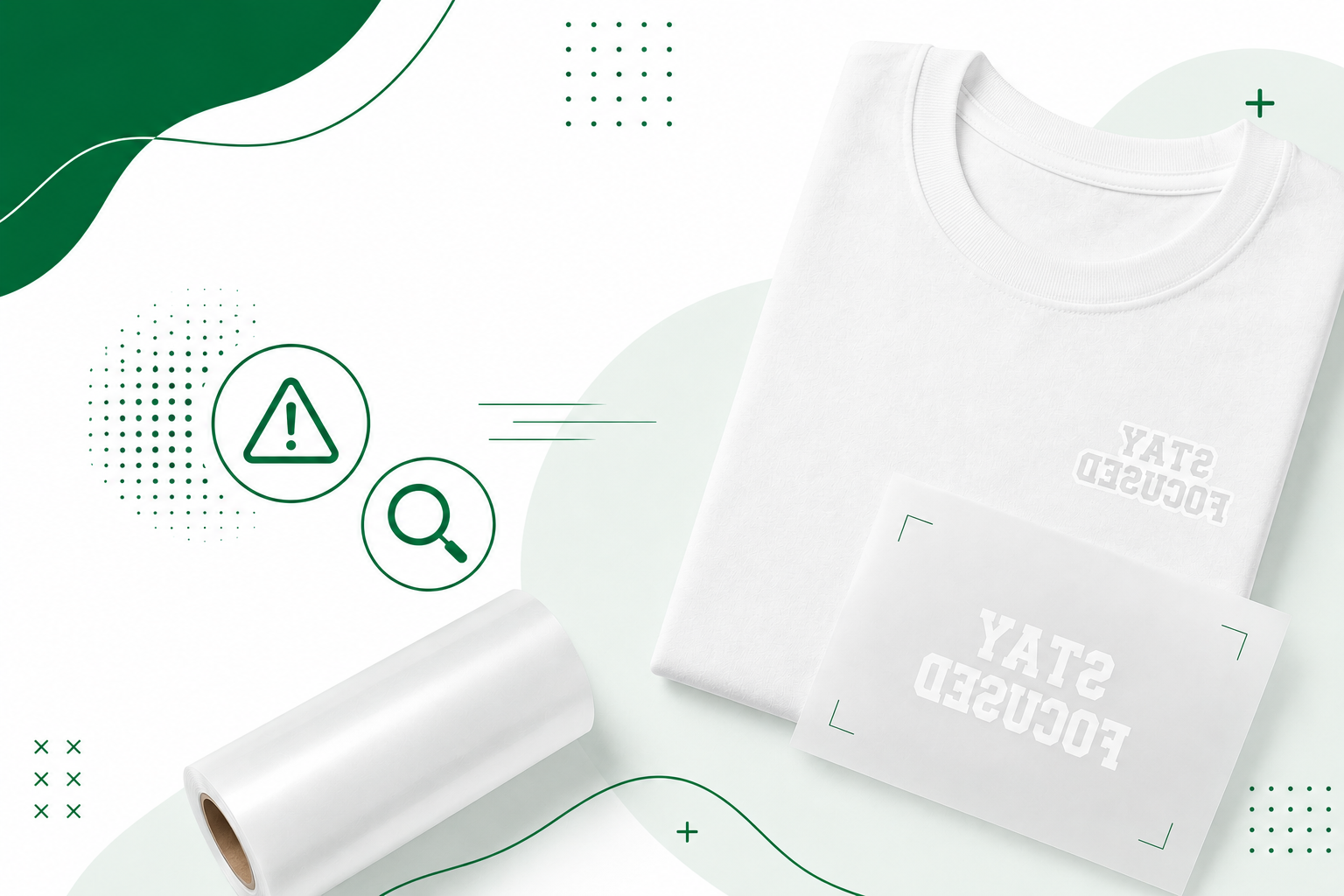
One of the biggest misconceptions in DTF printing is assuming that if a logo looks sharp on a monitor, it will print the same way on a garment. Unfortunately, that’s not how small DTF transfers work.
A tiny 3-inch chest logo may appear crystal clear at 400% zoom in Photoshop or Illustrator. But once the transfer is printed, cured, powdered, pressed, and applied to fabric, the physics of DTF printing changes the artwork completely. That’s where most small size DTF transfer design problems begin.
The biggest issue is scale compression. As artwork shrinks, every line, gap, and text element moves closer together. During printing, DTF ink naturally spreads slightly before curing — a process called ink dot gain. On larger graphics, this microscopic spread is almost invisible. On small transfers, however, it becomes a major problem. Thin outlines begin merging. Tiny text softens. Small counters inside letters like “a,” “e,” and “o” partially close.
This is one of the main reasons small DTF transfers lose detail after pressing.
Why Reverse Text Fails Faster
Reverse or knockout designs are even more vulnerable.
For example:
-
White text inside a black rectangle
-
Hollow logo lettering
-
Negative-space branding elements
These designs rely on preserving tiny empty gaps. But once adhesive powder melts during curing, those micro-gaps begin rounding and filling in. The smaller the spacing, the faster readability disappears.
That’s why professional DTF artwork guidelines always recommend:
-
Larger spacing for reverse text
-
Bold sans-serif fonts
-
Minimal decorative typography
-
Avoiding condensed lettering entirely
A simple rule used by experienced print shops:
Positive detail is forgiving. Reverse detail is vulnerable.
The Real Minimums Most Designers Ignore
Many failed DTF transfers happen because artwork was designed below safe production thresholds.
Here are some practical specs used to improve DTF printing small details:
-
Minimum positive line thickness: 0.40–0.50 mm
-
Minimum reverse gap: 0.60–0.80 mm
-
Positive text size: minimum 6 pt
-
Reverse white text: minimum 9–10 pt
-
Resolution: 300 DPI at final print size
Ignoring these minimums is one of the fastest ways to create blurry DTF prints.
Fabric Changes Everything
Even perfect artwork can fail depending on the garment surface. Smooth cotton retains detail fairly well, but textured materials absorb fine ink filaments into the weave.
High-risk fabrics include:
-
Fleece
-
Ribbed knit
-
Mesh polyester
-
Heavy cotton blends
That’s why the same logo may print beautifully on one garment but lose sharpness on another.
Smart Design Wins Small Transfers
The best small DTF transfers are not necessarily the most detailed ones. They are the ones designed specifically for physical production instead of screen appearance.
To improve DTF print quality:
-
Use vector artwork whenever possible
-
Design at final output size
-
Keep shapes bold and connected
-
Increase spacing around reverse elements
-
Simplify logos for small placements
-
Test prints before large production runs
Small DTF transfers demand precision. But when designed properly, they can still produce clean, sharp, professional-quality prints that hold up well after pressing and washing.
To Wrap Up
Small DTF transfers succeed when artwork is designed for physical printing, not just screen appearance. Fine details, reverse text, and tiny gaps become vulnerable once ink spread, adhesive powder, and fabric texture enter the process. By following proper DTF artwork guidelines, maintaining 300 DPI at final size, and simplifying small-scale elements, print shops can dramatically reduce blurry prints and failed transfers.
The key is understanding production limitations before printing begins. Strong spacing, bold typography, and placement-specific optimization help create cleaner, sharper, and more durable small DTF transfers that look professional both on press and after repeated washing.
Категории
Больше
Dubai social media campaigns have become a powerful driver of brand growth for businesses seeking to connect with audiences in one of the world's most dynamic commercial markets. Dubai combines innovation, multicultural diversity, and high digital adoption, creating ideal conditions for impactful social media marketing. Strategic campaigns integrate storytelling, creative design,...

Despite their inability to find the back of the net with any kind of regularity, the find themselves in the top five of these power rankings. That's because goaltender has been playing out of his mind. After shutting out the in a shootout lo s on Tuesday night, Gustav son hasn't allowed a goal since Feb. 28. In his last nine starts, Gustav son has posted a 1.17 GAA and has saved 15.79 goals...

Maintaining good health requires more than just treating illnesses when they occur. Regular health checkups with a qualified general physician can help detect potential health problems early, prevent complications, and ensure overall well-being. If you are searching for the Best Physician in Ranchi Jharkhand, Dr. Angshuman Sinha provides comprehensive healthcare services with a patient-centered...

"Hemophilia B Market Sumary According to the latest report published by Data Bridge Market Research, the Hemophilia B Market The global Hemophilia B market size was valued at USD 3.21 billion in 2025 and is expected to reach USD 6.39 billion by 2033, at a CAGR of 9.00% during the forecast period This world-wide Hemophilia B Market report is generated by a...
現代のデジタル社会では、オンラインを活用したさまざまな娯楽が発展しています。その中でもオンラインポーカーは、戦略性とエンターテインメント性を兼ね備えたゲームとして、多くのプレイヤーから注目されています。ポーカーは長い歴史を持つカードゲームですが、オンライン化によってその楽しみ方は大きく変化しました。現在では、特定の場所に集まる必要がなく、インターネットを通じて世界中のプレイヤーと対戦することができます。この環境の変化によって、ポーカーはより身近で参加しやすいゲームになりました。また、初心者でも基本的なルールを学びながら楽しめる一方で、経験を積んだプレイヤーは高度な戦略を研究し続けることができます。この幅広い楽しみ方が、オンラインポーカーの人気を長く維持している大きな理由です。さらに、プレイヤーごとに異なる考え方やプレイスタイルが存在するため、同じゲームでも毎回異なる展開を経験できる点...