


Einstein Discovery Integration: Transforming Complex Data into Actionable Insights
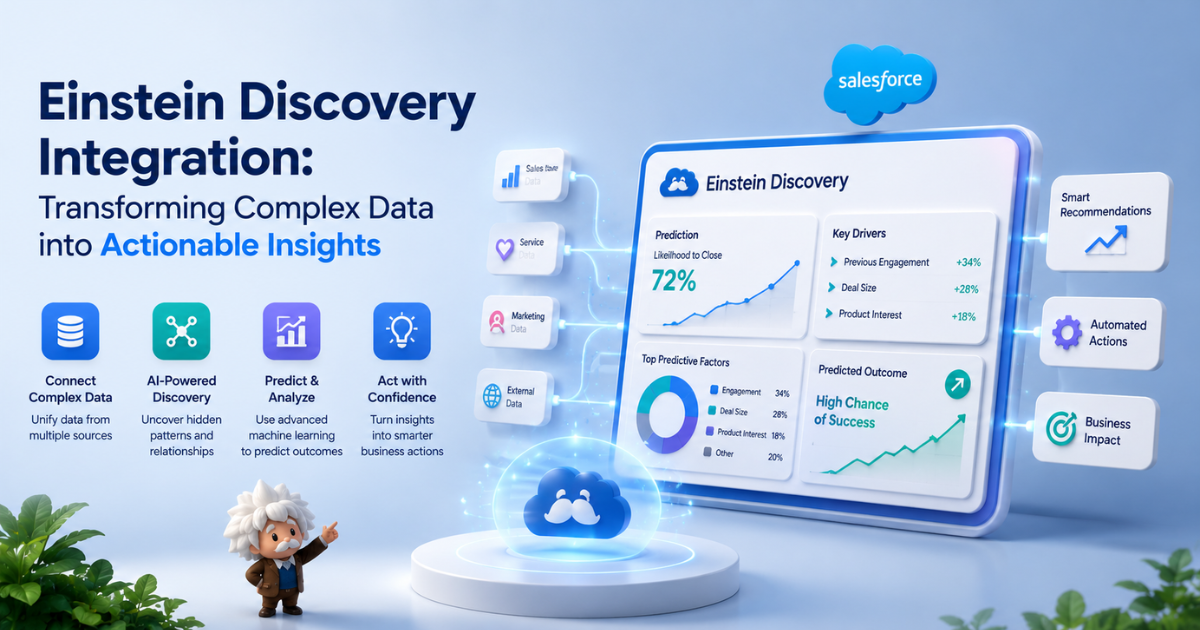
Enterprise data landscapes grow more intricate every day. Companies capture millions of rows of data across transactional ledgers, customer service logs, and marketing platforms. However, raw data does not automatically create business value.
Traditional business intelligence tools show what happened in the past. They generate static reports but fail to explain why events occurred. They cannot reliably predict what will happen next.
This predictive gap causes significant corporate waste. Organizations misallocate marketing budgets, miscalculate inventory requirements, and miss critical revenue targets.
To solve this issue, companies use advanced predictive modeling engines. Integrating diagnostic analytics directly into the corporate runtime environment transforms raw transactional data into prescriptive operational instructions.
Why Complex Data Confounds Standard Analytics
Many corporate IT systems operate in structural silos. Traditional data warehouses require data scientists to manually export tables, run custom Python scripts, and build independent regression models.
This manual process creates several critical bottlenecks:
-
Perishable Insights: Exporting and processing large datasets manually takes days or weeks. The resulting analytical patterns become outdated before business teams can apply them.
-
Lack of Contextual Clarity: Independent analytics packages lack direct connection to the daily workflows of sales representatives or service agents. Staff must switch between different software windows to find relevant context.
-
High Operational Friction: Data science teams often struggle to convert theoretical mathematical models into concrete operational rules that front-line workers can easily execute.
Statistical data underscores the severity of these integration barriers. Industry research from the IBM Institute for Business Value indicates that 74% of enterprise organizations still struggle to improve customer experience metrics using basic data models.
The primary structural roadblock remains data fragmentation, with 64% of technology executives citing legacy system modernization as their top operational concern. When predictive data sits separate from the primary engagement platform, statistical models cannot provide functional value.
Technical Architecture of Einstein Discovery
The platform operates as an integrated machine learning environment running directly on core corporate architecture. It combines statistical modeling, supervised machine learning algorithms, and natural language explanation tools without requiring complex code deployment.
The system relies on three core functional layers to process data and deliver insights:
1. The CRM Analytics Ingestion Layer
Before the engine can find data patterns, it requires a structured tabular dataset. The ingestion layer reads information from local objects and external databases via high-speed API connectors.
-
Massive Scale Capacity: The platform processes up to 20 million rows of data and 100 columns per dataset, allowing it to evaluate large enterprise transaction volumes.
-
Flexible Ingestion Schemas: The data prep engine blends varied data streams, matching sales opportunity histories with external ERP shipment ledgers.
-
Minimum Statistical Thresholds: The analysis engine requires at least 400 historical rows containing verified outcomes to build a reliable predictive baseline.
2. The Auto-Machine Learning (AutoML) Engine
The platform analyzes the prepared dataset using advanced regression and classification algorithms. It tests different statistical variations automatically to find the most accurate mathematical model.
The system evaluates the data to pinpoint which columns correlate most closely with the target business goal. It identifies key patterns while actively flagging data issues, such as duplicate fields or missing values, that could distort the mathematical results.
3. The Einstein Prediction Service
Once deployed, the predictive model moves into an active operational state. The Einstein Prediction Service exposes the model through secure REST API endpoints. Internal platform tools and external software applications can query these endpoints to retrieve live predictions and clear, natural language explanations instantly.
Step-by-Step Data Preparation and Story Building
Building an accurate predictive model requires a methodical approach to data assembly and variable selection. Careless data preparation leads to biased models and inaccurate business projections.
Step 1: Define the Business Objective
Architects must establish a clear target metric before touching any corporate data. You must frame the goal as a specific numeric measure or a binary classification question.
-
Numeric Example: "Maximize total gross margin dollars on industrial equipment service contracts."
-
Binary Example: "Predict the likelihood that a subscription account will cancel their service within 90 days."
Step 2: Clean and Normalize the Dataset
Engineers use data preparation recipes to clean incoming data. They remove irrelevant data fields that increase processing complexity without adding analytical value.
Developers also use these recipes to configure bucket columns. This step groups continuous numeric values, like age or mileage, into distinct categories to improve model processing speed.
Step 3: Run the Analysis Story
The platform processes the verified dataset to generate an analytical story. This narrative breaks down the statistical findings into three easy-to-understand dimensions:
-
What Happened: The system highlights major historical patterns, showing which product segments achieved the highest conversion success.
-
Why It Happened: The engine analyzes variable combinations, explaining how the interaction of two factors, like region and discount level, impacts the final outcome.
-
What Is the Difference: The story compares specific groups, helping teams understand how a changing market variable shifts performance expectations.
Deploying Insights Directly into Daily Workflows
An analytical model only drives business value when front-line employees can access its recommendations during daily tasks. The platform allows administrators to embed predictive insights directly into the primary workspace layout.
1. Lightning Record Page Integration
Administrators place graphic prediction cards directly onto standard workspace layouts. When a user opens an active record, the card displays a clear predictive score, a bulleted list of positive and negative risk factors, and actionable steps to improve the outcome.
2. Automation via Flow Builder
Developers can route predictive scores directly into automated workflows using Core Flow Builder. For example, if an account's retention score drops below 40%, the system triggers an automated flow to alert the account director and schedule an immediate review call.
3. Extended Deployment via Tableau
Organizations can export model patterns directly into global Tableau dashboards. This connection allows corporate analysts to view predictive calculations across large regional territories, helping leadership optimize annual budget allocations.
Overcoming Key Implementation and Governance Obstacles
Deploying an enterprise-grade artificial intelligence integration requires navigating clear data management and organizational hurdles.
1. Eradicating Data Leakage
Data leakage occurs when a dataset accidentally includes variables that are only known after the target event has already finished. For example, including a Shipping_Date field in a model designed to predict whether a lead will convert will distort the results.
Because completed conversions always have shipping dates while open leads do not, the machine learning model will rely too heavily on that single variable. This dependency makes the model highly inaccurate when evaluating new, open prospects.
2. Controlling Multicollinearity
Multicollinearity occurs when two or more independent data columns carry identical information, such as Postal_Code and City_Name. Including both fields forces the machine learning engine to double-count the impact of that geographic data. This over-indexing disrupts variable weighting and reduces model accuracy.
Engineers resolve this issue by reviewing the correlation matrices generated during the model building phase. They remove redundant text columns, keeping only the single variable that provides the cleanest statistical signal.
3. Establishing the Einstein Trust Layer
Deploying advanced predictive integrations requires maintaining total data control and adherence to global privacy rules like GDPR or HIPAA.
The system processes all data interactions through a secure gateway tier. This layer masks sensitive personal identifiers before running predictive calculations, ensuring the institution maintains total compliance without slowing down real-time analysis speeds.
Real-World Case Study: Manufacturing Distribution
Consider a major multinational manufacturing firm that distributes heavy industrial components to regional service facilities.
The Initial Operational Challenge
The distributor faced high rates of order cancellations, which disrupted factory production schedules and created excess warehouse inventory.
Their customer data sat fragmented across an old ERP system and an independent sales database. Regional managers could not identify which orders were at risk of cancellation until the buyers missed their payment deadlines.
The Rebuilding Solution
The manufacturer used specialized Salesforce Einstein AI Integration Services to deploy a predictive order-management platform.
-
Data Harmonization: The team combined historical data fields from the ERP and CRM databases into a unified analytics dataset containing 3 million historical order rows.
-
Model Configuration: Developers configured a binary classification story to isolate the root causes of order cancellations.
-
Variable Optimization: The audit process removed duplicate regional fields and post-event status codes, eliminating data leakage risks.
-
Operational Integration: The team embedded the final model directly onto account record pages, giving account managers real-time visibility into cancellation probabilities.
Quantifiable Operational Metrics
The integrated deployment delivered substantial improvements across the company's regional distribution network. The predictive model allowed customer service teams to identify at-risk orders early, driving a 20% average reduction in total order cancellations.
Furthermore, data from global integration audits shows that manufacturing groups leveraging unified data cloud infrastructure achieve an average 354% return on investment (ROI) over three years. This return stems from reduced safety stock requirements and significantly lower inventory carrying costs.
Conclusion
Traditional business intelligence models are no longer sufficient for managing modern enterprise data complexity. Static reports describe past issues but leave operations teams guessing how to resolve future bottlenecks.
By implementing Salesforce Einstein AI Integration, organizations convert large, fragmented datasets into clear, proactive operational instructions.
Using tools like CRM Analytics, the AutoML engine, and secure automated flows allows companies to identify operational risks early, predict consumer behaviors accurately, and deploy targeted solutions directly within daily workspaces.
Partnering with certified Salesforce Einstein AI Integration Services specialists ensures that institutions build a stable, well-governed data architecture. This modern foundation reduces administrative overhead for IT departments and delivers the clear, data-driven insights that modern businesses require to sustain long-term growth.
Categorias
Leia mais
Introduction Quality control has evolved significantly from manual inspection tools to intelligent inspection systems. Among these innovations, multi gauging systems have emerged as a powerful solution for manufacturers aiming to balance speed and accuracy. Multi gauging enables simultaneous inspection of multiple dimensions, making it a cornerstone of modern quality assurance. At Versa...
According to the latest report published by Data Bridge Market Research, the North America Healthcare Information Technology (IT) Integration Market CAGR Value The North America Healthcare Information Technology (IT) Integration market size was valued at USD 1.26 billion in 2025 and is expected to reach USD 2.46 billion by 2033, at a CAGR of...

How Sky Exchange Delivers a Fast, Secure, and Smooth Gaming Experience The online gaming industry has evolved rapidly over the past few years, and players today expect more than just a platform to place bets or enjoy casino games. They want speed, security, reliability, and a seamless user experience. This is where Sky Exchange has built a strong reputation among gaming enthusiasts....
The global Semiconductor Manufacturing Equipment Market is witnessing robust growth as semiconductor demand continues to surge across artificial intelligence (AI), 5G communications, electric vehicles, cloud computing, consumer electronics, and industrial automation. Semiconductor manufacturing equipment includes advanced machinery used for wafer fabrication, lithography, etching,...
Steel is one of the most important materials driving the UAE's rapid infrastructure and industrial growth. From towering skyscrapers and highways to manufacturing facilities and logistics hubs, nearly every major project depends on high-quality steel products. This is why businesses across multiple sectors choose a reliable UAE Steel Factory that can consistently deliver certified, durable, and...
