Compact Track Loader Market Outlook Exploring New Opportunities and Drivers to 2034
The global construction and material handling equipment landscapes are undergoing rapid transformations, driven by an increased need for efficiency, adaptability, and power on compact jobsites. At the center of this shift is the Compact Track Loader (CTL), a highly versatile machine engineered to excel where traditional wheeled skid steers struggle. Characterized by high-flotation rubber tracks, CTLs distribute their weight evenly, allowing them to navigate soft, muddy, sandy, or sensitive terrains without sinking or causing severe ground disturbance.
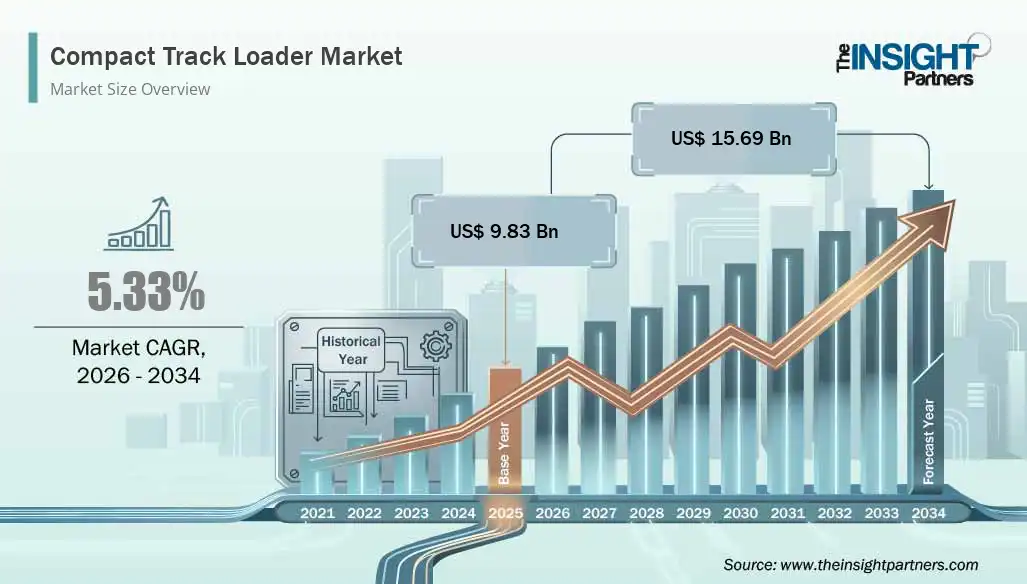
According to a comprehensive market analysis, the Compact Track Loader Market size is expected to reach US$ 15.69 Billion by 2034 from US$ 9.83 Billion in 2025. The market is anticipated to register a CAGR of 5.33% during the forecast period 2026–2034. This steady economic expansion highlights the machinery’s rising indispensability across infrastructure development, residential construction, landscaping, and agriculture sectors worldwide.
Primary Growth Drivers and Market Kinetics
Several market forces are converging to sustain the global demand for compact track loaders. Foremost among these is the escalating investment in global infrastructure development. As urban spaces become more densely populated, construction projects are increasingly restricted to tight, confined footprints. Large excavators and heavy earthmovers are often impractical in these environments. CTLs fill this gap perfectly, offering the raw breakout force and lifting capacity of larger machinery combined with a nimble, compact frame.
Furthermore, technological developments in attachments have turned these loaders into ultimate "multi-tool" assets. A single CTL can seamlessly switch between hydraulic breakers, augers, trenchers, mulchers, and sweepers. This adaptability saves contractors from purchasing or renting single-purpose machines, drastically improving their return on investment.
Ground pressure dynamics also play an important role in driving adoption. Traditional wheeled loaders exert significant downward pressure on small points of contact, which can ruin delicate surfaces or result in machines getting stuck in wet soil conditions. The broad tracks of a CTL provide a low ground pressure footprint. This expands the working season for contractors, allowing them to start working earlier in the spring and continue deep into rainy autumns, effectively reducing project downtime.
Get a PDF Sample– https://www.theinsightpartners.com/sample/TIPRE00015309
Key Industry Players
The competitive landscape of the compact track loader industry features established engineering giants and specialized manufacturers pushing the boundaries of machine capability, hydraulic flow, and operator safety. The leading companies steering market growth include:
-
AB Volvo
-
ASV Holdings, Inc.
-
Bobcat (Doosan Group)
-
Caterpillar Inc.
-
CNH Industrial N.V.
-
Deere and Company
-
JCB Ltd.
-
Kubota Corporation
-
Takeuchi Mfg. Co., Ltd.
-
Yanmar Co. Ltd
These prominent manufacturers are heavily focusing on research and development to introduce features like automated grade control, advanced telematics for fleet tracking, and enhanced ergonomic cabs designed to reduce operator fatigue over long shifts.
Regional Market Variations
Geographically, North America represents a major share of the global CTL market, primarily due to the high adoption rate of compact equipment in residential landscaping, forestry management, and snow removal applications. In Europe, the demand is largely sustained by stringent emissions regulations and a deep structural focus on urban utility maintenance, where compact dimensions are mandatory. Meanwhile, the Asia-Pacific region is recognized as a high-growth zone. Swift urbanization, rising disposable income, and government-backed rural infrastructure projects in developing economies are creating massive growth opportunities for equipment providers across the territory.
Future Outlook
Looking ahead, the future of the Compact Track Loader market will be heavily defined by sustainability, automation, and intelligent operations. As global industries push toward net-zero carbon goals, the development of fully electric and hybrid-electric CTL models is shifting from a conceptual prototype stage to a commercial reality. Electric power units drastically cut down on-site carbon footprints and yield near-silent operation, opening up opportunities for indoor work or night-time municipal construction. Additionally, the integration of autonomous operating systems, remote-controlled piloting capabilities, and artificial intelligence-driven preventative maintenance will optimize machine lifespans and tackle ongoing skilled labor shortages. These technological revolutions ensure that compact track loaders will remain foundational pillars of modern earthmoving and construction operations well into the future.
Related Reports-
About Us
The Insight Partners is a one-stop industry research provider of actionable intelligence. We help our clients in getting solutions to their research requirements through our syndicated and consulting research services. We specialize in industries such as Semiconductor and Electronics, Aerospace and Defense, Automotive and Transportation, Biotechnology, Healthcare IT, Manufacturing and Construction, Medical Devices, Technology, Media, and Telecommunications, as well as chemicals and Materials.
Contact Us
If you have any queries about this report or if you would like further information, don’t hesitate to get in touch with us:
Contact Person: Ankit Mathur
E-mail: ankit.mathur@theinsightpartners.com
Phone: +1-646-491-9876
Categorie
Leggi tutto
Sleep plays a vital role in maintaining physical health, mental well-being, and overall quality of life. However, insomnia can make it difficult to fall asleep, stay asleep, or wake up feeling refreshed. If you're considering buy Zopiclone online, it's important to understand how the medication works, its benefits, and the precautions you should take before making a purchase. What Is...

Neurological biomarkers are measurable biological indicators that help identify, diagnose, monitor, and predict the progression of neurological disorders. These biomarkers play a crucial role in understanding complex diseases such as Alzheimer’s disease, Parkinson’s disease, multiple sclerosis, epilepsy, and traumatic brain injuries. Advances in molecular diagnostics, genomics,...

According to the latest report published by Data Bridge Market Research, the Quartz Surfaces Market CAGR Value Quartz Surfaces Market report is a window to the industry which talks about what market definition, classifications, applications, engagements and market trends are. This report analyzes the status and future forecast involving sales, value (revenue), growth rate...
" Environmental Testing Market Summary: According to the latest report published by Data Bridge Market Research, the Environmental Testing Market The global environmental testing market size was valued at USD 12.48 billion in 2024 and is expected to reach USD 20.19 billion by 2032, at a CAGR of 6.20% during the forecast period The comprehensive...

If we fail to learn from history, we're likely to make the same mistakes again. One year has passed since the Heartbleed vulnerability broke into public view, and many people still don't know what happened. A Dashlane-commissioned study found that 86% of Americans had not heard of Heartbleed. For those unfamiliar: Heartbleed was a flaw in vulnerable versions of OpenSSL that allowed attackers...