AEO vs GEO vs SEO: The Search Visibility Playbook for the AI Age
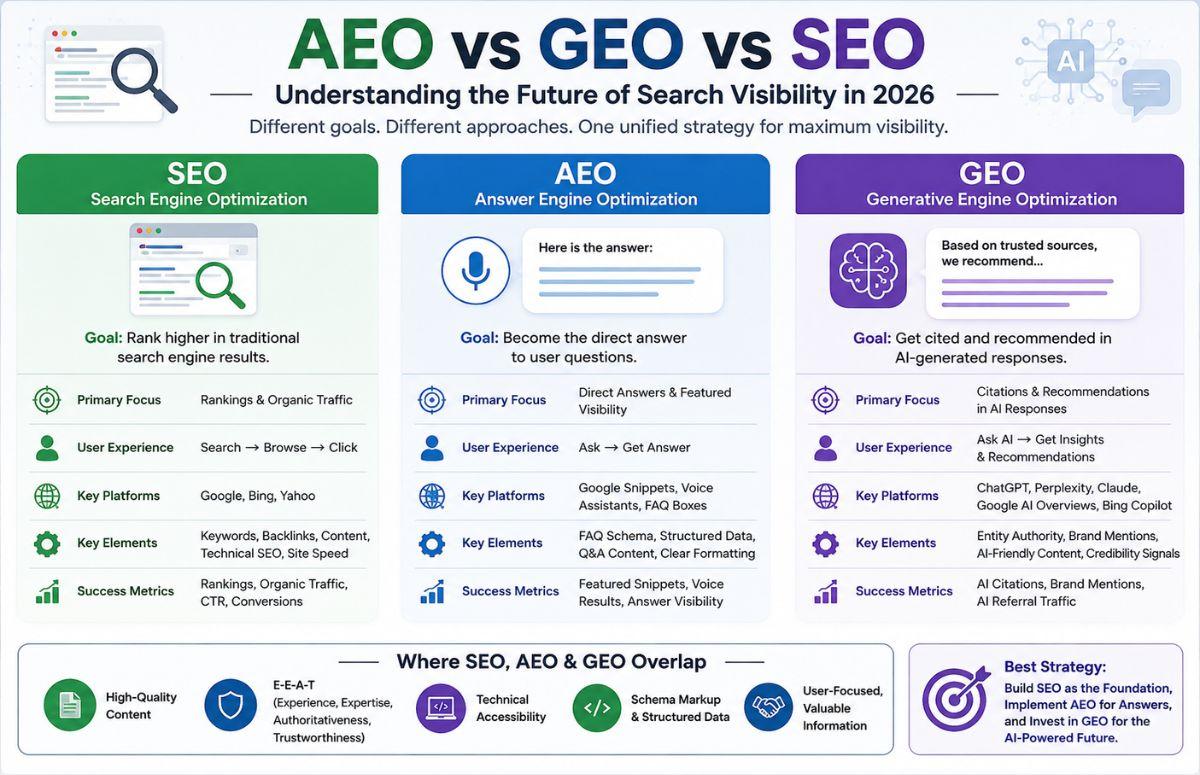
For more than twenty years, businesses have competed for attention on search engines. The strategy was straightforward: create relevant content, optimize it for keywords, earn backlinks, and climb Google's rankings. Higher rankings meant more visibility, more traffic, and ultimately more customers.
That formula is no longer enough.
Artificial intelligence is fundamentally changing how people discover information online. Instead of searching through pages of results, users are increasingly asking questions directly to AI-powered platforms and expecting immediate answers. Whether it's a recommendation from ChatGPT, an overview generated by Google AI, or an answer provided by Perplexity, the search experience is becoming faster, smarter, and more conversational.
This shift has expanded the concept of search optimization. Businesses now need to think beyond traditional SEO and embrace Answer Engine Optimization (AEO) and Generative Engine Optimization (GEO) as part of a modern visibility strategy.
The future of digital marketing belongs to brands that can be found, understood, and trusted by both search engines and artificial intelligence.
Search Has Evolved from Links to Answers
Traditional search engines were designed to connect users with websites. A person entered a query, received a list of results, and clicked the link that seemed most relevant.
AI-powered search changes that journey completely.
Today, users often receive the information they need without ever visiting a website. Instead of ten blue links, they see a summarized answer, a recommendation, or an AI-generated explanation.
This evolution is transforming user expectations. People want information instantly, and they trust technology to do much of the research on their behalf.
For businesses, this means visibility is no longer measured solely by rankings. Success now depends on whether your content can influence answers, recommendations, and AI-generated conversations.
SEO: The Foundation Remains Strong
Despite the rise of AI, SEO remains the cornerstone of digital visibility.
Search Engine Optimization focuses on helping websites appear prominently in search results when users look for relevant information. It ensures that search engines can discover, understand, and rank content effectively.
A successful SEO strategy includes:
- High-quality content creation
- Technical website optimization
- Keyword targeting
- Internal linking
- Authority building
- User experience improvements
SEO continues to be essential because search engines still drive a significant share of online traffic. Businesses that neglect SEO risk losing visibility at the very beginning of the customer journey.
However, rankings alone are no longer the ultimate goal.
AEO: Optimizing for the Answer Economy
As users seek faster answers, search engines have adapted by displaying information directly within search results.
This is where Answer Engine Optimization comes in.
AEO focuses on helping content become the answer rather than simply one of many search results. Instead of competing for clicks, businesses compete for answer visibility.
Examples include:
- Featured snippets
- Voice search results
- Knowledge panels
- FAQ-rich results
- Direct-answer boxes
To succeed with AEO, content must be structured around user intent. Questions should be answered clearly, information should be easy to scan, and key insights should be presented in a concise format.
The goal is simple: when someone asks a question, your content becomes the source of the answer.
GEO: The Next Frontier of Digital Visibility
If SEO helped businesses rank and AEO helped them answer questions, GEO helps them become part of AI-generated conversations.
Generative Engine Optimization is designed for platforms that generate responses rather than simply retrieve information.
AI systems such as ChatGPT, Google AI Overviews, Claude, and Perplexity gather information from multiple sources and use it to create unique answers. These systems prioritize content that appears authoritative, reliable, and relevant.
GEO focuses on increasing the likelihood that a brand will be cited, referenced, or recommended within those responses.
This requires businesses to strengthen their digital footprint through:
- Expert-led content
- Consistent brand information
- Strong entity recognition
- Third-party validation
- Industry authority
- Trust-building signals
The objective is no longer just visibility—it is influence.
Brands that establish authority are more likely to become part of the information ecosystem that AI systems rely on.
Why Authority Is the New Ranking Factor
One of the most significant shifts in modern search is the growing importance of trust.
Search engines have always rewarded authoritative content, but AI platforms take this concept even further. They aim to provide users with the most reliable and accurate information available.
As a result, businesses must focus on becoming recognized entities within their industries.
This means:
- Publishing original insights
- Demonstrating expertise
- Building a strong online reputation
- Earning mentions from credible sources
- Maintaining consistency across digital platforms
Authority is no longer just a competitive advantage—it is becoming a requirement for visibility in AI-driven search environments.
The Future Is Not SEO or GEO—It's SEO and GEO
A common misconception is that AI search will replace traditional SEO.
The reality is far more nuanced.
SEO, AEO, and GEO are not competing strategies. They are interconnected components of a broader visibility framework.
SEO ensures discoverability.
AEO ensures answerability.
GEO ensures recommendability.
Together, they help businesses reach users at every stage of the modern search journey.
Organizations that integrate all three approaches can create a stronger and more resilient digital presence than those relying on rankings alone.
Preparing for What Comes Next
The search landscape will continue evolving as artificial intelligence becomes more sophisticated. New platforms will emerge, user behavior will change, and the methods used to discover information will become increasingly conversational.
Businesses that adapt early will be in the strongest position to benefit from these changes.
The focus should shift from chasing rankings to building authority, trust, and relevance across the entire digital ecosystem.
Brands that achieve this will not only rank well—they will become the sources that search engines answer with and AI systems recommend.
Final Thoughts
The discussion around AEO vs GEO vs SEO reflects a broader transformation taking place across the internet.
Search is no longer just about finding websites. It is about finding answers, insights, and trusted recommendations.
SEO helps your audience discover you.
AEO helps your audience learn from you.
GEO helps artificial intelligence trust and recommend you.
Businesses that understand this shift and adapt their strategies accordingly will be better equipped to succeed in an increasingly AI-driven future. The brands that thrive will not simply be visible, they will be the voices that shape the answers people receive.
Nach Verein filtern
Read More
The demand for skilled analytics professionals is growing rapidly across industries. From healthcare and finance to e-commerce and digital marketing, companies rely on data-driven decisions to improve performance and customer experience. For students and working professionals looking to enter this field, selecting the right training institute can make a significant difference in long-term...

In recent years, online gaming and sports betting platforms have become increasingly popular among users who enjoy cricket, football, casino games, and fantasy sports. One such platform that has gained attention is GoExch9. The platform is widely known for offering online betting IDs, live sports betting, casino games, and various entertainment options for users looking for a smooth and...
In recent years, Botox in Riyadh has become one of the most popular non-surgical cosmetic treatments for people who want to look refreshed, youthful, and confident. With changing lifestyles and growing awareness of aesthetic self-care, Botox is now widely chosen by both men and women who prefer effective results without surgery or long recovery times. This blog will help you...

Polaris Market Research has announced the latest report, namely Brain Health Supplements Market Size, Share, Trends, Industry Analysis Report By Product (Natural Molecules, Herbal Extract, Vitamins & Minerals), By Application, and By Region -Market Forecast, 2025 - 2034, that examines the overall market condition both now and in the future. It provides comprehensive and accurate...

United States of America– 02 Dec 2026- The rheology modifiers market continues to evolve as a critical component in fluid formulations across multiple sectors, enhancing viscosity, stability, and flow properties. These additives, also known as thickeners or viscosity modifiers, divide into organic and inorganic types, serving applications from paints and coatings to...