


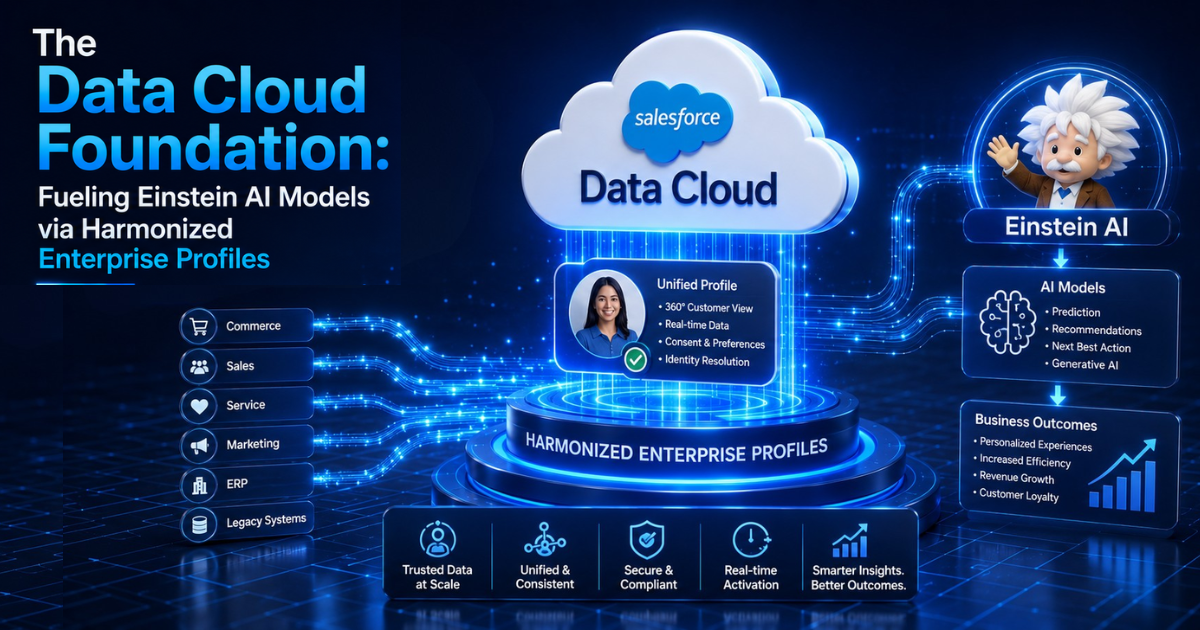
The Data Cloud Foundation: Fueling Einstein AI Models via Harmonized Enterprise Profiles
Artificial intelligence models cannot operate effectively in isolation. Large language models and predictive algorithms require extensive streams of accurate data. When an enterprise deploys artificial intelligence without a solid data strategy, the system generates inaccurate outputs.
Historically, companies stored their customer records across separate operational platforms. This segregation forced AI models to analyze incomplete datasets, resulting in severe processing delays, system hallucinations, and irrelevant customer insights.
To resolve these structural bottlenecks, enterprises implement comprehensive Salesforce Einstein AI Integration frameworks. This architecture relies on Salesforce Data Cloud to serve as the unified data foundation.
Utilizing advanced Salesforce Einstein AI Integration Services helps organizations connect separate corporate data channels. This process builds harmonized customer profiles that feed the Einstein engine with accurate, context-aware information.
The Core Technical Conflict: Scattered Data Versus Intelligent Models
Modern enterprise tech stacks contain hundreds of distinct cloud applications. This software fragmentation creates significant operational friction for standard machine learning platforms.
1. The Limits of Application Silos
A typical retail brand tracks customer behaviors across multiple independent systems. The marketing team logs website clickstreams using specialized web analytics software. The sales division manages active opportunities within a standalone CRM database. Meanwhile, the fulfillment team updates delivery logistics through an external ERP engine.
Each system assigns its own unique identifiers and formats to the same customer profile. This variation makes it impossible for an unintegrated artificial intelligence model to interpret the customer journey accurately.
2. The Problem of Traditional Data Pipelines
To connect these systems, companies historically built complex Extract, Transform, Load (ETL) data pipelines. These pipelines physically duplicate records from operational databases into centralized data warehouses.
However, this mechanical copying process introduces severe data synchronization lags. Artificial intelligence models running on these architectures process outdated information, which compromises real-time personalization efforts.
Architecture of Data Cloud as the Foundation for AI
Data Cloud operates as a high-scale data engine built directly on the global Hyperforce network architecture. It separates data computing activities from physical storage layers. This framework lets companies process petabytes of incoming records without slowing down core customer databases.
1. Zero-Copy Architecture Patterns
Professional integration services use zero-copy data federation to eliminate standard ETL processing loops. This architecture establishes a live metadata connection to external cloud data lakes, including Snowflake, Databricks, and Google BigQuery.
Data Cloud reads external data tables using open file formats like Apache Iceberg. The platform queries information directly from its original storage location, avoiding data duplication while keeping query speeds under a few milliseconds.
2. High-Throughput Ingestion Frameworks
For data sources that require physical ingestion, the platform utilizes high-throughput streaming APIs. These pipelines ingest thousands of real-time behavioral event logs per second from mobile applications and web browsers.
The system writes these raw inputs directly into Data Lake Objects (DLOs), preserving the exact schema structure of the originating system.
The Technical Mechanics of Data Harmonization
Ingesting raw enterprise data is only the initial step. Artificial intelligence engines require organized, clean data arrays to execute predictive calculations accurately.
1. Mapping Data Lake Objects to Data Model Objects
Data Cloud harmonizes raw records using the standardized Customer 360 Data Model. Engineers build metadata schemas that map raw Data Lake Objects (DLOs) to standard Data Model Objects (DMOs).
This structural mapping translates diverse data field labels into a single global language. For example, it converts the field cust_mail_id from an ERP system and EmailAddress from a marketing tool into the standard unified attribute Party.Email.
2. Identity Resolution Logic and Graph Generation
A consumer often interacts with a brand using different contact credentials across distinct applications. Data Cloud resolves these variations using advanced identity resolution rules.
Match Rule Condition: [Exact Hashed Email] OR [Exact Phone Number + Fuzzy First Name]
Execution Target: Combine 4 Disconnected Source Profiles into 1 Unified Individual ID
Architects define match rules based on exact criteria, such as matching hashed email records, or fuzzy parameters, like matching phone numbers with minor formatting differences.
The identity engine evaluates these rules to merge separate source profiles into a single Master Unified Individual ID. This process generates an identity graph that connects every transaction, support ticket, and web interaction to one unified consumer persona.
Fueling Einstein AI Models with Unified Context
A clean, harmonized data layer dramatically changes how the Einstein AI engine operates. It provides the necessary contextual background that transforms basic algorithmic calculations into sharp, actionable business insights.
1. Empowering Prompt Builder with Real-Time Context
Generative AI models require precise prompts to produce relevant outputs. When an account executive requests an automated email summary via Einstein Prompt Builder, the system does not send a generic text request to the large language model.
Instead, the platform queries the customer's harmonized profile in Data Cloud instantly. It retrieves real-time contextual variables, such as active order numbers, lifetime value metrics, and recent sentiment scores.
2. Training Predictive Models via Einstein Studio
Data Cloud allows data scientists to build, train, and test custom predictive machine learning models through Einstein Studio. Users can connect native Einstein algorithms or link external models, such as Amazon SageMaker or Google Vertex AI.
The engine trains these custom models using harmonized Data Model Objects rather than unorganized source tables. This clean training data improves prediction accuracy significantly. For instance, predictive models can calculate customer churn indicators or estimate future inventory needs with over 90% accuracy.
Securing the AI Processing Pipeline
Processing massive volumes of enterprise data through artificial intelligence tools requires strict data privacy controls and network protection frameworks.
1. The Einstein Trust Layer Gateway
Advanced Salesforce Einstein AI Integration Services deploy the Einstein Trust Layer to secure all data processing pipelines. This security gateway inspects all outgoing prompt text to identify and mask personally identifiable information (PII) automatically.
The gateway also screens outbound model responses using automated toxicity and hallucination filters. This safety check ensures that generated text complies with corporate compliance standards and privacy regulations, including GDPR and HIPAA.
2. Granular Separation via Data Spaces
Global enterprises must often isolate data records between different operational divisions or geographic markets to comply with regional data laws.
An automated Einstein model running within the North American wholesale division cannot access data stored in the European retail space. This logical isolation protects consumer privacy while maintaining a unified corporate software infrastructure.
Best Practices for Enterprise AI Integration Projects
Successfully deploying an enterprise AI foundation requires structured technical discipline. Technology teams should follow these core implementation principles to avoid common pitfalls:
-
Fix Source Data Quality Early: Do not connect uncleaned databases to Data Cloud. Prioritize cleaning address fields, fixing formatting errors, and establishing clear taxonomy rules within your source applications before starting migration tasks.
-
Prioritize Zero-Copy Federation: Maximize zero-copy architecture patterns instead of traditional ETL pipelines whenever possible. This choice minimizes data replication costs and provides your AI models with faster data access.
-
Build Incremental Activation Paths: Configure your data segments to use incremental refreshes rather than full database overwrites. Incremental updates consume fewer computing resources and ensure faster data synchronization across applications.
-
Maintain Strict Prompt Governance: Establish a centralized center of excellence to monitor and update your generative prompt templates regularly. Audit model outputs systematically to detect and correct logic drifts over time.
Quantifying Project Returns Across Key Performance Indicators
Transitioning from siloed data structures to a harmonized, cloud-native AI foundation delivers clear financial and operational advantages. Organizations track these key technical metrics to evaluate project success:
|
Technical Performance Metric |
Isolated Legacy Infrastructure |
Harmonized Data Cloud Foundation |
Measured Enterprise Impact |
|
AI Model Output Accuracy |
55% to 65% (Due to data gaps) |
92% to 96% verified accuracy |
30% reduction in hallucination errors |
|
Data Inbound Sync Latency |
12 to 24-hour batch intervals |
Sub-second streaming updates |
Near-instant data availability |
|
Custom Integration Build Times |
4 to 6 months per application |
2 to 4 weeks via unified schemas |
70% faster project time-to-market |
|
Data Engineering Maintenance |
High custom ETL script costs |
Low-code metadata configuration |
40% lower IT support expenditures |
Conclusion
Building a successful enterprise AI strategy requires a modern data foundation. Fragmented application silos and slow, traditional ETL pipelines cannot supply the real-time context that modern artificial intelligence demands. Salesforce Data Cloud solves this limitation by serving as a high-scale data engine designed specifically for complex AI operations.
Utilizing professional Salesforce Commerce Cloud Development Services helps companies implement these advanced data structures safely. The platform uses zero-copy architecture patterns, standardized customer schemas, and robust identity resolution rules to eliminate data silos.
This comprehensive engineering approach ensures your Salesforce Einstein AI Integration projects operate with clean, reliable enterprise data. A well-constructed data foundation helps companies minimize technical debt, maintain strict user privacy compliance, and maximize the operational efficiency of their AI investments.
Categorias
Leia mais
A clean home is a healthy, comfortable, and inviting place to be. If you are a homeowner looking for cleaning services, look no further than April's Cleaning Service. April's Cleaning service is a local cleaning company that provides house cleaning services to all Buffalo, Eden, Cheektowaga, West Seneca, Hamburg, Kenmore, Blasdell, Clarence, Tonawanda, East Aurora, Orchard Park, and other NY...

Cockroaches are among the most common and persistent pests found in Australian homes and businesses. They thrive in warm, humid environments and can quickly multiply if left untreated. Besides being unpleasant to see, cockroaches spread bacteria, contaminate food, and trigger allergies. If you're searching for reliable cockroach pest control services Crestmead, Auzzie Pest Control provides...

Mahadev Book for Beginners: Everything You Need to Know Before Getting Started If you're new to Mahadev Book, you may have questions about what it is, how it works, and what you should know before getting started. With so many online gaming platforms available today, understanding the basics can help you make informed decisions and avoid common mistakes. This beginner's guide explains the...
According to the latest report published by Data Bridge Market Research, the Pneumatic Stripper Market The global pneumatic stripper market size was valued at USD 990.63 million in 2024 and is expected to reach USD 1590.88 million by 2032, at a CAGR of 6.10% during the forecast period Global Pneumatic Stripper Market document gives important,...
Executive Summary Mycoplasma Testing Market : Data Bridge Market Research analyses that the mycoplasma testing market value is USD 295.06 million in 2022, is expected to reach USD 526.23 million by 2030, at a CAGR of 7.5% during the forecast period 2023 to 2030. This Mycoplasma Testing Market document provides market segmentation in the most-detailed pattern. A thorough analysis...