Fabric Management: The Overlooked Factor Behind Manufacturing Profitability
Fashion manufacturers today are being asked to achieve what once seemed impossible.
They must produce more styles in less time, meet aggressive cost targets, maintain quality standards, and demonstrate measurable progress toward sustainability goals. All of this is happening while supply chains become more complex and market expectations continue to rise.
In the middle of these challenges lies an area that rarely receives the attention it deserves: fabric management.
For many apparel manufacturers, fabric represents the largest single production cost. Yet despite its importance, decisions surrounding fabric planning are often made under tight deadlines and with incomplete information. The result is a constant struggle to balance cost control, production efficiency, and inventory management.
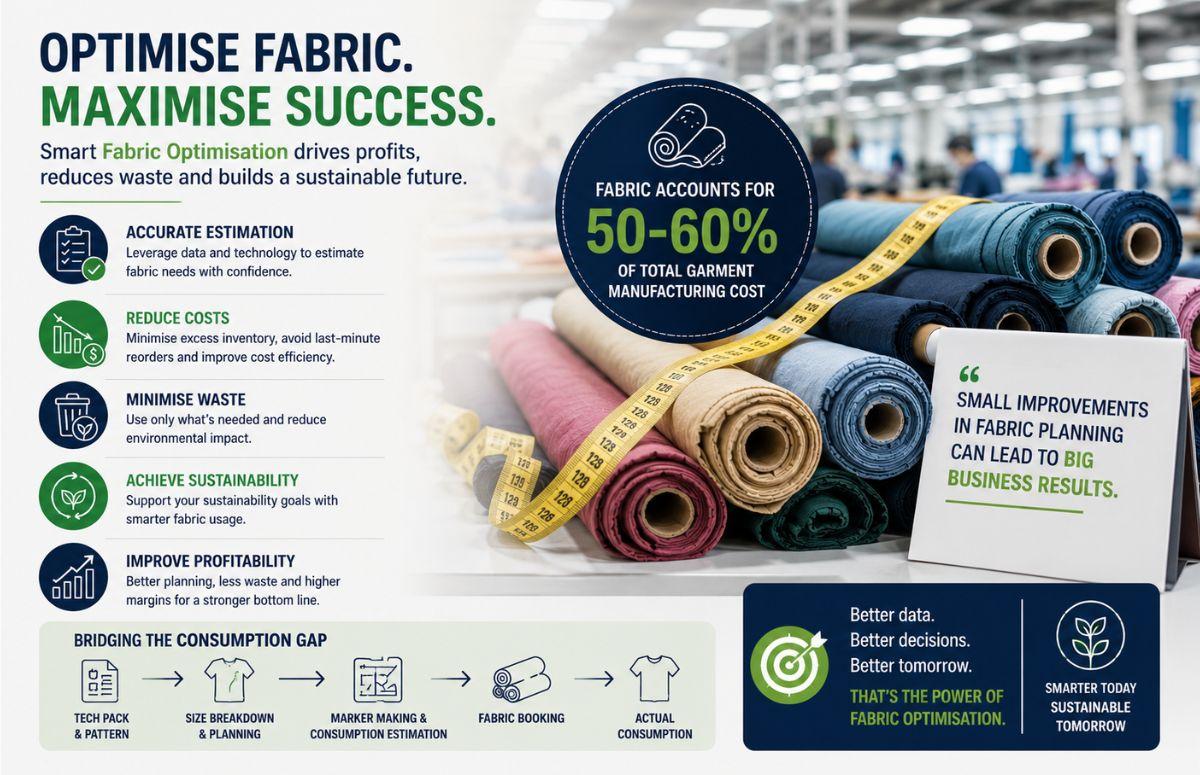
As the industry evolves, improving Fabric Optimisation is emerging as one of the most effective ways to strengthen both profitability and sustainability.
Why Fabric Matters More Than Any Other Material
Every garment begins with fabric.
Before production starts, before cutting plans are finalised, and before sewing lines begin operation, manufacturers must commit to purchasing the material needed to fulfil an order. This decision often accounts for more than half of the total manufacturing cost of a garment.
Because fabric represents such a significant investment, even small inaccuracies can have far-reaching consequences.
Ordering too little fabric creates production risks. Ordering too much creates financial inefficiencies. Finding the right balance has become increasingly difficult as fashion cycles accelerate and order complexity grows.
What was once a planning exercise has now become a strategic business decision.
The Cost of Uncertainty
One of the biggest challenges manufacturers face is uncertainty.
Fabric bookings are frequently made before all production details are available. Size distributions may still be pending. Customer requirements can change. Production variables may not yet be fully understood.
To reduce risk, manufacturers often build additional allowances into fabric orders.
While this approach helps avoid shortages, it can also create a costly side effect: excess inventory.
Across the industry, warehouses contain large volumes of unused fabric purchased as a precaution rather than a necessity. Some of this material eventually finds a use, but much of it remains idle or becomes obsolete as styles, colours, and customer requirements evolve.
The financial impact is significant, but so is the environmental one.
When Efficiency Becomes a Sustainability Issue
Fashion's sustainability conversation often focuses on materials, recycling, and responsible sourcing. However, one of the simplest ways to reduce waste is to avoid producing unnecessary material in the first place.
Every metre of excess fabric represents resources that were manufactured, transported, stored, and potentially discarded without creating value.
As brands place greater emphasis on sustainability throughout their supply chains, manufacturers are under increasing pressure to improve resource efficiency.
This is where Fabric Optimisation creates benefits that extend beyond cost reduction.
Improved planning reduces unnecessary purchasing. Better visibility helps minimise waste. More accurate forecasting supports both operational performance and environmental goals.
The outcome is a stronger business and a more sustainable production model.
Understanding the Gap Between Forecasts and Reality
Most manufacturers are familiar with the challenge of consumption variance.
Fabric is booked based on forecasts, but actual consumption often tells a different story. The difference between estimated requirements and real-world usage can appear relatively small on an individual order, yet the cumulative effect across multiple seasons and production runs is substantial.
This gap is one of the hidden drivers of excess inventory and material waste.
Reducing it requires more than tighter controls. It requires better insight into how fabric is consumed throughout the production process.
Manufacturers that can improve forecast accuracy gain a significant advantage because they are able to allocate capital more effectively and operate with greater confidence.
The Shift From Assumptions to Insights
Historically, fabric planning has relied heavily on experience.
Production teams use standard ratios, historical averages, and practical judgement to estimate requirements. While experience remains valuable, modern manufacturing environments demand a higher level of precision.
The availability of production data is changing how these decisions are made.
Historical order performance can reveal consumption patterns, size distribution trends, marker efficiencies, and wastage rates that are difficult to identify manually. These insights provide a stronger foundation for planning and reduce reliance on broad assumptions.
As manufacturers gain access to more accurate information, decision-making becomes increasingly data driven.
This transition is reshaping the way businesses approach Fabric Optimisation.
Technology's Growing Role
The complexity of modern fashion manufacturing makes manual planning increasingly difficult.
Digital solutions are helping manufacturers analyse larger volumes of data, improve forecasting accuracy, and identify opportunities to reduce waste before production begins.
Technology also creates greater visibility across the supply chain. Manufacturers can better understand where fabric is being consumed, where inefficiencies occur, and where improvements can be made.
Perhaps most importantly, technology enables faster decision-making without sacrificing accuracy.
In an industry where lead times continue to shrink, this capability is becoming essential.
Looking Beyond Cost Savings
The value of better fabric management extends far beyond immediate financial gains.
Manufacturers that improve planning accuracy often experience stronger inventory control, reduced waste, improved resource utilisation, and greater operational resilience. These benefits contribute directly to long-term competitiveness.
As customer expectations evolve and sustainability requirements become more demanding, businesses will need to find smarter ways to manage resources across the entire production lifecycle.
Fabric remains one of the most important resources they have.
The Bottom Line
The future of fashion manufacturing will be shaped by companies that can make better decisions with greater precision.
Fabric may not always be the most visible part of the manufacturing process, but it remains one of the most influential. It affects profitability, inventory levels, production efficiency, and sustainability performance all at once.
For manufacturers seeking to improve margins while reducing waste, Fabric Optimisation is no longer simply an operational initiative. It is a strategic capability that can influence the success of the entire business.
In an increasingly competitive industry, the manufacturers that manage fabric most effectively may ultimately be the ones that perform best.
Nach Verein filtern
Read More
TT88 is Asia’s leading online betting platform, offering players a seamless and exciting experience. With a focus on entertainment, safety, and rewarding opportunities, TT88 ensures that every player enjoys online betting to the fullest. Whether you are new to online betting or a seasoned player, TT88 provides a fun, safe, and engaging environment for everyone. A Massive Game Library to...

The analytical instruments market is experiencing steady expansion as industries place greater emphasis on research and development (R&D), product quality, and regulatory compliance. Analytical instruments are essential tools used to identify, measure, and analyze chemical, biological, and physical properties of materials. From pharmaceuticals and biotechnology...

Introduction Do you want to buy a used mobile in Dubai without losing quality or performance? One can find high-end mobile phones in Dubai at very reasonable prices as it is one of the leading and most admired hubs in the world. No matter you are a tourist, a resident or an expat, the city has something in store for everyone. In this guide, we will discuss the advantages and the best sources...

Cyber Security protects the digital backbone of organizations worldwide. At FITA Academy, you’ll explore ethical hacking, network defense, and incident response through hands-on projects. Expert mentors guide you in detecting threats, securing data, and implementing preventive measures. By combining theory with practice, you’ll gain the skills and confidence to tackle real-world...

In the fast-evolving digital world, businesses cannot rely solely on traditional marketing to stay competitive. Online visibility, lead generation, and brand engagement are critical for growth. Partnering with the top digital marketing companies can help you achieve these goals effectively. In this blog, we’ll explore the key services offered by these companies, their benefits for...