The difference in silhouette
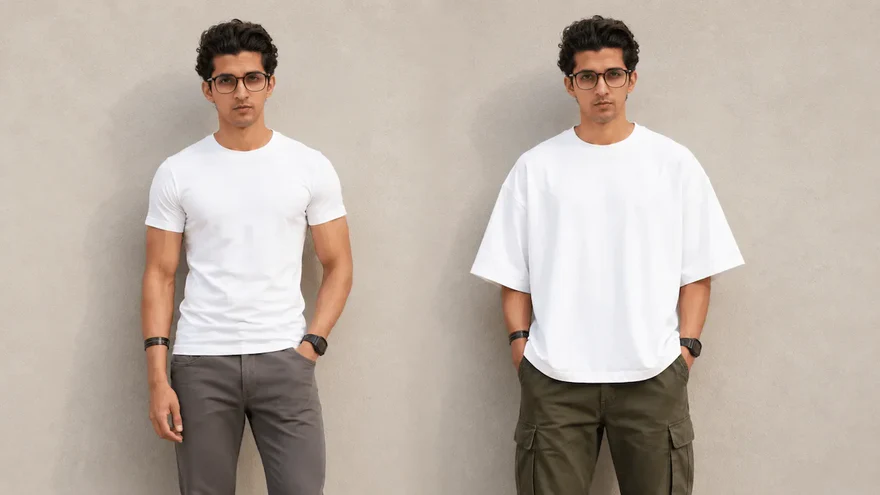
The most fundamental difference between an oversized T-shirt and a regular-fit tee is not size — it is pattern. A regular-fit tee is cut to mirror the body: it follows the shoulder line, tapers slightly at the waist, and ends at the hip. The garment tracks the body's shape. An oversized tee is cut to a fixed rectangular pattern that is wider, longer, and straighter than the body underneath it. The garment creates its own shape, independent of the body wearing it.
- Shoulder seam falls 1–3 inches below natural shoulder
- Chest ease of 6–10 inches above body measurement
- Straight drop from chest to hem — no waist taper
- Sleeve hem at mid-bicep
- Hem at hip level or just below
- Shoulder seam sits at natural shoulder point
- Chest ease of 2–4 inches above body measurement
- Slight waist taper retained in the cut
- Sleeve hem at or near the elbow
- Hem at hip or slightly above
These are structural differences — they cannot be replicated by simply buying a regular tee in a larger size. A size XL regular-fit tee is still cut with the regular pattern at a larger scale. The shoulder seam still sits at your shoulder point, the waist taper is still present, and the proportions still read as a big regular tee rather than a genuine plain oversized T-shirt.
Why oversized fits work for Indian body types
Indian men — particularly in the 18–35 age range — tend to have a specific set of proportions that interact with Western sizing in predictable ways. Broader shoulders relative to chest circumference. A shorter torso-to-height ratio. A denser upper body build. These are generalisations, but they are consistent enough to explain why a regular-fit tee cut to Western standards often pulls across the upper back on Indian frames, sits tight at the shoulder seams, and looks constrained rather than clean.
An oversized tee sidesteps this entirely. Because the garment is cut wider than the body at every point, it does not tension at the shoulders, does not pull across the upper back, and does not follow the torso in a way that exposes proportion differences between the wearer and the intended size standard. Essential Basics patterns are additionally calibrated for Indian proportions — the shoulder width-to-chest ratio and hem length are specific to how most Indian men are built, not adapted from a Western block.
"An oversized tee does not just look relaxed. For Indian body types, it often fits better — because it was not designed to track a body shape that was never ours."
When a regular fit makes more sense
There are contexts where a regular fit is the stronger choice. In formal or semi-formal settings — a tucked tee under a blazer, a smart-casual office environment, a structured event — the oversized silhouette reads as too casual. The excess volume at the chest and the dropped shoulder seam work against the clean lines that formal dressing requires.
Regular fit also makes more sense when the outfit already carries significant volume at the bottom. Wide-leg trousers, palazzo pants, or heavily structured cargo cuts at the full width can make an oversized tee feel top-heavy. In those cases, a slim or regular fit at the top balances the volume below rather than competing with it.
The boxy oversized fit — what it is
The boxy oversized fit is a specific sub-category of oversized that has become the dominant silhouette in Indian streetwear. Where a standard oversized tee might retain a slight A-line shape — wider at the hem than the chest — a boxy tee is cut in a true rectangle. Equal width from shoulder to hem. No taper anywhere. The silhouette when laid flat is a near-perfect box.
This is the cut that Essential Basics uses across the Core Collection. The boxy drop means the fabric falls in a clean, straight line from the shoulder seam to the hem. When the 210 GSM super combed cotton is heavy enough to maintain this drape through movement, the result is a silhouette that looks exactly the same at 9am and 9pm. The fabric weight is what makes the boxy cut possible — a light tee cannot maintain the straight drop and returns to cling to the body's shape. For a deeper dive into how GSM affects this, read our 210 GSM guide.
How to know if an oversized tee fits correctly
The most common mistake people make is confusing an oversized tee with a tee that is simply too big. They are not the same thing. Here is a five-point checklist. If all five are true, the tee is fitting correctly as an oversized garment. If one or more is off, refer to the Essential Basics size guide to adjust.
FAQs
Is an oversized T-shirt better than a regular fit for Indian men?
For casual and street wear, yes — for most Indian men. The oversized cut accommodates the broader Indian shoulder-to-chest ratio without pulling at the seams. A regular fit tee sized for Western proportions often sits tight across the upper back on Indian frames. The oversized cut removes that friction entirely.
How should an oversized tee fit on a shorter Indian man?
Size up by one from your regular measurement — not two. One size gives you a 1–1.5 inch shoulder drop and a hem at hip level. Two sizes up risks the hem falling to mid-thigh, which shortens the visual leg length. For the exact measurements by body height and chest, check the full size guide.
Can a regular-fit tee be altered to look oversized?
No — not convincingly. A regular tee at a larger size still has the original waist taper in the pattern. The shoulder seam sits differently, the sleeve falls differently, and the waist taper breaks the boxy silhouette that defines a true oversized cut.
When does regular fit make more sense?
In formal settings, when tucking the tee, or when the outfit already carries high volume at the bottom — wide-leg trousers, structured cargos. In those cases, a slim or regular top balances the silhouette rather than compounding it.
All six colours. Boxy cut. 210 GSM super combed cotton. Sizes S to XL. ₹599 each.
Free prepaid delivery · 7-day returns · Cut for Indian body types
Not sure of your size? The size guide has your exact garment measurements, shoulder drop reference, and home measurement steps.
→ Try Our Oversized Tees at essentialbasics.in/collections/core-essential
Oversized or regular — the right fit is the one that works for your body, your context, and your intention. For most Indian men in casual settings, the oversized boxy cut does all three better. The fabric weight is what makes it possible.
Visit Us -> https://essentialbasics.in/blogs/news/oversized-vs-regular-fit-t-shirt-indian-body-types