Scaling Enterprise Automation via MuleSoft Consulting Solutions
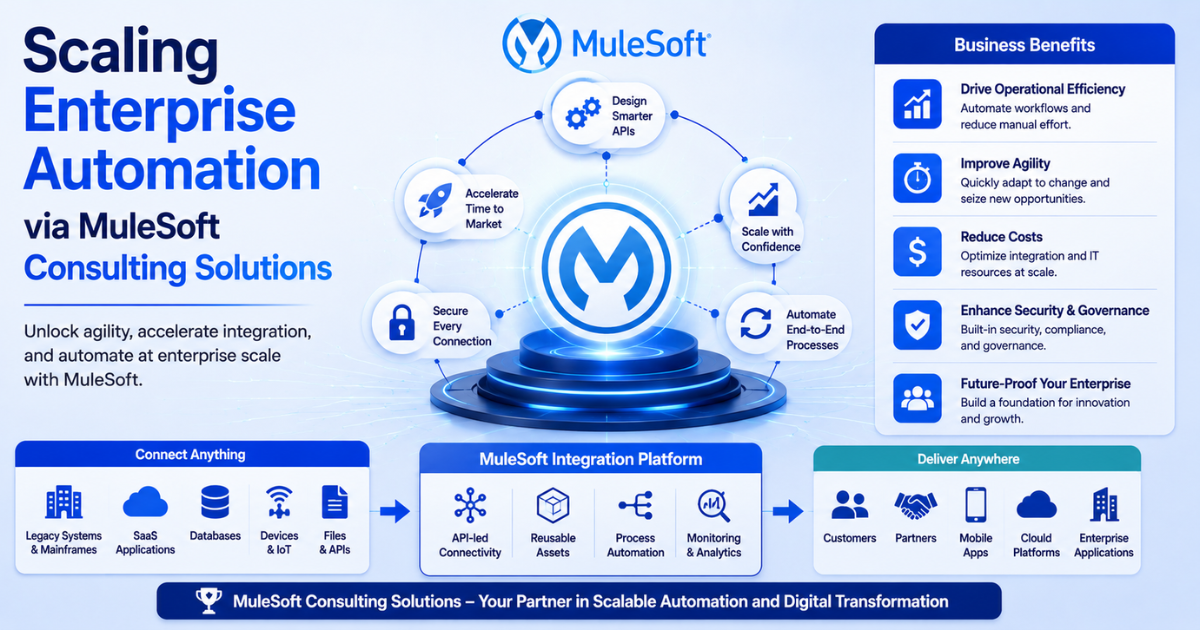
Modern corporations use hundreds of separate software applications to manage daily business operations. According to recent IT industry benchmarks, the average enterprise maintains over 900 individual applications across different departments. Unfortunately, less than 30% of these platforms connect natively to each other. This disconnection creates fragmented workflows and manual processing bottlenecks.
To overcome these data divisions, companies deploy advanced orchestration frameworks. Choosing MuleSoft Consulting helps businesses convert isolated software applications into an integrated digital ecosystem. This details how companies scale automation using professional MuleSoft Consulting Services from a deep technical perspective.
Technical Foundations of Modern Automation
Enterprise automation requires more than simple UI recording or script creation. It demands a highly structured, scalable integration layer that links cloud applications, on-premises databases, and legacy mainframes.
1. API-Led Connectivity
MuleSoft scales automation through its signature three-tier API architecture. This framework replaces rigid, point-to-point connections with structured components:
-
System APIs: These assets connect directly to underlying systems of record. They expose raw data from platforms like SAP, Oracle, or Salesforce while hiding technical complexities.
-
Process APIs: These components combine and shape the data from multiple System APIs. They model specific business functions, such as order fulfillment or customer onboarding.
-
Experience APIs: These modules deliver the processed data to final consumption points. These points include mobile apps, web portals, or internal employee dashboards.
This layered separation protects core systems from high traffic volumes. It also allows developers to update individual user interfaces without disrupting underlying database connections.
2. Components of the MuleRuntime
The core execution environment, known as Mule Runtime, handles complex data processing tasks. The runtime manages message queuing, exception handling, and transaction routing. It utilizes an in-memory execution model to process data blocks with minimal latency.
Expert consultants tune these runtime engines to ensure high-speed performance during peak traffic windows. They set precise memory allocation rules and configure cluster policies to distribute computing workloads evenly across servers.
Merging Integration and Robotic Automation
True end-to-end automation combines application programming interfaces (APIs) with Robotic Process Automation (RPA). This combination bridges the gap between modern cloud systems and old legacy software that lacks API access.
1. Deploying MuleSoft RPA
Many older internal systems require manual user input because they do not have modern integration interfaces. MuleSoft RPA addresses this problem by training software bots to copy human actions. These bots log into secure portals, extract unstructured text from PDF invoices, and enter details into local databases.
Consultants integrate these RPA bots directly into the Anypoint Platform. This integration turns a basic user-interface bot into an accessible service component. The diagram below illustrates how an API calls an RPA bot to handle data processing tasks:
2. Advanced Data Transformation
Data moving between systems rarely shares the same format. A web storefront might output structured JSON data, while an old inventory database requires traditional XML or flat files.
MuleSoft uses DataWeave as its primary language for data transformation. DataWeave changes data formats at high speeds. It allows systems to map data elements, filter null values, and convert data types mid-stream.
Establishing Integration Governance
As automation spreads across an organization, keeping track of hundreds of active APIs becomes difficult. Without central control, different teams often build identical integrations. This duplicate work increases IT costs and introduces security risks.
1. Center of Excellence Creation
To prevent chaotic development cycles, MuleSoft Consulting Services establish a Center of Excellence (CoE). A CoE acts as a central governing body within the corporation. It sets development standards, reviews code quality, and manages platform access permissions.
The CoE focuses heavily on component reuse. When a development team builds a secure customer lookup API, they publish it to Anypoint Exchange. Anypoint Exchange serves as an internal marketplace for software assets. Other departments reuse this exact API instead of building a new one from scratch.
Recent integration studies show that companies using a CoE model increase asset reuse rates by 40% to 50%. This approach reduces the development time required for subsequent automation projects.
2. Policy Enforcement and Security
Securing enterprise data is a critical requirement during automation rollouts. MuleSoft API Manager allows administrators to apply universal security policies to integrations without modifying the core code. These security layers include:
-
OAuth 2.0 Authentication: Verifies the digital identity of requesting systems.
-
IP Whitelisting: Restricts API access to trusted corporate networks.
-
Rate Limiting: Prevents service crashes by capping the number of requests per minute.
-
Data Masking: Hides sensitive information, like credit card numbers, in system logs.
These automated guardrails ensure compliance with global data privacy mandates like GDPR and HIPAA.
Analyzing System Benefits and Metrics
Investing in enterprise automation provides measurable technical and financial returns for complex businesses.
1. Development Speed and Agility
Reusable API architectures alter project timelines significantly. Instead of coding every integration from scratch, developers assemble workflows using existing blocks.
This model reduces average project delivery times by up to 60%. IT departments shift their focus from basic maintenance tasks to creating new business features.
2. System Reliability and Error Reduction
Manual data entry introduces human typing mistakes into corporate databases. Automated data synchronization eliminates these errors entirely.
The tables below present operational data contrasting legacy point-to-point connections with structured MuleSoft implementations:
|
Operational Metric |
Legacy Infrastructure |
MuleSoft Automated Architecture |
|
Integration Pattern |
Custom Point-to-Point |
Structured API-Led |
|
Average Deployment Time |
6 to 8 Weeks |
2 to 3 Weeks |
|
Component Reusability |
Less than 5% |
35% to 55% |
|
System Visibility |
Fragmented Log Files |
Centralized Anypoint Monitoring |
|
Enterprise Performance KPI |
Before MuleSoft Consulting |
After MuleSoft Consulting |
|
API Response Time (Average) |
850 Milliseconds |
190 Milliseconds |
|
Monthly System Downtime |
14.2 Hours |
0.4 Hours |
|
Data Sync Errors (Per 10k Runs) |
340 Errors |
2 Errors |
Real-World Automation Examples
Examining specific technical use cases demonstrates how MuleSoft Consulting solves complex corporate operational issues.
1. Financial Service Orchestration
Large retail banking institutions often handle mortgage approvals through slow, manual steps. A customer submits an application online, and loan officers manually copy data across three separate databases to check credit scores and verify assets.
A structured MuleSoft automation replaces this manual process entirely. An Experience API captures the web application form data instantly. A Process API coordinates data validation by calling external credit bureau APIs simultaneously.
Finally, a System API updates the internal banking core database. This automated approach reduces mortgage processing timelines from five business days to under ten minutes.
2. Supply Chain Order Syncing
Global manufacturing firms experience major bottlenecks when processing purchasing contracts. Orders arrive via electronic data interchange (EDI) documents, emails, and direct web sales.
Consultants configure Anypoint MQ to act as an asynchronous message queue. This layer holds incoming orders safely during traffic spikes. The runtime processes each order sequentially, updates the main ERP software, and notifies the shipping warehouse automatically. This design prevents database crashes during high-volume sales events.
Long-Term Platform Maintenance
Maintaining an automated infrastructure over time requires continuous performance monitoring and tactical software updates.
1. Comprehensive Telemetry Tracking
MuleSoft Anypoint Visualizer provides real-time maps of all active system dependencies. It illustrates exactly how data flows across the corporate infrastructure.
If a specific database slows down, the visualizer highlights the affected pathway in red. This immediate notification allows network engineers to isolate and fix performance bugs before users notice an outage.
2. Automated Testing Frameworks
To preserve system stability during software upgrades, consultants implement MUnit testing suites. MUnit allows developers to build automated unit and integration tests for their APIs.
These tests run automatically within continuous integration (CI/CD) pipelines. They check that data transformations function correctly before deploying new code to live production servers. This automation minimizes the risk of accidental system regressions.
Technical Summary of Automation Scaling
Scaling enterprise automation requires a shift away from brittle scripting and manual data management. By selecting MuleSoft Consulting Services, companies build an adaptable integration foundation using an API-led methodology.
The strategic combination of system orchestration, unified RPA deployment, and strict component governance allows corporations to automate multi-step operations safely. This technical architecture eliminates data silos, optimizes system processing speeds, and provides a dependable framework for continuous corporate growth.
Conclusion
As digital application ecosystems grow more complex, companies cannot afford to rely on disconnected systems. Fragmented data structures lower operational output and slow down corporate responsiveness. Organizations must view integration as a core business driver rather than a basic IT requirement.
Deploying MuleSoft Consulting solutions provides the technical framework needed to achieve sustained operational efficiency. The platform structures data exchange across all company levels, ensuring data security and high system availability. By embracing reusable APIs and unified management practices, modern enterprises eliminate manual bottlenecks, lower software maintenance overhead, and build an agile digital foundation ready for future market changes.
Categorii
Citeste mai mult
The fever for cricket peaks at the time of Indian Premier League (IPL) and, when you have the IPL Login ID, you're no longer an observer, you're playing. If you're trying to predict matches, building Fantasy teams or trying to win huge jackpots, having an IPL ID is the key to exciting action and genuine reward. This guide will walk you through everything from how to login to successful...

The console version of the acclaimed Riot Games tactical shooter, Valorant, has now entered an open beta phase accessible to all PlayStation 5 and Xbox Series X users. This marks a significant expansion from the initial limited testing period, opening the door for a broader audience to experience the game on home consoles. Originally released on PC in mid-2020 after several years of...

A tyre safety checklist works by catching the early warning signs of tyre wear, poor pressure, structural damage, and performance issues before they turn into dangerous on-road failures. When drivers regularly check tread depth, tyre pressure, alignment, and overall tyre condition, they dramatically reduce the risk of blowouts, skidding, long braking distances, aquaplaning, and unpredictable...

"Aramid Fiber Market Summary: According to the latest report published by Data Bridge Market Research, the Aramid Fiber Market CAGR Value Data Bridge Market Research analyses that the aramid fiber market is expected to undergo a CAGR of 5.80% from 2023 to 2030. This indicates that the market value, USD 3.82 billion in 2022, would rocket up to USD 6.01 billion by 2030. The wide...
Taking care of oral health is an important part of overall wellness. While brushing and flossing are essential habits, many people today are also looking for additional ways to support their teeth and gums. This is where Dentpure comes in. Dentpure is a natural oral health supplement designed to help support the balance of good bacteria in the mouth. The mouth contains millions of bacteria,...