


How to Achieve Deep Focus on Demand: The Science Behind the Sychedelic Method
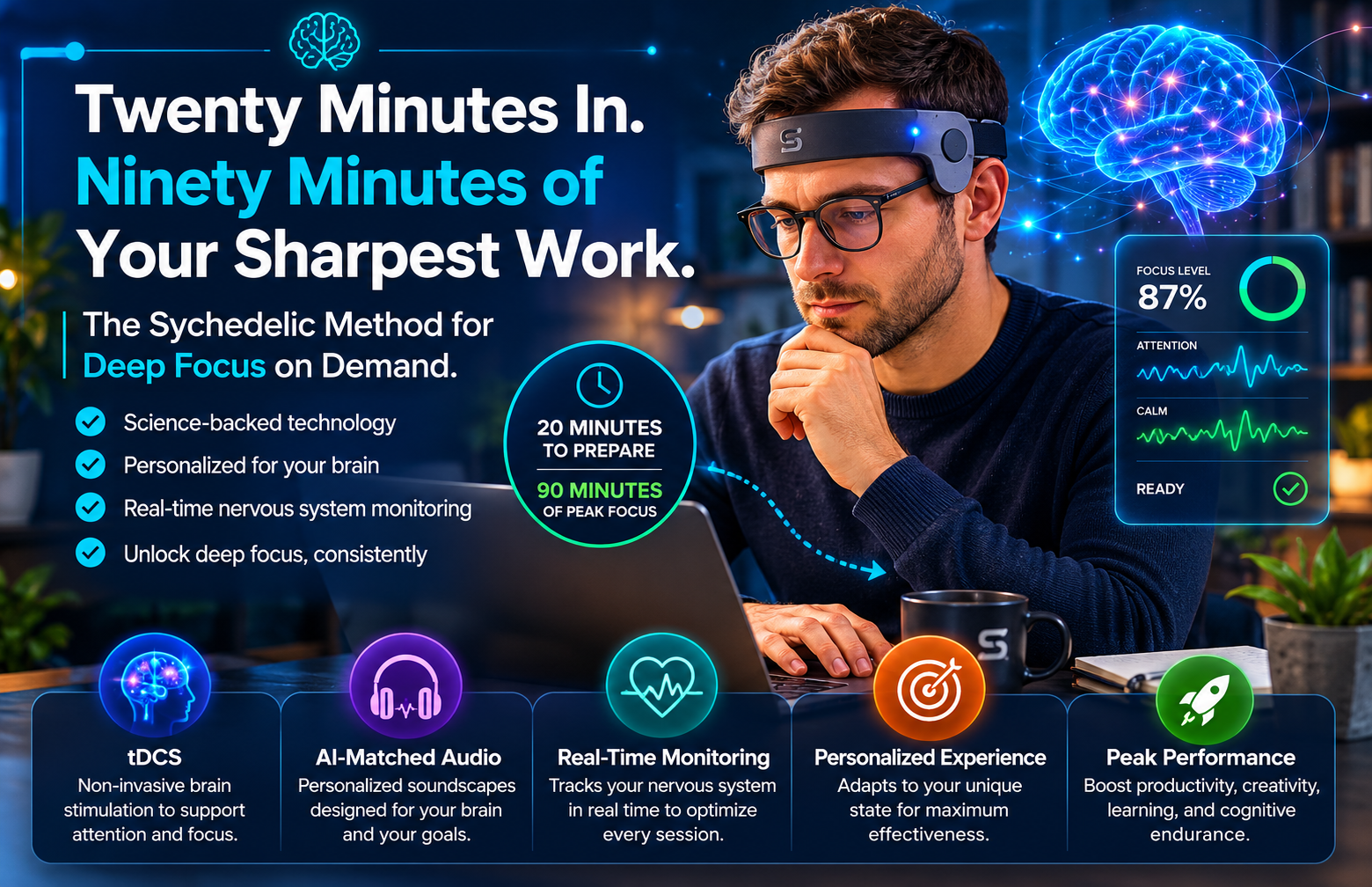
In a world filled with distractions, deep focus has become one of the most valuable skills a person can develop. Professionals, entrepreneurs, students, and creatives all search for ways to improve concentration and sustain high levels of cognitive performance. Traditional solutions such as caffeine, meditation apps, productivity hacks, and time-management systems promise better focus, but many people still struggle to maintain attention when it matters most.
The article “Twenty Minutes In. Ninety Minutes of Your Sharpest Work” introduces a different approach. Instead of forcing the brain into a productive state through willpower alone, the Sychedelic method uses real-time physiological feedback, AI-matched audio, and transcranial direct current stimulation (tDCS) to help users achieve a state of deep focus on demand.
This approach is built on the idea that focus is not simply a matter of motivation. It is a physiological state that can be measured, influenced, and optimized.
The Problem With Traditional Focus Solutions
Most focus advice follows a familiar pattern. Drink coffee, reduce distractions, wake up earlier, meditate, or simply push through mental fatigue. While these methods can help under certain circumstances, they often fail when the brain is already exhausted.
According to the document, the problem is physiological rather than motivational. The prefrontal cortex—the area of the brain responsible for executive function, working memory, decision-making, and sustained attention—does not respond effectively when it is depleted.
Many common focus tools work without considering a person's current mental state. They deliver the same intervention whether someone is well-rested or severely fatigued. As a result, users are left guessing which technique might work on a given day.
The Limitations of Caffeine
Caffeine is one of the most widely used cognitive enhancers in the world. However, the document explains that caffeine does not actually create energy. Instead, it blocks adenosine, the chemical signal that tells the brain it is tired.
While this can temporarily increase alertness, it may also contribute to elevated stress levels, disrupted sleep patterns, and eventual crashes in performance. The temporary boost often comes at the expense of long-term cognitive recovery.
Why Meditation Isn’t Always Enough
Meditation can be highly effective for many people, but it often assumes the user already has a relatively stable nervous system. Chronic stress, poor sleep, and ongoing mental overload can make it difficult to achieve the calm state required for effective meditation.
When someone is already overwhelmed, simply trying harder to relax may not be enough.
The Missing Element: Feedback
The document highlights a critical gap in most focus interventions: real-time feedback.
Whether it's caffeine, breathing exercises, cold exposure, or mindfulness practices, most methods provide the same input regardless of a person's current physiological condition. They do not measure stress levels, nervous system activity, or cognitive readiness before attempting to improve performance.
Sychedelic was designed to address this gap by continuously monitoring the user’s state and adjusting its response accordingly.
What Is the Sychedelic Method?
Sychedelic is described as a closed-loop neuro-acoustic system that combines physiological monitoring, artificial intelligence, audio stimulation, and tDCS technology.
The goal is simple: help users enter a productive mental state and create a window for high-performance cognitive work.
The system works by reading physiological signals through a temple-mounted sensor. Using this information, it determines the user’s current mental and nervous system state and then delivers customized interventions.
Rather than applying stimulation immediately, the system adapts to what the user needs in the moment.
Understanding the Core Technologies
Transcranial Direct Current Stimulation (tDCS)
One of the primary components of the Sychedelic method is tDCS.
Transcranial Direct Current Stimulation is a non-invasive technique that delivers a low electrical current to targeted areas of the brain. In the Sychedelic protocol, stimulation is directed toward the dorsolateral prefrontal cortex (DLPFC), a region associated with:
-
Executive function
-
Working memory
-
Attention control
-
Emotional regulation
-
Cognitive performance
The stimulation is designed to enhance cortical excitability, creating conditions that support focused mental work.
Heart Rate Variability (HRV)
Another important measurement used by the system is Heart Rate Variability, commonly known as HRV.
HRV refers to the variation in time between heartbeats and serves as an indicator of nervous system flexibility. Higher-quality HRV patterns are often associated with improved resilience, adaptability, and cognitive readiness.
By monitoring physiological signals, the system gains insight into the user's current condition before determining the best intervention.
Closed-Loop Feedback
A closed-loop system continuously measures input, analyzes it, and adjusts output accordingly.
Instead of delivering identical stimulation to every user, Sychedelic uses biometric data to guide its decisions in real time. This creates a more personalized experience that adapts to changing conditions throughout the session.
How the Sychedelic Session Works
The document outlines a structured session designed to prepare the brain for deep work.
Step 1: Setup and Calibration
The session begins with preparation of the device. Users position the headband and complete an impedance check to ensure proper contact and signal quality.
This setup phase ensures accurate measurement and effective stimulation.
Step 2: Baseline Assessment
The physiological sensor collects data and evaluates the user's current state.
The system classifies users into one of several cognitive or emotional categories, including:
-
Drowsy
-
Brain Fog
-
Focused
-
Anxious
This assessment provides the foundation for the rest of the session.
Step 3: Personalized Audio Entrainment
Once the baseline state is identified, an AI-selected audio environment begins.
The soundscape is matched to the user’s condition and designed to help regulate nervous system activity. For example, alpha-frequency audio patterns may be used to reduce excessive arousal and encourage a calmer, more productive mental state.
The objective is not merely relaxation but optimization of the brain's readiness for focused work.
Step 4: Stimulation Unlock
A key feature of the system is that stimulation is not activated immediately.
Instead, the software monitors whether a meaningful physiological shift has occurred. If the nervous system shows signs of improvement, the stimulation phase begins.
If the user remains in a highly stressed or anxious state, the stimulation remains gated until conditions improve.
This feedback-driven approach differentiates the system from static cognitive enhancement tools.
Step 5: Twenty Minutes of Brain Stimulation
Once unlocked, the tDCS protocol is delivered for approximately twenty minutes.
The stimulation targets the dorsolateral prefrontal cortex and is designed to increase cortical excitability associated with focused cognition.
Step 6: Ninety Minutes of Peak Performance
According to the document, the most valuable part of the process occurs after stimulation.
The post-stimulation period creates a roughly ninety-minute window of enhanced cognitive readiness. This is the time intended for demanding mental tasks such as:
-
Writing
-
Strategic planning
-
Problem-solving
-
Studying
-
Creative work
-
Complex decision-making
The document describes this as the peak performance window—the period users effectively prepare for during the session.
Why Timing Matters
A central idea behind the Sychedelic method is sequencing.
The system does not simply stimulate the brain. Instead, it follows a specific order:
-
Measure the current state.
-
Reduce unnecessary stress.
-
Improve nervous system readiness.
-
Deliver targeted stimulation.
-
Create an extended performance window.
This sequence aims to support focus more effectively than applying stimulation or productivity techniques without context.
By preparing the nervous system first, the system seeks to maximize the benefits of cognitive enhancement.
The Long-Term Goal
Beyond immediate productivity, the document suggests that repeated use may contribute to broader improvements.
Over multiple sessions, the protocol is described as supporting positive changes in:
-
Focus
-
Mood
-
Sleep quality
-
Cognitive resilience
Rather than functioning as a one-time performance boost, the approach is positioned as a tool for ongoing cognitive optimization.
A New Perspective on Deep Work
The Sychedelic method challenges a common assumption about productivity: that focus is purely a matter of discipline.
Instead, it presents focus as a measurable biological state influenced by nervous system regulation, brain activity, and physiological readiness.
When people struggle to concentrate, the issue may not be a lack of motivation. It may be that their brain is operating under conditions that make sustained attention difficult.
By combining biometric monitoring, adaptive audio, artificial intelligence, and targeted brain stimulation, the system seeks to create conditions where deep work becomes more accessible.
Conclusion
Deep focus is increasingly difficult to achieve in today's fast-paced environment. Traditional solutions often rely on generalized advice that does not account for an individual's current physiological state.
The Sychedelic method offers a different model. By measuring real-time biometric signals, delivering personalized audio, and applying targeted tDCS stimulation only when the nervous system is ready, it aims to create a structured path toward high-performance cognition.
The result is a process designed to transform a short preparation session into an extended period of productive mental work. Rather than forcing focus through willpower alone, the Sychedelic approach focuses on creating the biological conditions that allow deep work to happen naturally.
For individuals seeking a more science-driven approach to concentration and cognitive performance, the Sychedelic method represents an innovative perspective on achieving deep focus on demand.
Categorie
Leggi tutto
According to the latest report published by Data Bridge Market Research, the Plant-Based Meat Market CAGR Value The Plant-Based Meat Market document contains precise and up to date information about the consumer’s demands, their preferences, and their variable likings about particular product. It also guesstimates the prospective market for a new product to be...

Document cameras have become valuable visual presentation tools that enable users to display documents, books, photographs, objects, and live demonstrations with exceptional clarity. These devices are widely used in education, corporate training, healthcare, legal services, research laboratories, government organizations, and business environments to enhance collaboration and knowledge sharing....

At PVC Patches UK, Our customised morale patches UK are a simple way for clubs, gaming groups, cadet teams, and small brands to show identity and unity. These patches can carry fun slogans, positive messages, or unique logos that make members feel proud and connected. Soft PVC material keeps colours bright and clear even in rain, travel, or daily use. With easy artwork support,...

The global adult entertainment market has evolved into a significant segment of the broader media and entertainment industry, driven by rapid technological innovation, shifting social perceptions, and increasing digital accessibility. In 2023, the global industry was valued at US$ 287.8 billion, highlighting its substantial economic presence across multiple regions and distribution channels....
How Thick Film Chip Resistors Quietly Power the World's Digital Infrastructure Through Scale, Precision, and Ubiquitous Electronics Every digital interaction begins with control. Whether a smartphone processes a payment in less than 2 seconds, an electric vehicle manages battery temperature across hundreds of cells, or an industrial robot executes movements within millisecond...
