


Cooling Solutions for Military & Defense Vehicles: The Hidden Infrastructure Powering Battlefield Survivability in an Era of Extreme Heat, Electronics, and Mobility
Cooling Solutions for Military & Defense Vehicles: The Hidden Infrastructure Powering Battlefield Survivability in an Era of Extreme Heat, Electronics, and Mobility
Military modernization is often described through tanks, armored vehicles, missiles, and autonomous platforms. Yet behind every successful mission lies an invisible layer of engineering that determines whether a vehicle can operate for 12 hours or 72 hours, whether sensitive electronics survive a desert deployment, and whether soldiers remain combat-effective in temperatures exceeding 50°C. That invisible layer is Cooling solutions for Military & Defense vehicles market.
The importance of Cooling solutions for Military & Defense vehicles has grown dramatically over the last decade. Modern armored platforms now carry significantly more electronic equipment than their predecessors. A main battle tank deployed in the 1990s may have contained a few kilowatts of onboard electronics. Contemporary platforms often operate with 20–50 kW of electronic loads, while advanced command vehicles, radar carriers, and electronic warfare platforms can exceed 100 kW.
This increase is not incremental. It represents a fundamental shift in battlefield infrastructure.
Every additional sensor, communication terminal, battle management system, thermal imaging device, and active protection system generates heat. If that heat is not managed efficiently, mission reliability declines. Industry assessments indicate that electronic component failure rates can double with every 10°C rise above recommended operating temperatures. As a result, Cooling solutions for Military & Defense vehicles have become a survivability requirement rather than a comfort feature.
The Battlefield Is Becoming Hotter Than the Vehicles Were Designed For
Operational environments are changing rapidly. Defense planners increasingly prepare for deployments in regions where ambient temperatures frequently exceed 45°C. Vehicles operating in desert environments often experience internal compartment temperatures 15–25°C higher than external conditions.
A tracked vehicle parked under direct sunlight may see cabin temperatures exceeding 65°C before engine startup. Electronics compartments can experience even higher thermal loads if cooling infrastructure is inadequate.
This creates a cascading operational challenge.
Crew fatigue can increase by 20–30% during prolonged exposure to extreme temperatures. Electronic systems experience accelerated degradation. Battery performance declines. Thermal imaging equipment loses calibration accuracy. Consequently, investments in Cooling solutions for Military & Defense vehicles are now being evaluated alongside armor upgrades and mobility enhancements.
The modern military vehicle is increasingly viewed as a thermal ecosystem rather than a mechanical platform.
Mapping the Infrastructure Behind Military Cooling Systems
The infrastructure supporting Cooling solutions for Military & Defense vehicles extends far beyond conventional air-conditioning.
A contemporary armored platform may incorporate:
-
Engine cooling circuits
-
Transmission cooling systems
-
Electronic equipment cooling modules
-
Battery thermal management systems
-
Crew compartment HVAC units
-
Auxiliary power unit cooling loops
-
Directed-energy system cooling architecture
-
Thermal management software
Together, these subsystems can account for 3–8% of total vehicle engineering complexity and a growing share of lifecycle maintenance budgets.
For a fleet of 1,000 armored vehicles, thermal management infrastructure can involve thousands of heat exchangers, pumps, condensers, evaporators, sensors, and control modules distributed across maintenance depots and operational bases.
This is why Cooling solutions for Military & Defense vehicles are increasingly viewed as defense infrastructure assets rather than isolated vehicle components.
Use Case Mapping: Main Battle Tanks
The most demanding use case for Cooling solutions for Military & Defense vehicles remains the main battle tank.
Modern tanks combine high-output diesel engines producing 1,200–1,500 horsepower with dense electronic architectures. Engine compartments can generate temperatures exceeding 100°C during sustained operations.
Without effective cooling, engine efficiency declines, fuel consumption rises, and maintenance intervals shorten.
Military vehicle manufacturers therefore employ high-capacity radiators, variable-speed cooling fans, advanced coolant channels, and electronically controlled thermal management systems.
In some deployments, cooling upgrades have demonstrated measurable operational benefits. A reduction of only 5–8°C in critical engine temperatures can improve component longevity by double-digit percentages over a vehicle's service life.
As armies seek service lives of 30–40 years from armored fleets, Cooling solutions for Military & Defense vehicles increasingly influence total ownership costs.
Use Case Mapping: Armored Personnel Carriers and Infantry Fighting Vehicles
Armored personnel carriers present a different challenge.
Unlike tanks, these vehicles must balance crew comfort, troop transport, electronics protection, and mobility within restricted internal space.
An infantry fighting vehicle may carry 8–12 soldiers alongside communication systems, navigation equipment, sensors, and weapons control electronics.
The thermal load generated by personnel alone can exceed several kilowatts during extended operations.
Consequently, Cooling solutions for Military & Defense vehicles in this category focus heavily on compartment climate management.
Studies conducted across military operating environments indicate that maintaining crew compartment temperatures even 8–10°C below external ambient conditions can improve personnel endurance, cognitive performance, and mission effectiveness during long deployments.
This operational benefit is increasingly quantifiable, making thermal management a force multiplier rather than a support function.
Quantifying the Rise of Electrification
Vehicle electrification is creating an entirely new demand profile for Cooling solutions for Military & Defense vehicles.
Defense organizations worldwide are investing in hybrid propulsion systems, silent watch capabilities, onboard batteries, and high-capacity power generation systems.
Lithium-ion battery packs operate most effectively within controlled temperature ranges. Deviations can reduce efficiency, shorten service life, and create safety concerns.
A military battery system operating continuously at elevated temperatures may experience significantly faster degradation than one maintained within optimal thermal limits.
For this reason, battery cooling loops, liquid cooling plates, and intelligent thermal monitoring systems are becoming standard components of future vehicle architectures.
Industry engineers increasingly estimate that thermal management requirements for next-generation hybrid military vehicles could be 30–50% greater than those of conventional diesel-only platforms.
Market Size and Forecast Perspective
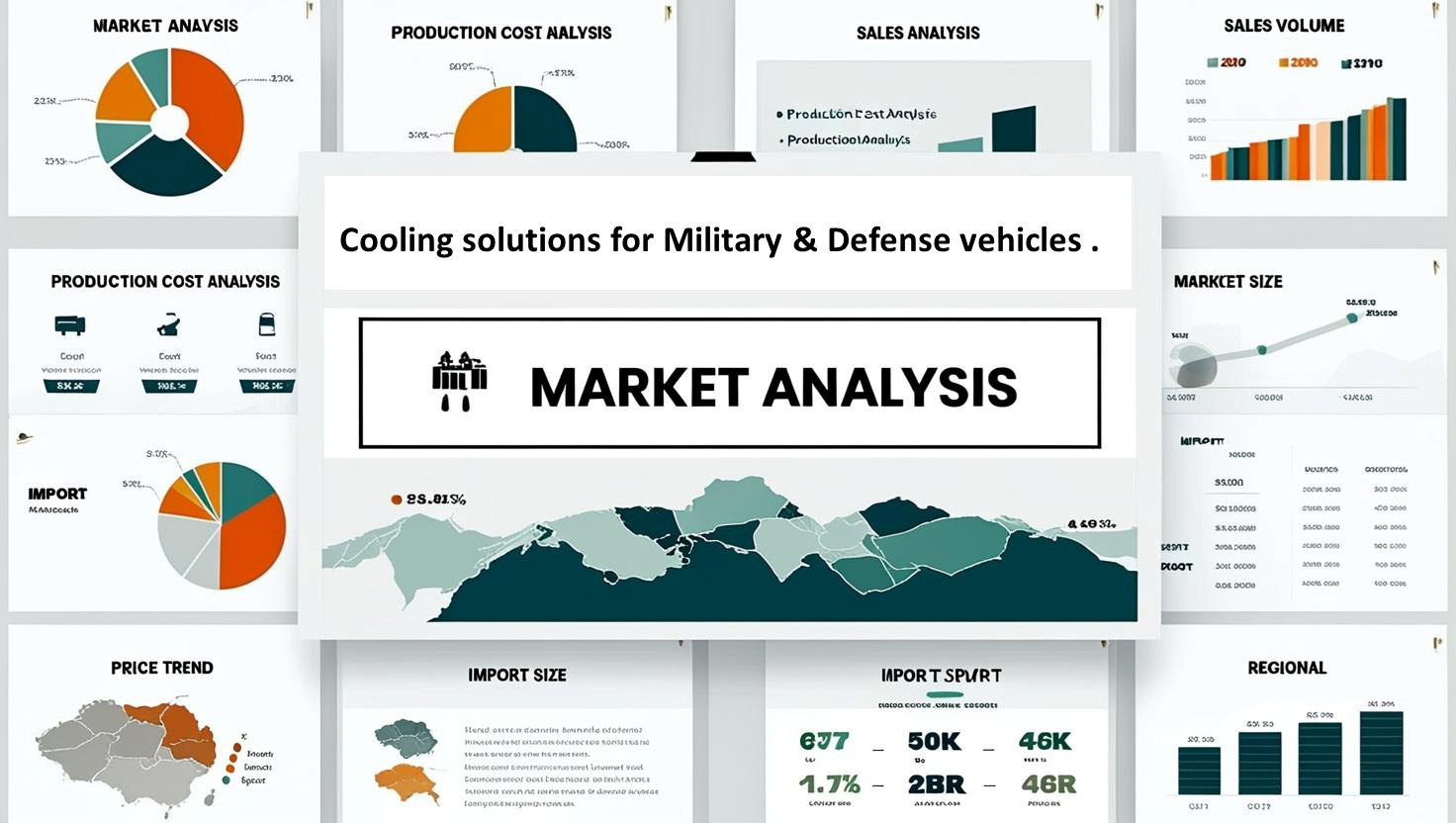
According to Staticker, the Cooling solutions for Military & Defense vehicles market in 2026 is positioned within a phase of sustained expansion driven by vehicle electrification, modernization of armored fleets, higher electronic content per platform, and increasing deployments in extreme-temperature environments. Staticker indicates that the market is expected to maintain a strong growth trajectory through the forecast period, supported by defense procurement programs, upgrades of legacy vehicle fleets, and rising investments in thermal management infrastructure for advanced battlefield electronics. Growth momentum is expected to remain strongest in regions emphasizing next-generation combat vehicles, hybrid propulsion systems, and network-centric warfare capabilities.
The Electronics Revolution Is Rewriting Thermal Requirements
Perhaps the strongest growth driver for Cooling solutions for Military & Defense vehicles is the proliferation of onboard electronics.
A modern command-and-control vehicle can host dozens of computing modules, communication systems, displays, and processing units operating simultaneously.
Each watt consumed eventually becomes heat.
A vehicle carrying 50 kW of electronic equipment effectively generates thermal loads comparable to those encountered in small industrial facilities.
This reality is forcing military vehicle designers to adopt liquid cooling systems, intelligent airflow architectures, advanced heat exchangers, and predictive thermal management software.
The result is a transformation of military mobility infrastructure where cooling performance increasingly determines operational readiness, mission endurance, and battlefield effectiveness.
Request for customization: https://staticker.com/reports/cooling-solutions-for-military-defense-vehicles-market/
Catégories
Lire la suite
Millions of expatriates living abroad constantly look for efficient ways to support their families back home. The financial connection between the United Kingdom and Pakistan is built on strong family ties and enduring economic relationships. Finding a reliable financial partner is essential to ensure that hard earned money reaches loved ones without unnecessary delays or exorbitant costs....

Expanding your business into Saudi Arabia requires more than just market readiness—it demands strict compliance with regulatory frameworks established by Saudi authorities. From product quality standards to safety certifications, every exporter must align with the Kingdom’s import regulations. This is where professional SASO certification services in Saudi Arabia become essential....

In modern manufacturing, the need for high-performance, safe, and environmentally responsible materials has never been greater. Among the advanced chemical compounds gaining widespread recognition is aluminum hypophosphite—a highly effective, halogen-free flame retardant. Neemcco, a trusted name in the chemical industry, delivers premium-grade aluminum hypophosphite that supports a wide...
If you want a smoother and faster experience while using Allpanelexch Login, a few simple performance optimization tips can make a noticeable difference. Slow loading pages, login delays, or browser-related issues can interrupt your experience, but most of these problems can be solved within minutes. Whether you're a new user or someone who accesses the platform regularly, optimizing your...

Introduction to Haka4D in Everyday Internet UsePeople use the internet every day to search for many kinds of information, and one keyword that often appears is haka4d. This term is commonly searched by users who are trying to understand simple online information systems. When someone types haka4d into a search engine, they usually want easy and clear details. The idea of haka4d is linked with...
