


Curved Treadmill vs Motorised Treadmill: Which is Better for Your Gym?
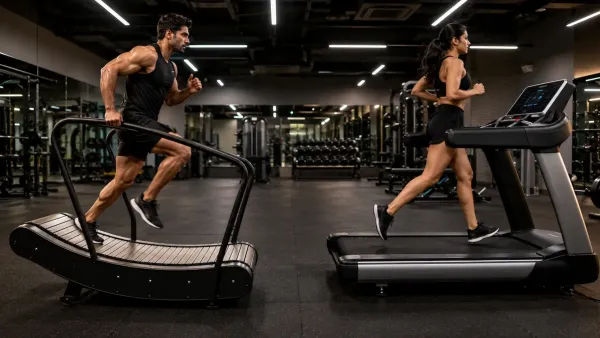
Walk into any serious gym in India today and you will notice something different sitting alongside the rows of traditional motorised treadmills. It has no power cable. No motor hum. No speed buttons. Just a curved, slatted running surface that moves entirely because you move it.
The curve treadmill is no longer a novelty — it is fast becoming a genuine conversation in gym setups across Maharashtra and beyond. But does it actually replace the motorised treadmill? Or do both have a place in a well-equipped gym?
We have been supplying commercial gym equipment across Maharashtra for over 15 years. This is the honest comparison you need before spending your budget.
What Is a Curved Treadmill?
A curved treadmill — sometimes called a curve treadmill or non-motorised treadmill — has a concave, arc-shaped running surface made of individual slats (typically aluminium). There is no electric motor, no belt speed setting, and no power plug required.
The runner drives the belt entirely with their own foot strike. Push harder and the belt moves faster. Ease off and it slows. The machine responds entirely to the athlete’s effort — which is fundamentally different from a motorised treadmill where a motor dictates the pace.
The curved treadmill used to be considered a specialist or luxury item in India. Curved treadmill prices were high because almost all options were imported. That has changed significantly — and gyms that understand its value are moving quickly to add one.
What Is a Motorised Treadmill?
A motorised treadmill uses a DC or AC electric motor to drive the belt at a set speed. The user matches the belt speed rather than controlling it. Most commercial motorised treadmills in India today use AC motors for durability — the commercial treadmill range from Maharashtra Fitness runs on a 4HP to 8HP AC motor built for 8–10 hours of daily commercial use.
Motorised treadmills offer programmable speed and incline, heart rate monitoring, pre-set workout programmes, and entertainment compatibility. They are the backbone of virtually every gym in India and have been for decades.
Curved Treadmill vs Motorised Treadmill — Head-to-Head
1. Calorie Burn & Workout Intensity
This is where the curved treadmill makes its strongest argument.
Running on a curved treadmill forces a natural mid-foot strike and engages your posterior chain — hamstrings, glutes, calves — far more than a motorised belt does. Studies consistently show runners burn 30–40% more calories on a curved treadmill at the same perceived effort compared to a motorised machine.
The reason is simple: there is no motor helping the belt along. Every single rotation of that belt is powered by you. Your cardiovascular system works harder. Your muscles recruit more. Your calorie expenditure rises without you having to think about it.
Winner: Curved treadmill — significantly higher intensity for the same duration.
2. Running Biomechanics & Joint Impact
The curved shape of the running surface encourages a natural gait cycle that flat motorised belts actually work against. On a motorised treadmill, the belt pulls your foot backward, which subtly encourages heel striking — a pattern associated with higher impact on knees and ankles over time.
On a curve treadmill, you naturally land mid-foot because the surface curves away from you. This is the same landing pattern coaches teach sprinters and distance runners for optimal biomechanics. For gym members with knee issues or those returning from injury, this is a meaningful advantage.
Winner: Curved treadmill — better biomechanics, lower joint stress.
3. Speed Control & Workout Variety
Here the motorised treadmill takes the lead for most gym members.
The ability to set a precise speed — 8.5 km/h for a steady jog, 14 km/h for tempo work — makes programme design far simpler for trainers. Motorised treadmills also offer automatic incline adjustment, heart rate zone training, pre-set interval programmes, and in premium models, entertainment screens.
For a general gym population that includes beginners, seniors, rehabilitation patients, and casual walkers, motorised treadmills offer a more controlled, accessible experience. A first-time runner on a curved treadmill can find the self-powered mechanism unfamiliar and somewhat demanding.
Winner: Motorised treadmill — better for beginners, programmable training, and varied member base.
4. Electricity & Running Costs
The curved treadmill uses zero electricity. No motor means no power draw, no electricity bill contribution, and no motor to service or replace.
A commercial motorised treadmill with a 4–8HP AC motor running 8–10 hours per day adds meaningful electricity consumption to your gym’s monthly costs. Multiply that across 6–10 treadmills in a large facility and the numbers become significant.
Over a 5-year period, the electricity savings on a curved treadmill can partially offset its higher purchase price.
Winner: Curved treadmill — zero running cost after purchase.
5. Curved Treadmill Price vs Motorised Treadmill Price
This is the most common question we get: what is the curved treadmill price in India compared to a commercial motorised treadmill?
| Type | Price Range (India 2026) |
|---|---|
| Home motorised treadmill | ₹17,500 – ₹45,000 |
| Semi-commercial motorised | ₹45,000 – ₹90,000 |
| Commercial AC motor treadmill | ₹90,000 – ₹1,80,000 |
| Curved treadmill (imported brands) | ₹1,50,000 – ₹3,50,000 |
| Curved treadmill (Maharashtra Fitness CC-100) | Contact for best price |
The curved treadmill price is higher upfront. However, factor in zero electricity costs, no motor servicing, and the premium positioning it gives your gym — for serious training facilities, the long-term value calculation often favours the curved option.
For the best curved treadmill price in India with direct manufacturer support, contact our team.
Winner: Motorised on upfront price. Curved on 5-year total cost of ownership.
6. Maintenance
Motorised treadmills require regular maintenance — belt lubrication every 3–6 months, motor servicing, electronic component checks, and eventually motor replacement after heavy use.
Curved treadmills have far fewer components to maintain. No motor, no electronics, no lubrication schedule. The aluminium slatted belt is highly durable. The primary maintenance is periodic inspection of the slats and frame — that is largely it.
For busy commercial gyms where maintenance downtime is expensive, the curved treadmill’s simplicity is a genuine operational advantage.
Winner: Curved treadmill — significantly lower maintenance burden.
7. Space & Aesthetics
Both machines occupy roughly similar floor space. However, the curved treadmill has a distinctive, premium visual presence that signals serious training intent. Many boutique gyms, CrossFit boxes, and high-end fitness studios choose curved treadmills specifically for the statement they make about the facility’s quality.
If your gym positioning is premium, performance, or athletic — the curved treadmill reinforces that at a glance.
Winner: Curved treadmill — premium aesthetics and positioning.
Which One Should You Choose?
The honest answer is: both, ideally.
The optimal commercial gym setup in 2026 combines motorised treadmills for your general member base with one or two curved treadmills for high-intensity training, personal training sessions, and the members who want maximum performance.
| Gym Type | Recommended |
|---|---|
| Large commercial gym | 6–8 motorised + 1–2 curved |
| Boutique / CrossFit box | 4–6 curved treadmills |
| Hotel fitness centre | 3–4 motorised (accessible for all guests) |
| Personal training studio | 1 curved + 1 motorised |
| Home gym (serious athlete) | 1 curved treadmill |
| Home gym (general fitness) | 1 motorised treadmill |
The Maharashtra Fitness Recommendation
If budget allows only one choice for a new commercial gym, start with a high-quality commercial motorised treadmill — it serves the widest range of members. Add a curve treadmill as your second purchase once the gym is operational — it will immediately become the most-talked-about piece of equipment in the facility.
For home gym users who are serious about performance and want the best long-term investment — the curved treadmill wins clearly. Zero electricity, superior workout quality, and built to last.
Frequently Asked Questions
Q: Is a curved treadmill better than a motorised treadmill for weight loss? A: For calorie burn and fat loss, yes — a curved treadmill burns 30–40% more calories at the same speed. For beginners or those who need structured pace control, a motorised treadmill may be more practical initially.
Q: What is the curved treadmill price in India? A: Curved treadmill prices in India range from ₹1,20,000 to ₹3,50,000 for most commercial options. Maharashtra Fitness offers the CC-100 at a competitive price — contact us for the latest quote.
Q: Can beginners use a curved treadmill? A: Yes, but there is a short adjustment period. Most users feel comfortable within 2–3 sessions. Starting at a walking pace is recommended.
Q: Do curved treadmills need electricity? A: No — this is one of their biggest advantages. Curved treadmills are completely self-powered with zero electricity consumption.
Q: Which treadmill is best for a commercial gym in India? A: An AC motor commercial treadmill for the general floor, with one or two curved treadmills for performance training. Browse our full commercial treadmill range for pricing and specifications.
Q: How long do curved treadmills last compared to motorised? A: Curved treadmills typically outlast motorised treadmills significantly — with fewer mechanical components, there is simply less to fail. A well-maintained curved treadmill can last 10–15 years in commercial use.
Visit Us - https://maharashtrasport.in/curved-treadmill-vs-motorised/
Categorias
Leia mais
Golfers looking for custom golf shafts, premium golf club shafts, and high-performing affordable golf shafts understand that shaft performance can directly impact launch, distance, and consistency. The Jupiter Lite 9 Wood Shaft is designed for players who want more speed, higher launch, and tighter dispersion from their fairway setup without sacrificing feel. Developed by Steadfast Golf in...

When it comes to your home’s safety and comfort, hiring professional residential electricians in Kearney, MO is essential. Electrical systems are the backbone of every property, powering lights, appliances, and essential devices. Whether you are dealing with faulty wiring, upgrading your electrical panel, or installing new lighting, experienced electricians ensure every job is completed...

AI in Data Center Networking: Transforming the Future of Connectivity Artificial Intelligence (AI) is revolutionizing data center networking by enabling smarter, faster, and more efficient network operations. As data traffic continues to surge due to cloud computing, big data analytics, and digital services, traditional networking approaches are no longer sufficient. AI-driven technologies...

A new growth forecast report titled Software Defined Vehicle Market Size, Share, Trends, Industry Analysis Report By Deployment Mode [On-Board (Edge), Cloud-Based], By Type, By Application, By Vehicle Type By Region – Market Forecast, 2025–2034 introduced by Polaris Market Research represents conclusive data on the overall market. It majorly targets to provide a detailed...

Pokémon TCG Challenge Trainiere dein Deck und fordere die Wellen heraus, wenn das Flegmon-Event in Pokémon TCG Pocket die Bühne betritt. Ab dem 9. April erwartet dich eine besondere Herausforderung, bei der du gegen mächtige Wasser-Typ Decks antrittst. Die Gegner werden mit jeder neuen Runde stärker, doch die Belohnungen sind die Mühe wert. Sammle einzigartige...