What Is the Difference Between Fighter Pilots and Other Pilots?
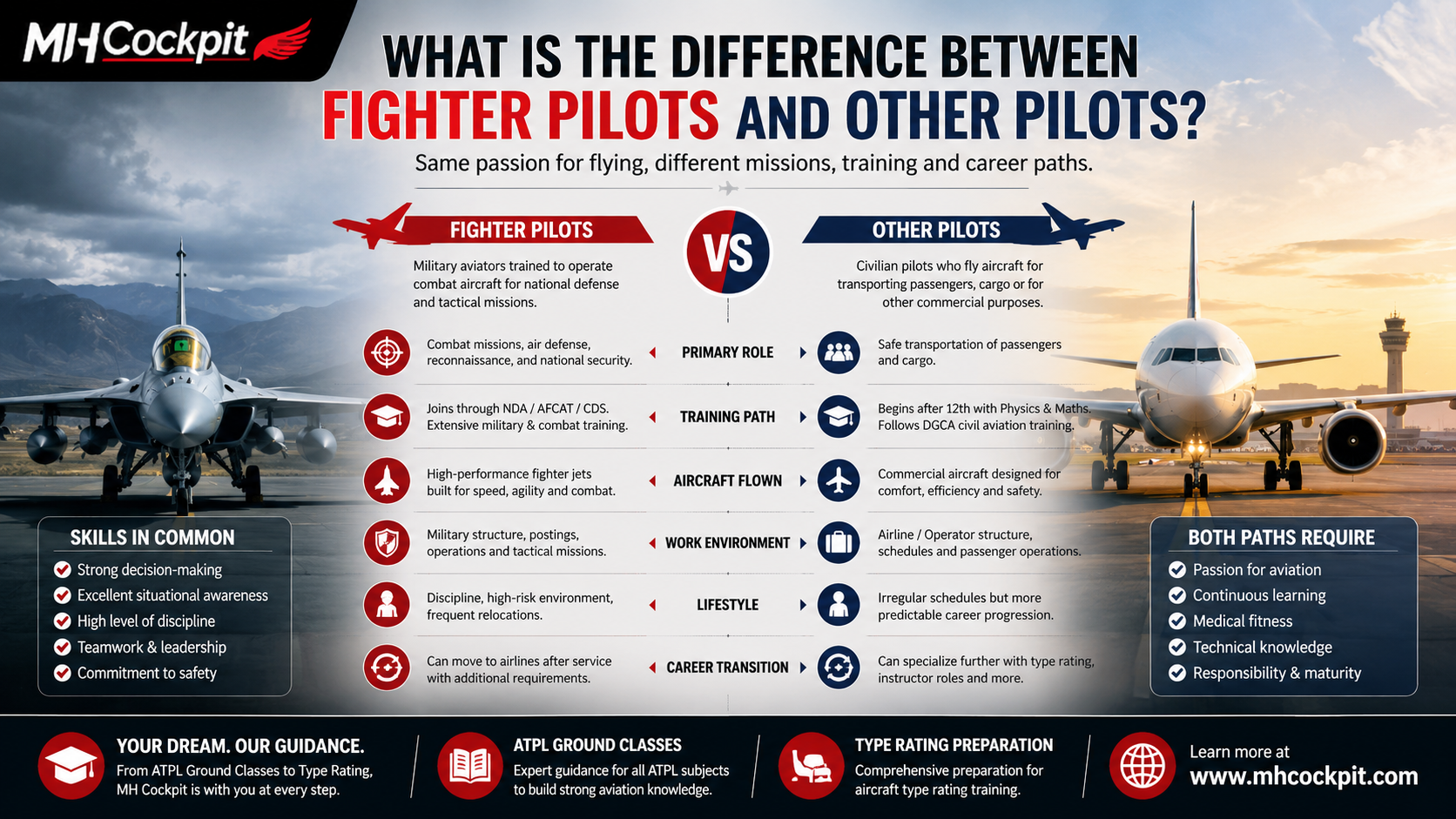
When most people think of pilots, they usually imagine either a fighter pilot flying a high-speed military jet or an airline pilot commanding a large passenger aircraft. While both careers involve flying aircraft, the similarities largely end there. Fighter pilots and commercial pilots have different missions, training systems, lifestyles, and career paths.
If you're considering a future in aviation, understanding these differences can help you make a more informed career decision.
Understanding the Role of a Fighter Pilot
A fighter pilot is a military aviator trained to operate combat aircraft for national defense and military operations. In India, fighter pilots serve in the Indian Air Force and undergo extensive military and flight training before being assigned to fighter aircraft.
Their responsibilities can include:
- Air defense missions
- Combat operations
- Reconnaissance and surveillance
- Tactical military exercises
- Border security operations
- Emergency response missions
Fighter pilots often operate in high-pressure environments where quick decision-making and precision are critical. Their primary objective is not transportation but the successful completion of military missions while protecting national interests.
Understanding the Role of Commercial and Civilian Pilots
Commercial pilots, on the other hand, work in civilian aviation. Their main responsibility is the safe transportation of passengers and cargo while following civil aviation regulations and airline operating procedures.
Commercial aviation includes several career options such as:
- Airline Pilot
- Cargo Pilot
- Charter Pilot
- Corporate Jet Pilot
- Helicopter Pilot
- Flight Instructor
Unlike fighter pilots, commercial pilots focus on passenger safety, operational efficiency, customer service, and regulatory compliance.
Although the nature of the work differs, both professions require discipline, technical knowledge, and a commitment to safety.
Training Pathways
One of the biggest differences between fighter pilots and commercial pilots is the way they enter the profession.
Fighter Pilot Training
Aspiring fighter pilots generally join the military through pathways such as:
- National Defence Academy (NDA)
- Air Force Common Admission Test (AFCAT)
- Combined Defence Services (CDS)
After selection, candidates undergo military officer training followed by flight training. Only a limited number of trainees eventually qualify to fly fighter aircraft.
Training focuses heavily on:
- Military procedures
- Combat flying
- Tactical operations
- Formation flying
- Weapons systems
- Emergency and survival training
The process is highly competitive and physically demanding.
Commercial Pilot Training
Commercial pilots follow a civilian route.
The typical pathway is:
- Class 12 with Physics and Mathematics
- DGCA Medical Examination
- Student Pilot Licence (SPL)
- Private Pilot Licence (PPL)
- Commercial Pilot Licence (CPL)
After obtaining a CPL, aspiring airline pilots often continue with:
- Airline preparation programs
- ATPL Ground Classes
- Simulator assessments
- Airline interviews
- Type Rating training
This route is specifically designed for airline and commercial aviation careers.
Aircraft and Technology
The aircraft flown by fighter pilots and commercial pilots are built for entirely different purposes.
Fighter aircraft are designed for:
- Speed
- Agility
- Tactical maneuvering
- Combat effectiveness
Examples include aircraft such as the Rafale, Sukhoi Su-30MKI, and Tejas.
Commercial aircraft are designed for:
- Passenger comfort
- Fuel efficiency
- Long-distance travel
- Operational reliability
Examples include the Airbus A320, Boeing 737, and Boeing 787.
A fighter aircraft may carry weapons and advanced combat systems, while an airliner is optimized for transporting hundreds of passengers safely and efficiently.
Lifestyle and Work Environment
The lifestyle of a fighter pilot is very different from that of an airline pilot.
Fighter pilots operate within a military structure. Their careers involve:
- Frequent postings
- Military discipline
- Operational readiness
- Training exercises
- National defense responsibilities
Their work environment is highly structured and mission-oriented.
Commercial pilots generally work according to airline schedules. Their responsibilities include:
- Flight planning
- Weather analysis
- Crew coordination
- Passenger operations
- International and domestic flights
Although airline schedules can be demanding, commercial pilots typically have a more predictable career progression compared to military aviators.
Can Fighter Pilots Become Commercial Pilots?
Yes, many fighter pilots successfully transition into airline careers after completing their military service.
In fact, former military pilots are often highly regarded by airlines because of their extensive flying experience, professionalism, and decision-making abilities.
However, military flying experience alone does not automatically qualify someone to become an airline pilot.
Former fighter pilots may still need to complete:
- Civil aviation licence conversion requirements
- DGCA regulatory procedures
- ATPL examinations
- Airline assessments
- Simulator evaluations
- Type Rating training
The transition is usually smoother because of their flying background, but commercial aviation has its own standards and regulations.
Why ATPL and Type Rating Are Important
Many aspiring pilots believe obtaining a CPL is the final step. In reality, airline careers often require additional qualifications.
ATPL (Airline Transport Pilot Licence) ground subjects help pilots develop advanced knowledge in areas such as:
- Air Navigation
- Air Regulations
- Meteorology
- Flight Planning
- Technical General
A Type Rating is another important milestone. It is a specialized certification that allows a pilot to operate a specific aircraft type, such as the Airbus A320 or Boeing 737.
Even highly experienced pilots cannot fly a particular commercial aircraft unless they are type-rated on that aircraft.
For students preparing for airline careers, proper preparation in ATPL subjects and aircraft-specific knowledge can be extremely valuable. MH Cockpit provides coaching for ATPL Ground Classes and Type Rating preparation, helping aspiring pilots strengthen their knowledge before entering airline training programs.
Apart from pilot training support, students interested in building a strong academic foundation can also explore UGC-recognized aviation degree programs through MH Cockpit's aviation college network. Programs such as BBA Aviation and B.Sc Aviation allow students to pursue higher education while remaining connected to the aviation industry.
Which Career Is Right for You?
The answer depends on your interests and long-term goals.
A fighter pilot career may be suitable if you:
- Want to serve your country
- Enjoy military life
- Thrive under pressure
- Are interested in combat aviation
A commercial pilot career may be a better fit if you:
- Want to work in civilian aviation
- Enjoy passenger operations
- Prefer airline-based flying
- Are focused on long-term airline growth
Both professions demand dedication, continuous learning, and a passion for aviation.
Conclusion
Fighter pilots and commercial pilots may share the same cockpit environment, but their careers are fundamentally different. Fighter pilots focus on military missions and national defense, while commercial pilots focus on transporting passengers and cargo safely around the world.
Understanding these differences is important for students exploring aviation as a career. Whether you dream of flying a fighter jet or commanding a commercial airliner, success ultimately comes from choosing the path that best aligns with your skills, interests, and professional aspirations.
Categorias
Leia Mais
A hydraulic pump supplier is a critical component in fluid power systems, converting mechanical energy into hydraulic energy to transmit force through pressurized fluid. These pumps are widely used across numerous industries due to their ability to provide precise control, high efficiency, and powerful performance. The versatility of hydraulic pumps allows them to serve in applications...

Introduction Statutory audits are an essential part of business compliance and financial transparency. They ensure that financial statements are accurate and legally valid. KKCA Chartered Accountant firm provides professional audit services to companies, startups, and SMEs, helping them maintain trust, meet legal requirements, and improve overall financial management and business credibility....

Knowing yourself will enable you to live a more peaceful and healthier life. A lot of people struggle with relationships, but don't know what is causing it. They may be feeling too demanding or distant, or even confused about their feelings. A powerful method to comprehend these patterns is to find out about your personal attachment style. When you identify your own...

Running gambling ppc campaigns in today’s advertising ecosystem is very different from what it was even three years ago. Costs are higher. Compliance checks are stricter. And platform tolerance for ambiguity is almost zero. What used to be a relatively aggressive scaling channel has evolved into a disciplined, infrastructure-driven performance strategy. Advertisers entering this vertical...

ProstaVive is a natural supplement designed to support prostate health and overall well-being in men. It offers a simple and effective way to maintain a healthy prostate without relying on complicated treatments or harsh medications. Created for daily use, ProstaVive fits easily into everyday routines, making it a practical choice for long-term support. One of the key benefits of ProstaVive is...