


Why Twin Rod Cylinders Are Becoming the Backbone of Precision Automation
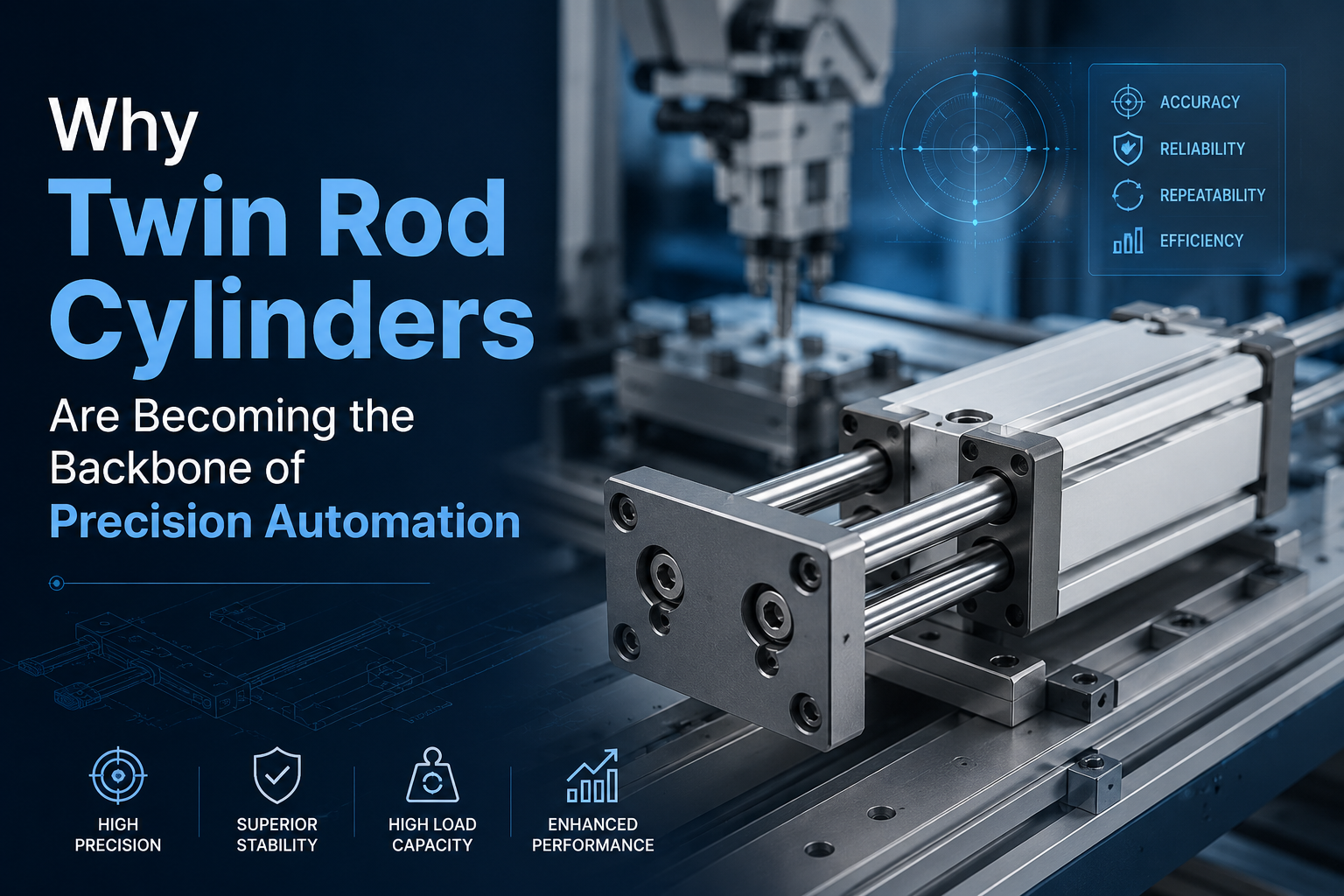
A packaging line misses alignment by just 2 mm, and suddenly hundreds of units require rework before shipment. That's the kind of problem manufacturers are under pressure to eliminate. Across assembly lines, material handling systems, and automated production cells, Pneumatic Twin Rod Cylinders are becoming a preferred solution because standard actuators often struggle to maintain stability under side loads and repetitive motion.
Most buyers focus heavily on speed and force ratings. The real challenge is maintaining accuracy after thousands of cycles. Industry studies show that unplanned downtime can cost manufacturers between $5,000 and $50,000 per hour depending on the operation. In that environment, component selection becomes a profit decision, not just a technical one.
Which means the growing demand for precision automation is pushing procurement teams toward actuator designs that offer greater stability, better load handling, and longer service life. That is exactly where twin rod cylinders are changing the conversation.
Specification
Understanding How Twin Rod Cylinders Differ
Unlike conventional single-rod cylinders, twin rod designs use two parallel piston rods connected to a common carriage. This structure minimizes rotational movement and increases stability during operation.
The result is more accurate linear motion, especially in applications where loads extend away from the cylinder centerline.
Common Technical Specifications Buyers Review
Typical specifications include:
-
Bore sizes ranging from 10 mm to 100 mm
-
Stroke lengths from 25 mm to 500 mm
-
Operating pressure between 1 and 10 bar
-
Double-acting pneumatic operation
-
Magnetic piston options for sensor integration
-
Aluminum alloy body construction
-
Adjustable cushioning systems
Many Pneumatic Twin Rod Cylinders Manufacturers also provide customized stroke lengths and mounting configurations for OEM applications.
The Specification Detail Most Buyers Skip
Nobody tells you that guide rod tolerance matters almost as much as bore size.
A surprising number of procurement teams compare cylinders based only on force output. Then they wonder why accuracy drops after six months. Rod parallelism, bearing quality, and guide mechanism design directly influence repeatability. Ignoring those factors often creates maintenance costs that never appear on the original quotation.
Integration With Automation Systems
Modern automation lines frequently pair twin rod cylinders with sensors, PLC systems, and Solenoid Valves to achieve synchronized motion control.
That's particularly important in pick-and-place systems, labeling machines, electronics assembly lines, and packaging equipment where positioning consistency affects product quality.
Objective: Five Supplier Evaluation Criteria That Actually Matter
1. Ask About Repeatability Data
A reliable supplier should provide actual repeatability figures and testing information.
A bad answer sounds like: "Our products work well in most conditions."
That isn't a specification. It's marketing.
2. Verify Material Traceability
Good manufacturers maintain traceability for critical components.
A bad answer sounds like: "We source from multiple vendors depending on availability."
That approach often creates performance variation between production batches.
3. Check Export Experience
Manufacturers exporting to multiple countries usually maintain stricter documentation and quality processes.
A bad answer sounds like: "We'll arrange paperwork later."
Late documentation delays shipments and customs clearance.
4. Review Quality Certifications Carefully
ISO certification matters. Understanding its scope matters more.
Some buyers glance at a certificate without checking whether it covers manufacturing operations or merely administrative functions.
5. Evaluate Technical Support Response Time
Response speed often predicts future service quality.
A bad answer sounds like: "We'll review your issue after receiving the shipment back."
By then, production losses have already happened.
Benefits
Improved Load Stability
Twin rod construction reduces rotational movement during operation. For manufacturers handling delicate components, that translates directly into fewer alignment-related defects.
Better Protection Against Product Rejection
Even small positioning errors can create expensive quality failures.
Accurate motion control helps maintain consistency across production batches, protecting margins and customer relationships.
Longer Service Life Under Side Loads
Single-rod cylinders can experience accelerated wear when exposed to side loading conditions. Twin rod designs distribute forces more effectively, reducing component stress over time.
Reduced Maintenance Costs
According to industrial maintenance studies, motion-control-related failures account for a significant share of production interruptions.
Stable actuator systems help reduce emergency maintenance events and replacement frequency.
Easier Automation Integration
Most modern systems combine Solenoid Valves with pneumatic actuators for controlled operation.
That compatibility simplifies integration into existing production environments.
Greater Process Consistency
Consistency is difficult to measure until it disappears.
Manufacturers operating multi-shift production schedules often discover that stable motion control contributes more to long-term output quality than simply increasing machine speed.
Availability Across India and Global Markets
India's automation sector continues expanding across automotive, pharmaceuticals, food processing, electronics, and packaging industries. Industry reports estimate India's industrial automation market is growing at more than 10% annually.
As demand increases, businesses are actively searching for reliable Pneumatic Twin Rod Cylinders Suppliers in India capable of supporting both OEM and replacement requirements.
And yet, geography still matters.
Suppliers located near major manufacturing corridors such as Gujarat, Maharashtra, Tamil Nadu, Karnataka, and NCR often provide faster dispatch times and lower logistics costs. Procurement teams frequently underestimate how much delivery lead time impacts production planning.
Alongside twin rod systems, buyers commonly source Solenoid Valves, Pneumatic Round Body Cylinders, and related automation components from integrated suppliers to simplify procurement.
Many organizations also evaluate Pneumatic Round Body Cylinders Manufacturers in India and Pneumatic Round Body Cylinders Suppliers when developing broader automation projects that require multiple actuator configurations.
About Us
At V.S Enterprises, we've spent years working with manufacturers that cannot afford inconsistent pneumatic performance. Our focus is not simply supplying components. We help buyers select products that match the realities of production environments.
We export to 31 countries and support customers across multiple industrial sectors where reliability is tied directly to output targets.
Here's something only experience teaches you: we changed a guide-bearing specification on one product range after repeated feedback from export customers running high-cycle packaging lines. The previous version met specification requirements, but long-term wear patterns suggested room for improvement. We made the change. That's what real-world performance data looks like.
Our product portfolio includes Solenoid Valves, Pneumatic Round Body Cylinders, and Pneumatic Twin Rod Cylinders designed for demanding industrial applications.
Request the Information Buyers Usually Need First
If you're comparing suppliers, send us the following:
-
Required bore size
-
Stroke length
-
Operating pressure
-
Application details
-
Expected monthly volume
-
Destination country or delivery location
We typically respond to technical inquiries within one business day.
For OEM projects, MOQ requirements vary depending on specifications and customization needs. Share your drawing, part number, or performance requirements, and we'll provide a detailed recommendation along with availability and lead-time information.
Conclusion
Precision automation depends on repeatable motion, not just movement. That reality is why Pneumatic Twin Rod Cylinders are becoming a critical component in modern manufacturing systems. Buyers who evaluate stability, guide quality, and supplier capability together usually avoid the expensive surprises that emerge later. As automation standards continue rising, demand for higher-accuracy pneumatic solutions will only accelerate.
FAQs
1. Why are Pneumatic Twin Rod Cylinders preferred over standard cylinders?
They provide greater stability and resistance to rotational movement. In applications involving side loads or precision positioning, that extra support often improves long-term accuracy and component life.
2. How do Pneumatic Twin Rod Cylinders Manufacturers ensure quality?
The stronger manufacturers perform repeatability testing, pressure testing, dimensional inspection, and maintain documented quality systems. Not every supplier follows the same standards, so verification matters.
3. Are Pneumatic Twin Rod Cylinders Suppliers in India capable of serving export markets?
Many are. The better suppliers support international documentation, export packaging, and compliance requirements. Some, including established exporters, ship regularly to dozens of countries.
4. Where are Pneumatic Round Body Cylinders commonly used?
Pneumatic Round Body Cylinders are widely used in packaging equipment, light assembly systems, material handling applications, and compact automation setups where space is limited.
5. How do I evaluate Pneumatic Round Body Cylinders Manufacturers in India?
Review certifications, production capabilities, export experience, and technical support processes. A low price means very little if consistency varies between batches.
6. What role do Solenoid Valves play in pneumatic automation?
Solenoid Valves control airflow direction and timing within pneumatic systems. Without proper valve selection, even a high-quality actuator may fail to deliver expected performance.
7. Can one supplier provide Solenoid Valves and multiple cylinder types?
Yes. Many buyers prefer sourcing Solenoid Valves suppliers in India, Pneumatic Round Body Cylinders Suppliers, and twin rod cylinder products from a single vendor because it reduces procurement complexity. The caveat is that buyers should still verify expertise across every product category rather than assuming broad capability automatically.
Nach Verein filtern
Read More
USA vs Australia Tickets: Mauricio Pochettino has sent a clear message to the U.S. Men’s National Team. He wants the World Cup mindset to begin now. Even though the tournament officially starts in June, Pochettino believes preparation must begin in March. The pressure is high because the United States will host the World Cup. Fans expect strong performances. We are offering FIFA World...

Managing financial records is essential for business success, and Bookkeeping Services In Kent, WA help companies maintain accurate and organized financial data. Proper bookkeeping ensures all transactions are recorded and categorized correctly. This helps businesses track income, expenses, and overall performance. Reliable bookkeeping supports better decision-making and ensures compliance with...

The beauty and wellness market has expanded rapidly as consumers place more importance on self-care, relaxation, and skincare routines. Businesses such as spas, online retailers, boutiques, and wellness brands constantly search for reliable suppliers that can provide quality products in large quantities. Access to bath and body products in bulk allows businesses to maintain steady...

Hybrid Powertrain Market According to the latest report published by Data Bridge Market Research, the Hybrid Powertrain Market The global hybrid powertrain market size was valued at USD 126.04 billion in 2024 and is expected to reach USD 364.62 billion by 2032, at a CAGR of 14.2% during the forecast period The supreme Hybrid Powertrain Market research...

"Future of Executive Summary Nanocapsules Market: Size and Share Dynamics The global nanocapsules market size was valued at USD 4.65 billion in 2025 and is expected to reach USD 9.09 billion by 2033, at a CAGR of 8.75% during the forecast period The Nanocapsules business document lists and studies the leading competitors and also provides the insights with...
