


The Complete Guide to Booking Connecting Flights: Layovers, Stopovers, and How to Make Them Work for You
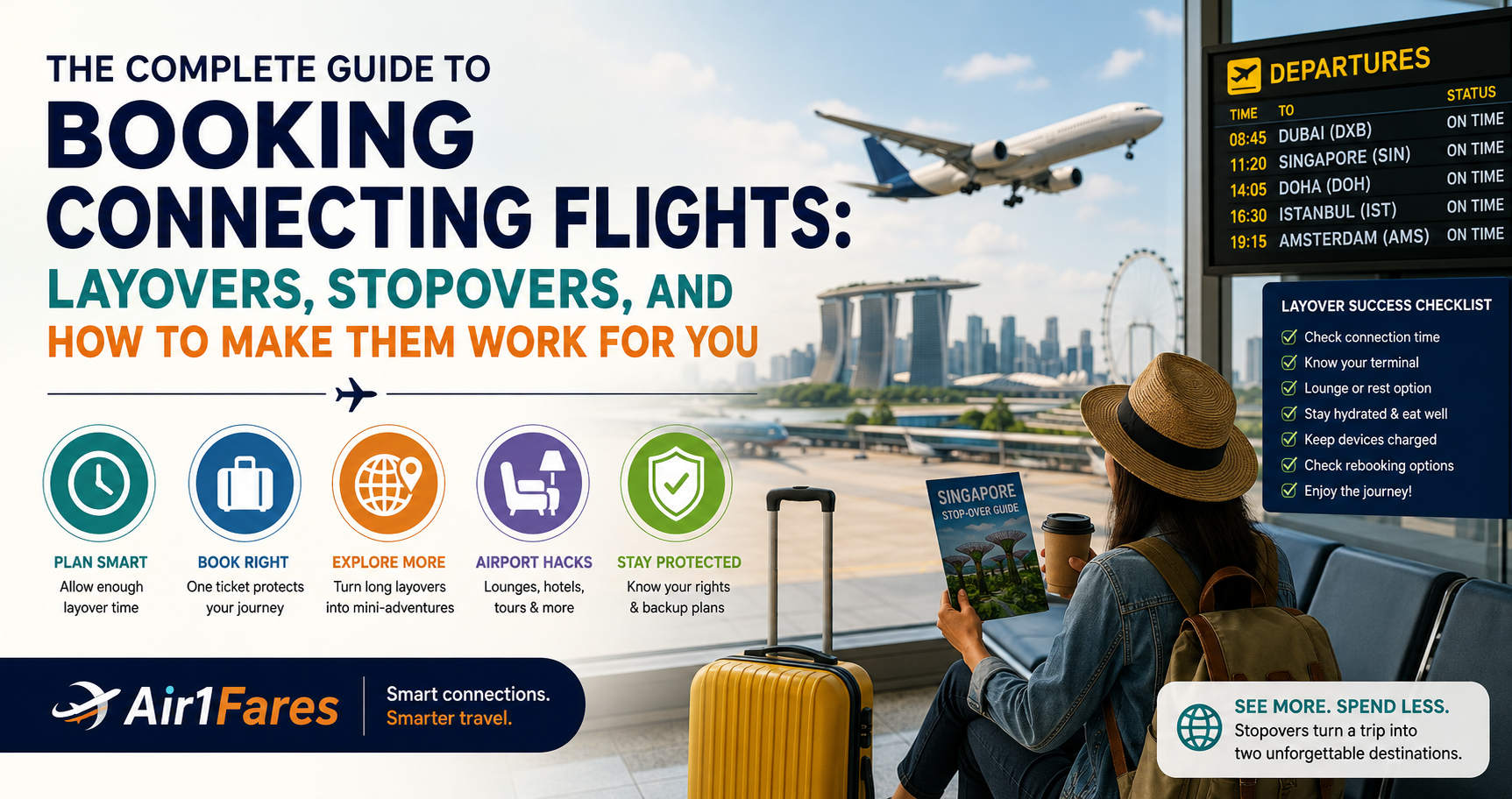
Introduction
The word "layover" makes many travelers cringe. Images of sterile airport corridors, uncomfortable gate chairs, and the hollow discomfort of killing four hours between flights come to mind. But layovers don't have to be ordeals — and for seasoned travelers who know how to work the system, they can become genuine mini-adventures, strategic cost-saving tools, or at worst, manageable pauses in a journey. This guide covers everything you need to know about connecting flights: how to book them smartly on Air1Fares, how to protect yourself when things go wrong, and how to turn a long layover into an unexpected highlight of your trip.
Why Connecting Flights Exist — and Why They're Often Cheaper
Airlines operate through hub-and-spoke networks: a relatively small number of major hub airports connect to a vast web of smaller destinations. A direct flight from Indianapolis to Tokyo doesn't exist because demand doesn't justify it — but you can fly Indianapolis to Chicago (O'Hare) and then Chicago to Tokyo, using the hub as a connecting point. This hub model also creates pricing dynamics that benefit budget travelers: connecting flights are almost always cheaper than direct flights on the same route, sometimes dramatically so. The tradeoff is time and complexity.
Understanding Layover vs. Stopover
These terms are often used interchangeably but technically refer to different durations. A layover is a connection of less than 24 hours — a standard connecting flight. A stopover is an intentional break in a journey of 24 hours or more, effectively a free night (or several nights) in a connecting city. Several airlines have recognized that stopovers can be marketed as a travel feature, not a bug: Singapore Airlines has long promoted Singapore stopovers as a way to experience Asia's most dynamic city-state en route to Australia or Europe. Qatar Airways promotes Doha; Emirates promotes Dubai. These programs often include complimentary hotel nights, tours, and city experiences.
How Much Layover Time Do You Actually Need?
This is one of the most consequential questions in travel planning, and the answer depends on several variables. The absolute minimum connection time varies by airport: at a large, busy hub like Atlanta Hartsfield or Chicago O'Hare, 60–75 minutes is technically the minimum but genuinely risky — any delay, a long walk between terminals, or a full security re-screening can make this unachievable. In general: allow at least 90 minutes for domestic-to-domestic connections, 2 hours for international connections at large hubs, and 2.5–3 hours if you're connecting between different airlines or crossing terminals requiring a shuttle or train.
For flights booked on a single ticket (a single booking that includes both legs), the airline assumes responsibility for getting you on your connection if the first flight is delayed. For separately booked flights — "self-connection" — you bear all the risk yourself. Never book a tight self-connection.
When to Embrace a Longer Layover
If a connecting flight already saves you $200–$300 compared to a direct flight, a slightly longer layover doesn't change the math negatively — and if the layover is in an interesting airport city, it becomes an opportunity. Dubai (DXB), Singapore (SIN), Tokyo Narita (NRT), Amsterdam (AMS), and Istanbul (IST) are among the world's best airports for long layovers because their connecting cities are genuinely worth visiting. Many airports offer free transit tours specifically designed for passengers with long layovers — Dubai and Singapore being the most famous examples. Check with your connecting airport before dismissing a long layover as dead time.
Airport Hacks for Long Layovers
Make the most of every layover regardless of its length. If you have 3+ hours, access an airport lounge (via credit card perk, day pass, or elite status) for free food, Wi-Fi, comfortable seating, and often a shower. Many international airports have airside hotels — hotels accessible without clearing immigration — specifically designed for transit passengers who want rest without the formality of entering the country. Narita, Changi, Doha, and Dubai all offer airside hotel options. For shorter layovers, locate your departure gate immediately upon arrival, then decompress: walk, stretch, hydrate, and eat something real before the next leg.
Protect Yourself With the Right Booking Structure
When booking connecting flights on Air1Fares, look for options on a single ticket whenever possible. Bundled connections protect you: if the first flight is late and you miss your connection, the airline is obligated to rebook you on the next available flight at no additional charge. Self-connections — separately booked flights — carry all the risk yourself, and airline staff at the second airline's check-in desk have no obligation to help. If self-connections are unavoidable (perhaps because the cheapest routing requires them), allow extremely generous connection times — 3+ hours — and purchase travel insurance that covers missed connections.
Managing Checked Baggage Through Connections
On a single-ticket connection, your checked baggage is typically checked through to your final destination — you don't need to collect and recheck it at the connecting airport (except when clearing US Customs on international arrivals into the US, where everyone must collect and recheck their bags after clearing immigration). On self-connections, you will always need to collect your bag, exit the secure area, recheck with the second airline, and clear security again — a process that can easily take 60–90 minutes and dictates very generous connection times.
Missed Connections: What To Do
Despite best planning, missed connections happen. The moment you realize you'll miss your connection, act: call the airline's customer service line immediately (often faster than the gate agent queue), open the airline's app for self-service rebooking options, and if you're on a single ticket, communicate directly with gate staff who can hold the connecting flight if it's close. Airlines will accommodate missed connections on single-ticket bookings; document everything and request meal or accommodation vouchers if you're stranded for more than a few hours.
The Art of the Stopover Trip
If your budget allows for only one international long-haul flight per year, the stopover trick effectively doubles the number of destinations you visit. Flying from New York to Bali? Route through Tokyo and spend three days there. Flying London to Cape Town? Stop in Dubai or Nairobi. Airlines like Singapore, Emirates, Qatar, Etihad, and Turkish Airlines — all of which operate major global hubs — are your natural partners for ambitious stopover routing. Platforms like Air1Fares allow multi-city itinerary searches that make finding and pricing these creative routings straightforward.
Conclusion
Connecting flights and layovers are not obstacles to great travel — they're features, when approached correctly. The right layover duration, the right booking structure, and the right mindset turn connections from ordeals into opportunities. Start building your next creative itinerary, including any stopovers worth a stay, at Air1Fares — where multi-city search makes the complex feel simple.
Catégories
Lire la suite
If you are searching for a fun and relaxing winter game, snow rider is an excellent choice. The smooth sled movement and endless gameplay mode keep players entertained for hours. I always try to beat my high score every time I play this game! One of the best things about Snow Rider is the fast gameplay mixed with beautiful snowy environments. The simple controls make it easy to play, while the...

The Rise of Pea Protein Ham: How Plant-Based Innovation Is Transforming the Deli Counter Pea protein ham is no longer a fringe food product tucked away in the corner of a health food store it is fast becoming a mainstream staple reshaping how the world thinks about protein, sustainability, and the future of food. As consumers across the globe rethink their relationship with meat, driven by...

The Cobalt Carbonate Market has emerged as a foundational technology in an environment where the shift toward responsible mineral sourcing and the remediation of hazardous industrial waste streams is accelerating. Valued for their exceptional ability to facilitate carbon-neutral manufacturing lifecycles—a factor driving the Sustainable Infrastructure and Clean-Tech segments toward...

Владислав Кузьменко из Яндекс Маркета отметил, что выбор пал на Mobile Legends: Bang Bang для расширения киберспортивной деятельности. Это решение продиктовано стремлением привлечь новую аудиторию, которая мало представлена в таких играх, как CS 2 и Dota 2. MLBB демонстрирует впечатляющие показатели популярности, лидируя по просмотрам и собирая многомиллионную аудиторию на крупных турнирах....
The global emergency lighting industry is benefiting from increasing adoption of smart building technologies, stricter fire safety regulations, and growing investments in public infrastructure. Modern emergency lighting systems provide reliable illumination, automated self-testing, and energy-efficient operation, making them essential for ensuring occupant safety and regulatory compliance. As...