


Google Ads Agency: Why Lead Quality Matters More Than Lead Quantity
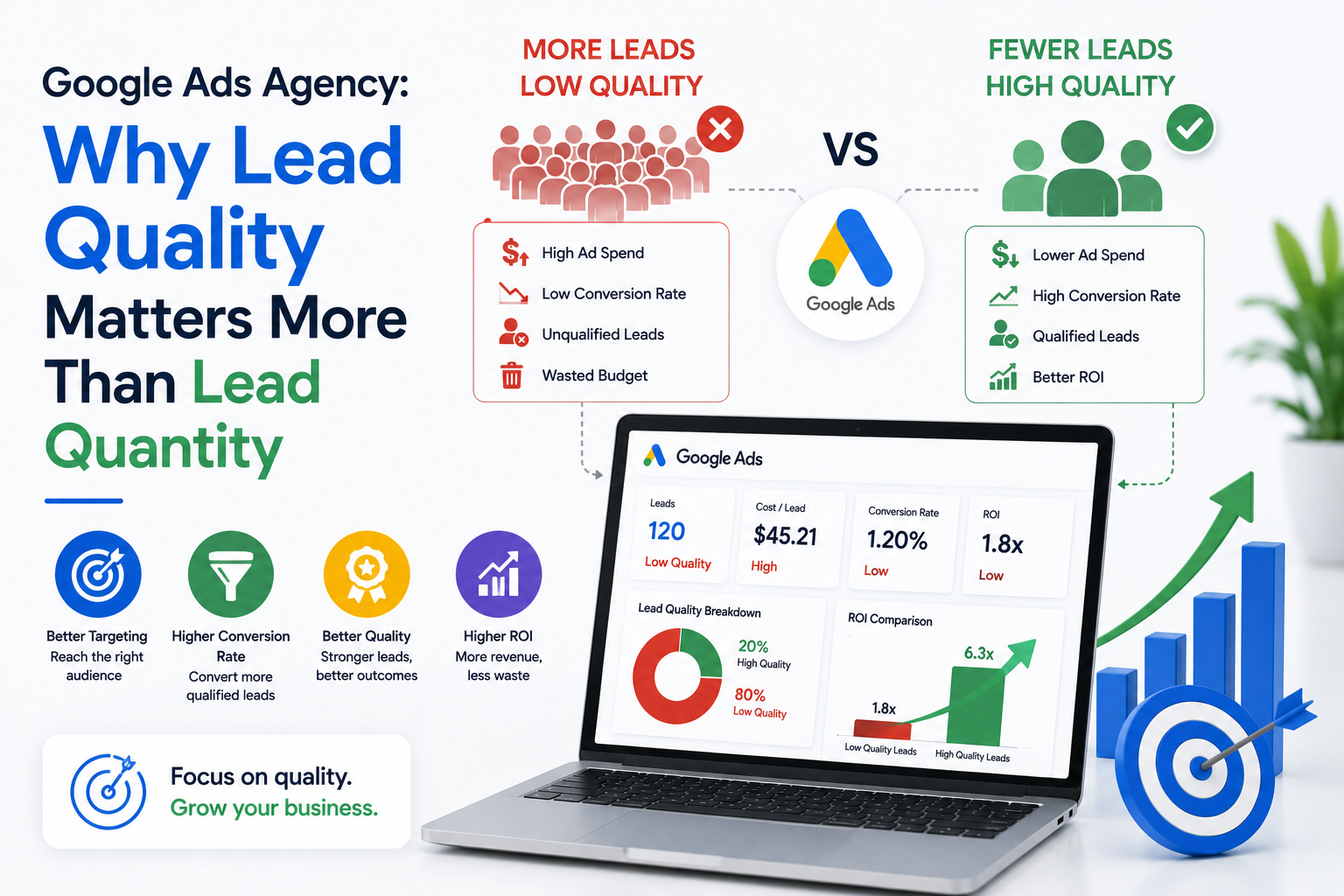
Not Every Lead Has the Same Value
Many businesses evaluate advertising success by counting the number of leads generated each month. While lead volume is important, it does not always reflect the true performance of a marketing campaign. A business can receive hundreds of inquiries and still struggle to increase revenue if those leads are not qualified.
The most successful companies focus on attracting prospects who are genuinely interested in their services and ready to make purchasing decisions. This approach often generates stronger business outcomes than simply increasing the total number of inquiries.
A professional Google Ads agency understands that the ultimate goal of advertising is not just lead generation but profitable customer acquisition.
The Difference Between Lead Quantity and Lead Quality
Lead quantity measures how many inquiries, calls, or form submissions a business receives. Lead quality focuses on how likely those prospects are to become paying customers.
A campaign producing fifty highly qualified leads may generate significantly more revenue than a campaign producing two hundred unqualified inquiries.
Businesses that prioritize lead quality often experience:
Higher conversion rates, improved sales efficiency, lower acquisition costs, and stronger return on investment.
Understanding this difference is essential for long-term advertising success.
Why Intent-Based Marketing Produces Better Leads
One of the biggest advantages of search advertising is the ability to reach users who are actively looking for solutions. These users often have stronger purchase intent compared to audiences reached through interruption-based advertising channels.
When campaigns are built around user intent, businesses can connect with people who are already researching products, comparing providers, or preparing to make purchasing decisions.
This creates more valuable opportunities for customer acquisition and improves overall lead quality.
The Role of Audience Targeting
Audience targeting plays a major role in determining lead quality. Businesses that try to reach everyone often attract large amounts of irrelevant traffic.
More focused targeting helps advertisers connect with specific customer groups that are most likely to convert.
By understanding customer demographics, behaviors, interests, and geographic locations, businesses can create campaigns that generate more relevant inquiries.
Targeting the right audience is often more important than increasing traffic volume.
Why Landing Pages Affect Lead Quality
The quality of a lead is influenced by more than the advertisement itself. Landing pages play a critical role in setting expectations and guiding users toward meaningful actions.
A well-designed landing page clearly communicates who the service is for and what customers can expect. This naturally filters out less-qualified prospects while attracting users who are a better fit.
Businesses that improve landing page relevance often notice improvements in both lead quality and conversion rates.
How Conversion Tracking Improves Results
Without proper tracking systems, businesses have limited visibility into which campaigns generate valuable customers.
Conversion tracking allows advertisers to identify which keywords, audiences, and advertisements produce the highest-quality leads.
This information helps businesses optimize campaigns based on actual performance rather than assumptions.
Companies that use data-driven optimization often achieve more predictable and profitable results over time.
Why Cost Per Lead Can Be Misleading
Many advertisers focus heavily on reducing cost per lead. While controlling costs is important, a lower cost does not always indicate better performance.
A campaign generating inexpensive but unqualified leads may actually cost more in the long run because sales teams spend valuable time following up with prospects who never convert.
Higher-quality leads may cost more initially, but they often produce stronger revenue and better overall return on investment.
Businesses should evaluate advertising performance based on profitability rather than lead volume alone.
The Importance of Negative Keywords
Negative keywords are often overlooked, yet they play a major role in lead quality.
By excluding irrelevant searches, businesses can prevent advertisements from appearing to users who are unlikely to become customers.
This helps reduce wasted spend while improving the relevance of incoming traffic.
Effective negative keyword management often leads to stronger campaign efficiency and more qualified leads.
Why Sales and Marketing Must Work Together
Lead quality improves when advertising and sales teams share information.
Sales teams often understand customer objections, common questions, and buying behavior better than anyone else within an organization.
By incorporating these insights into advertising strategies, businesses can create campaigns that attract more qualified prospects.
Collaboration between marketing and sales creates a stronger customer acquisition process.
The Future of Lead Generation
As competition continues increasing online, businesses will need to focus more on quality than quantity.
Advances in artificial intelligence, audience targeting, and predictive analytics are making it easier to identify high-value prospects before they convert.
Companies that embrace data-driven lead generation strategies will be better positioned to maximize marketing efficiency and improve profitability.
Future success will depend less on generating large numbers of inquiries and more on attracting the right customers.
Conclusion
Generating leads is important, but generating the right leads is what drives business growth. Companies that focus only on volume often waste resources on unqualified prospects and miss opportunities to improve profitability.
A Google Ads agency helps businesses attract higher-quality leads through better targeting, conversion optimization, audience analysis, and campaign strategy.
By prioritizing quality over quantity, businesses can improve sales performance, increase return on investment, and build a stronger foundation for long-term growth.
FAQs
1. What is lead quality?
Lead quality refers to how likely a prospect is to become a paying customer.
2. Why is lead quality important?
Higher-quality leads often convert more easily and generate better return on investment.
3. How does audience targeting improve lead quality?
Targeting helps businesses reach users who are more likely to be interested in their products or services.
4. What role do landing pages play in lead generation?
Landing pages help qualify visitors and encourage relevant users to take action.
5. Can fewer leads produce better results?
Yes. A smaller number of highly qualified leads can often generate more revenue than a larger number of unqualified inquiries.
Kategoriler
Read More
Exoskeleton Market 2025–2033: Global Industry Overview, Size, Growth Drivers, Key Companies, and Segments The Global Exoskeleton Market is entering a transformative phase. With rapid advancements in robotics, AI integration, and rehabilitation technology, wearable exoskeletons are moving from science fiction to everyday reality. According to the latest industry analysis,...

On the internet pai gow poker are among the preferred sorts of digital camera gaming. They are really simple to have fun with, quick, and give several different designs along with features. For novices, on the other hand, panduan pemula slot online line} starting with internet pai gow poker can appear overwhelming. Having the basic principles is vital to have fun with the activity...

In today’s digital-first world, fashion is no longer just about style—it’s about communication, identity, and connection. Traditional clothing may express personality through colors and designs, but interactive apparel takes things to another level. This is exactly where Dont Click On Me stands out with its innovative collection of qr clothing and wearable...
Maintaining a healthy body weight is important for overall wellness, confidence, and long-term fitness. In today’s busy world, many people struggle with unhealthy eating habits, stress, poor sleep, and lack of exercise. These everyday challenges can make it difficult to stay active and maintain balance. Healthy weight loss is not about extreme dieting or avoiding food completely....
TRANG CHỦ SC88 is a reputable and high-class online betting platform designed to deliver a secure, enjoyable, and world-class gaming experience. It offers a wide range of entertainment products that meet the needs of modern players who value convenience, reliability, and innovation. From immersive online casino games and massive slot collections to dynamic sports betting and exciting fish...