


How Open Source Indic AI Models Are Beating SOTA Models

India is home to 1.4 billion people and 22 official languages, yet most AI models still treat Indic languages like an afterthought. The result is predictable: transcription that mangles names and numbers, translations that lag behind real-time conversation, and language coverage that leaves entire regions underserved.
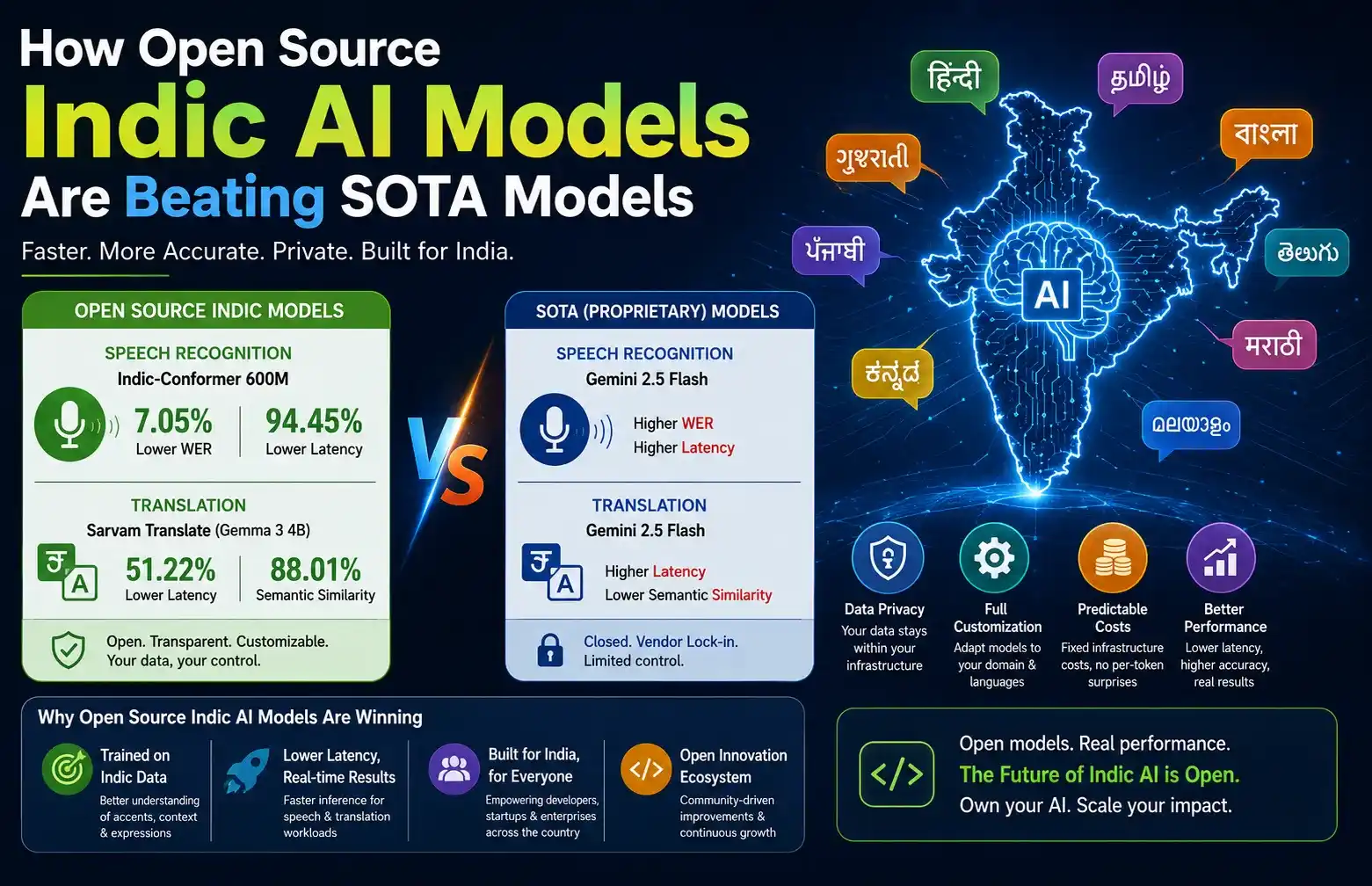
That's starting to change. A new wave of open-weight models built specifically for Indic languages is proving it can go toe-to-toe with — and in some cases outperform — frontier closed APIs like Google's Gemini. Two benchmarks make the case clearly: Indic-Conformer, a 600M-parameter speech recognition model, and Sarvam Translate, a 4B-parameter translation model fine-tuned from Gemma 3. Both were tested head-to-head against Gemini 2.5 Flash, and both held their own or won outright.
The bigger takeaway isn't just accuracy — it's that these open models can now be deployed in production with the speed and reliability that real applications demand, thanks to platforms like Simplismart that close the deployment gap.
The Problem: AI Doesn't Speak India's Languages Well
Building AI for India isn't the same as building AI for English. With 22 official languages and hundreds of dialects, generic multilingual models tend to average out performance — doing reasonably well on major world languages while stumbling on Indic scripts, phonetics, and regional phrasing. That shows up as garbled transcripts, slow translation pipelines, and voice assistants that simply don't work well in a user's native tongue. The question this benchmark set out to answer: can specialized, open-weight Indic models close that gap without sacrificing speed?
Benchmark 1: Transcription — Indic-Conformer vs. Gemini 2.5 Flash
For speech-to-text, the test used IndicVoices, a benchmark dataset built around real Indic speech, and measured performance using Word Error Rate (WER) — the standard metric for how many words a model gets wrong in a transcript.
The results were striking. Indic-Conformer, despite being a relatively compact 600M-parameter model, achieved a 7.05% lower WER than Gemini 2.5 Flash. Just as importantly, it delivered this accuracy with roughly 94% lower latency when deployed on Simplismart.
Concretely, Gemini 2.5 Flash averaged around 0.39 WER, while Indic-Conformer came in near 0.32 — a meaningful jump in real-world transcription quality. On the latency side, Gemini's transcription averaged roughly 2,589 milliseconds per request, compared to about 130 milliseconds for Indic-Conformer running on Simplismart's infrastructure — a difference of roughly 95%.
What does a 7% WER improvement actually mean in practice? It means names get spelled correctly more often, numbers are captured accurately, and regional phrases survive the transcription process instead of being flattened into something unrecognizable. Combine that accuracy gain with near-instant inference, and you get voice assistants, automated subtitles, and voice-driven workflows — healthcare dictation, legal transcription, customer support — that actually function well in a user's native language. And this is coming from a model roughly a fraction of the size of frontier closed systems.
Benchmark 2: Translation — Sarvam Translate vs. Gemini
The second benchmark examined translation quality and speed using Sarvam Translate, a Gemma 3 4B model fine-tuned by Sarvam AI specifically for Indic language translation.
Here, the comparison focused on latency and semantic similarity — how closely the meaning of a translated sentence matches the original, even if the exact wording differs. Gemini 2.5 Flash averaged about 628 milliseconds per translation request. Sarvam Translate, deployed on Simplismart, cut that down to roughly 296 milliseconds — a 51.22% reduction in latency — while maintaining approximately 88.01% semantic similarity to Gemini's output.
In other words, a 4B-parameter open model can cut response time nearly in half while keeping translation quality close to parity with a much larger frontier system. For user-facing applications like chatbots and real-time translation tools, or batch pipelines like document translation and content localization, that latency difference is often the line between a product that feels usable and one that doesn't.
Why These Results Matter
Both benchmarks point to the same underlying conclusion: open-weight models trained specifically on Indic data are now matching or beating frontier closed APIs — not just on cost, but on raw accuracy and speed. Beyond the numbers, this shift brings structural advantages that closed APIs can't match:
-
Self-hostable: Audio and text data never has to leave your own infrastructure, which matters enormously for regulated industries like healthcare, legal, and finance.
-
Full model control: Teams can modify architecture, adjust training data, and optimize for a specific domain or dialect without waiting on a vendor's roadmap.
-
No vendor lock-in: Because the models are open-weight, organizations aren't tied to a single API provider's pricing or availability.
Historically, the tradeoff for these benefits was production readiness — open models were accurate but hard to deploy at scale with low latency. These benchmarks show that gap is closing fast, particularly when paired with inference infrastructure purpose-built for production workloads.
Closing the Gap: Deploying Open Models in Production
The accuracy numbers only matter if the models can actually run in production reliably. This is where Simplismart comes in — a hosted, scalable inference platform designed to take an open-weight model from Hugging Face to a live API endpoint in minutes, without the usual DevOps overhead.
The workflow is straightforward:
-
Add the model from Hugging Face — point to a model path (for example, sarvamai/sarvam-translate), verify it, and choose your infrastructure and GPU type (Simplismart Cloud or your own cloud). Quantization options include FP8, INT8, INT4, BFLOAT16, FLOAT32, AWQ, and MXFP4, and tensor parallelism can be scaled across multiple GPUs.
-
Deploy the model — select your compiled model, choose infrastructure and accelerator type, tag the deployment as production or testing, and configure autoscaling. Scaling can be triggered by CPU, GPU utilization, time-to-first-token, latency, or throughput, with options to scale to zero when idle and to scale up rapidly during traffic surges.
-
Test the model — once deployed, Simplismart exposes an OpenAI-compatible API endpoint, so it can be called using any standard OpenAI-compatible SDK with no custom integration work required.
The Bottom Line
The data is clear: open-weight, Indic-specific models can now outperform frontier closed APIs on both accuracy and speed for languages that make up a huge share of the world's population. Indic-Conformer beats Gemini 2.5 Flash on transcription accuracy while running dramatically faster, and Sarvam Translate delivers near-parity translation quality at roughly half the latency. The remaining challenge was never really about model quality — it was about production deployment. With hosted, scalable inference platforms closing that gap, there's no longer a strong reason to default to closed APIs for Indic language AI. The open-source ecosystem has caught up, and in some cases, pulled ahead.
Catégories
Lire la suite
The global Automotive anti-Lock breaking system market size was valued at USD 54.10 billion in 2024 and is expected to reach USD 101.63 billion by 2032, at a CAGR of 8.2% during the forecast period. The global business landscape is undergoing a transformation, with industries increasingly leaning on deep research and actionable insights to make strategic decisions....

Detailed Analysis of Executive Summary Shape Memory Alloy Market Size and Share CAGR Value The shape memory alloy market is expected to gain market growth in the forecast period of 2022 to 2029. Data Bridge Market Research analyses the market will stand tall by USD 42.8 billion by 2029 to grow at a CAGR of 12.36% in the above-mentioned forecast period. In the universal Shape Memory...
In today’s digital-first world, visibility on search engines like Google is one of the most powerful drivers of business growth. When your website ranks on the first page for relevant search terms, you attract more organic traffic, build brand authority, and generate quality leads — without relying solely on paid ads. That’s why partnering with one of the best SEO...
Solid State Drive Market: Powering the Future of High-Speed Data Storage The global solid state drive market was valued at USD 22.24 billion in 2024 and is projected to grow at a compound annual growth rate of 16.4% between 2025 and 2034, according to research from Polaris Market Research. This trajectory places the market on track to reach approximately USD 25.84 billion in 2025 and...
According to the latest report published by Data Bridge Market Research, the Anti-Emetic Drugs Market Data Bridge Market Research analyses that the global anti-emetic drugs market which was USD 7,543.13 million in 2022, is expected to reach USD 12,840.23 million by 2030, and is expected to undergo a CAGR of 6.06% during the forecast period of 2023 to 2030 Global market research...