


Asset Fractionalization Through Real Estate Tokenization vs Syndication
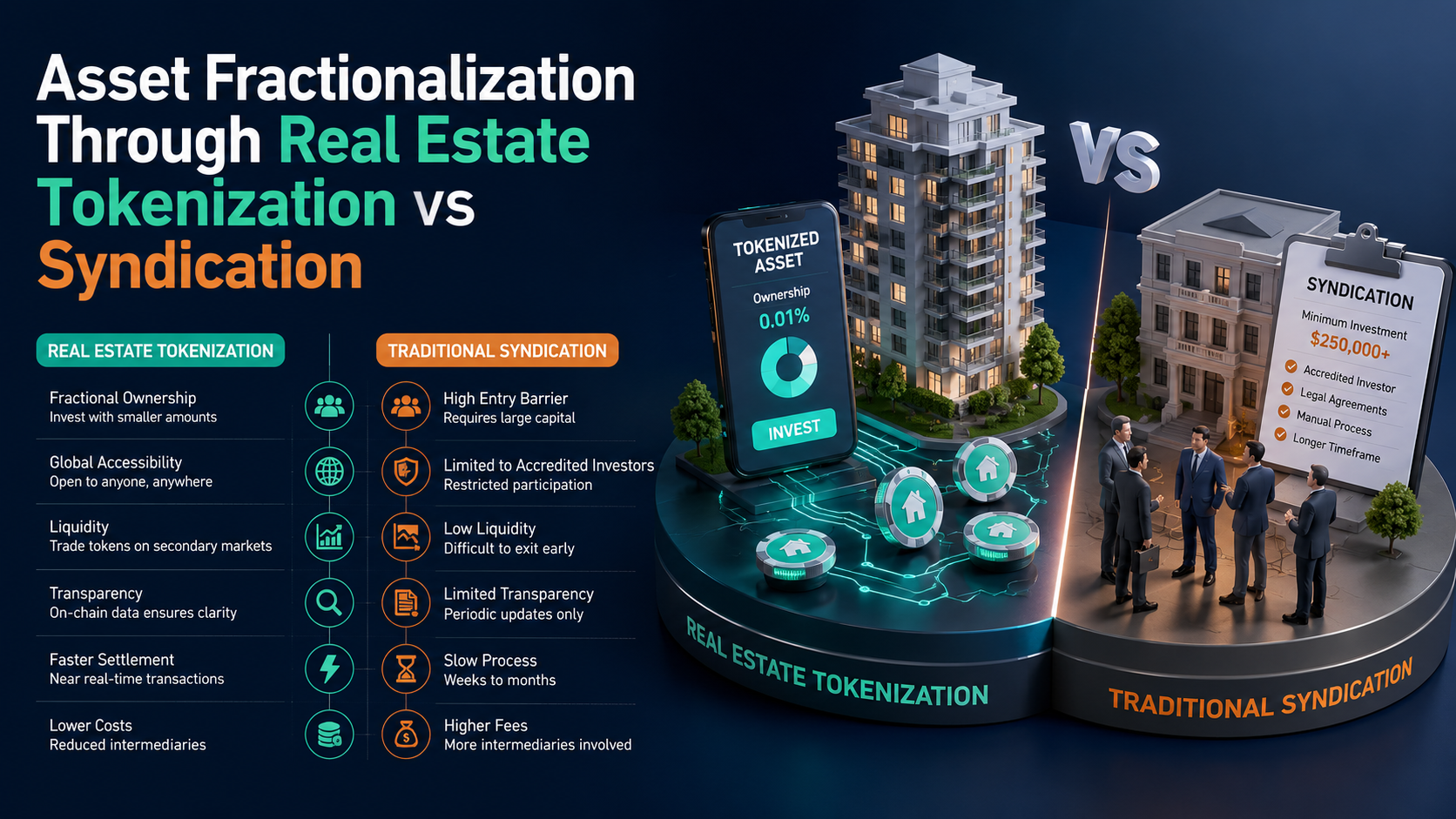
Property investment has traditionally required significant capital, making it difficult for many investors to participate in premium real estate opportunities. Over time, different investment structures have emerged to lower this barrier. Syndication has been one of the most common approaches, allowing multiple investors to pool funds and jointly own real estate assets. More recently, Real Estate Tokenization has introduced another way to divide ownership into digital units that represent shares of a property.
Although both methods support shared ownership, they differ in how ownership is represented, how investments are managed, how transactions take place, and how investors participate. Businesses, property developers, investment firms, and entrepreneurs are increasingly comparing these models before selecting the right investment structure for their projects.
This article compares asset fractionalization through Real Estate Tokenization and traditional syndication. It explains how each model works, highlights their differences, discusses their benefits and limitations, and outlines the situations where one approach may be more suitable than the other.
Understanding Asset Fractionalization
Asset fractionalization refers to dividing ownership of a valuable asset into smaller portions so multiple investors can participate without purchasing the entire property.
For example, instead of buying a commercial building worth several million pounds, investors can purchase a fraction of the ownership. This makes participation possible for individuals with different investment capacities while allowing property owners to raise funds from multiple participants.
Real estate has become one of the most suitable asset classes for fractional ownership because of its long-term value, rental income opportunities, and appreciation potential. Modern digital platforms have introduced new ways to manage fractional ownership, giving rise to real estate asset tokenization alongside traditional syndication.
What Is Real Estate Tokenization?
Real Estate Tokenization refers to converting ownership rights of a property into digital tokens recorded on a blockchain network. Each token represents a fractional share of the underlying property or investment vehicle.
Instead of issuing conventional ownership certificates or partnership units, ownership is represented digitally. Investors purchase tokens through a regulated investment platform, and these tokens represent their proportional ownership according to the legal structure governing the project.
A Real Estate Tokenization company generally assists businesses in planning the legal framework, blockchain infrastructure, smart contract implementation, investor onboarding, compliance procedures, and digital asset management.
As demand continues to increase, many businesses seek Real Estate Tokenization Services to introduce fractional property investments with digital ownership records and efficient investor management.
What Is Real Estate Syndication?
Real estate syndication is a long-established investment structure where several investors combine capital to acquire or develop a property.
A sponsor identifies the investment opportunity, manages the acquisition process, oversees operations, and distributes returns to investors. Individual investors contribute funds and receive ownership interests based on the legal agreement.
Most syndications are organised through limited partnerships or limited liability companies. Investor records are maintained using legal documentation rather than blockchain-based digital assets.
Syndication remains popular for apartment developments, office buildings, hotels, industrial facilities, and mixed-use projects where experienced sponsors manage assets on behalf of investors.
How Asset Fractionalization Works in Both Models
Although both structures divide ownership among multiple investors, their operational methods differ considerably.
Real Estate Tokenization
In a tokenized investment, ownership is divided into digital tokens. Investors register through an online platform, complete compliance procedures, purchase tokens, and receive digital ownership records. Rental income or profit distributions are allocated according to token ownership.
Blockchain records ownership updates, helping reduce manual recordkeeping while simplifying ownership tracking.
Syndication
In syndication, investors contribute capital into a partnership or investment entity. Ownership percentages are documented in legal agreements, and the sponsor manages the property throughout the investment period.
Income distributions, voting rights, and exit procedures are governed by partnership agreements instead of blockchain technology.
Ownership Structure Comparison
Ownership representation is one of the biggest differences between both models.
With Real Estate Tokenization, ownership is represented by digital tokens linked to the investment structure. Investors can often access online dashboards showing token balances, distributions, investment history, and documentation.
Syndication relies on partnership agreements, membership certificates, or company shares. Ownership changes usually require legal documentation and administrative processing.
While both methods represent legitimate ownership interests, tokenization introduces a more digital approach to ownership management.
Investment Accessibility
One of the biggest reasons businesses consider Real Estate Tokenization is its ability to accommodate investors with varying investment sizes.
Since ownership can be divided into thousands of digital tokens, minimum investment thresholds can be much lower than traditional property ownership.
Syndication also lowers entry barriers compared to direct property ownership. However, minimum investments often remain relatively higher because sponsors typically target accredited or institutional investors depending on local regulations.
Businesses planning wider investor participation frequently evaluate real estate tokenization development as part of their fundraising strategy.
Liquidity Considerations
Liquidity is often discussed when comparing these two investment structures.
Traditional syndications usually have predefined holding periods that may range from several years. Investors generally remain committed until refinancing or asset sale unless partnership agreements allow transfers.
Tokenized real estate has the potential to support secondary market trading where regulations permit. Investors may have opportunities to transfer eligible ownership tokens through approved digital marketplaces.
Actual liquidity depends on legal requirements, market demand, trading platforms, and jurisdictional regulations rather than technology alone.
Administrative Processes
Managing hundreds or thousands of investors creates administrative responsibilities regardless of investment structure.
Tokenization platforms can automate several operational tasks, including investor onboarding, ownership recording, dividend calculations, compliance verification, and reporting.
A Real Estate Tokenization Development company often develops these operational systems according to business requirements and regulatory obligations.
Traditional syndications generally rely on fund administrators, legal teams, accounting professionals, and manual record management throughout the investment lifecycle.
Compliance Requirements
Compliance remains one of the most important considerations for both models.
Tokenized real estate investments still require investor verification, anti-money laundering procedures, securities law compliance, taxation considerations, and reporting obligations.
Similarly, syndications operate under securities regulations, investor qualification rules, disclosure requirements, and partnership laws.
Regardless of the investment model, legal compliance cannot be overlooked during project planning.
Technology Differences
Technology significantly separates these investment approaches.
Real Estate Tokenization Platform Development focuses on blockchain infrastructure, digital wallets, smart contracts, investor portals, asset management systems, compliance integrations, and reporting tools.
Syndication platforms primarily manage investor communication, documentation, financial reporting, and partnership administration without issuing blockchain-based ownership tokens.
Businesses seeking digital investment ecosystems often evaluate Real Estate Tokenization Platform Development to support long-term operational efficiency.
Investor Experience
Investor expectations have changed considerably with digital financial services.
Tokenized investment platforms often provide online registration, digital documentation, ownership dashboards, distribution tracking, and investment history within a single interface.
Traditional syndications generally communicate through investor portals, emails, quarterly reports, and periodic financial statements.
Both methods provide investors with property ownership opportunities, although their day-to-day interaction differs.
Cost Considerations
Launching either investment model involves professional expenses.
Tokenization projects require blockchain development, legal structuring, smart contract creation, compliance implementation, cybersecurity assessments, and platform maintenance.
Syndications involve legal documentation, entity formation, accounting, administration, investor management, and ongoing operational costs.
Businesses should evaluate long-term operational objectives rather than comparing only initial development expenses.
Suitable Property Types
Both approaches can support multiple categories of real estate, including:
-
Residential apartment projects
-
Commercial office buildings
-
Shopping centres
-
Hotels
-
Warehouses
-
Industrial facilities
-
Student accommodation
-
Healthcare properties
-
Mixed-use developments
-
Holiday rental properties
Property selection depends more on investment objectives than on the ownership model itself.
Advantages of Real Estate Tokenization
Several practical benefits encourage businesses to consider Real Estate Tokenization.
Digital Ownership Records
Blockchain records maintain ownership information digitally, reducing reliance on manual documentation.
Fractional Investment
Property ownership can be divided into numerous digital units, allowing wider investor participation.
Efficient Investor Management
Digital platforms simplify ownership records, reporting, and investment administration.
International Investment Opportunities
Subject to regulatory requirements, businesses may attract investors from multiple jurisdictions using compliant digital investment platforms.
Operational Automation
Certain administrative processes such as dividend calculations, ownership updates, and reporting may be automated through smart contracts and integrated software.
These capabilities encourage many organisations to seek Real Estate Tokenization Development Services for new investment platforms.
Advantages of Syndication
Traditional syndication also continues to offer several practical benefits.
Established Legal Framework
Syndication has decades of legal precedent across numerous jurisdictions.
Experienced Asset Management
Professional sponsors typically oversee acquisitions, operations, leasing, maintenance, and property sales.
Familiar Investment Structure
Many institutional investors and experienced property professionals are already comfortable with syndicated investments.
Long-Term Property Management
Sponsors remain actively involved throughout the investment period, reducing operational responsibilities for passive investors.
Challenges of Real Estate Tokenization
Businesses should also consider several implementation challenges.
-
Regulatory requirements vary across countries.
-
Investor education remains necessary for digital assets.
-
Secondary market activity depends on local regulations.
-
Platform security requires continuous attention.
-
Legal structuring must align with securities laws.
Selecting experienced Real Estate Tokenization Services providers helps businesses address these requirements during project planning.
Challenges of Syndication
Traditional syndication also presents operational limitations.
-
Lengthy investment periods.
-
Manual administrative processes.
-
Limited transfer flexibility.
-
Higher minimum investments in many offerings.
-
Increased paperwork for ownership changes.
These factors have encouraged many property firms to evaluate digital ownership alternatives.
Choosing the Right Model
The appropriate investment structure depends on business objectives, investor preferences, regulatory considerations, and operational priorities.
Businesses seeking digital ownership records, broader investor participation, and technology-based investment management may find Real Estate Tokenization suitable for future projects.
Organisations that prefer conventional legal structures with experienced sponsors and long-term investment strategies may continue choosing syndication.
Some investment firms are even combining both approaches by organising syndicated property acquisitions while issuing regulated digital ownership tokens to investors.
Careful planning, legal guidance, technology selection, and compliance preparation remain important regardless of the chosen investment model.
Future Outlook
Property investment continues to adopt digital financial technologies while maintaining established legal investment structures. As regulations become more defined and investor familiarity increases, digital ownership models are expected to become more common across commercial and residential real estate markets.
At the same time, syndication will continue serving investors who value conventional partnership structures and professionally managed investment funds. Rather than replacing one another completely, both methods are likely to coexist, serving different investor preferences and business objectives.
Conclusion
Asset fractionalization has opened new opportunities for property investment by allowing multiple investors to participate in valuable real estate assets. While syndication remains a familiar and well-established investment structure, Real Estate Tokenization introduces digital ownership records, efficient investor management, and flexible participation through blockchain technology. The right choice depends on regulatory requirements, investment goals, target investors, and operational plans. Businesses planning digital property investment platforms should work with experienced professionals who understand legal compliance, blockchain infrastructure, and investment platform architecture. Blockchain App Factory provides Real Estate Tokenization Development Services, helping businesses design, develop, and launch secure digital platforms for modern real estate investment projects.
FAQs
1. What is the difference between Real Estate Tokenization and real estate syndication?
Real Estate Tokenization represents property ownership through blockchain-based digital tokens, while syndication represents ownership through traditional legal agreements such as partnerships or limited liability companies.
2. Is Real Estate Tokenization suitable for commercial properties?
Yes. Commercial offices, hotels, retail centres, warehouses, industrial properties, healthcare facilities, and residential developments can all be structured using Real Estate Tokenization, subject to applicable regulations.
3. Why do businesses choose Real Estate Tokenization Services?
Businesses choose Real Estate Tokenization Services to develop digital investment platforms, manage fractional ownership, improve investor administration, implement blockchain infrastructure, and comply with applicable investment regulations.
4. What does a Real Estate Tokenization Development company do?
A Real Estate Tokenization Development company assists with blockchain integration, smart contract development, investor portals, compliance features, digital asset issuance, security implementation, and platform maintenance.
5. Can tokenized real estate replace traditional syndication?
Not entirely. Both investment structures serve different purposes and investor groups. Many businesses evaluate each option based on project size, regulations, investor preferences, and long-term investment objectives.
6. What is included in Real Estate Tokenization Platform Development?
Real Estate Tokenization Platform Development typically includes blockchain integration, smart contracts, investor onboarding systems, compliance modules, digital wallets, reporting dashboards, payment integration, and property management functionality.
7. How does real estate asset tokenization support fractional ownership?
Real estate asset tokenization divides property ownership into digital tokens that represent proportional ownership interests, allowing multiple investors to participate in the same real estate asset according to the applicable legal framework.
Categorie
Leggi tutto
Running a durable medical equipment (DME) business in Texas comes with its fair share of challenges. From navigating complex insurance claims to maintaining compliance with ever-changing healthcare regulations, medical billing can become a time-consuming burden. This is where partnering with the top DME billing company Ohio has to offer, like 247 Medical Billing Services, can make all the...

The Contract Lifecycle Management (CLM) market is poised for significant growth by 2034, driven by the increasing complexity of contracts and the need for organizations to manage them efficiently. CLM solutions facilitate the entire contract process, from initiation and negotiation to execution and renewal. As businesses strive for operational efficiency and compliance, the demand for robust...

Le code promo 1xBet est 1XBIG2026. Il vous permet d'obtenir un bonus de 200 % sur votre premier dépôt, dans la limite de 130 000 XOF ou 200 EUR, selon votre pays de résidence. Code Promo 1xBet 2026 — Afrique Bonus Exclusif 130€/$ Le code promo 1xBet gratuit: 1XBIG2026 offre aux nouveaux clients un bonus de bienvenue exceptionnel : 100%...
Introduction aux casinos en ligneLes casinos en ligne connaissent une popularité croissante en France grâce à leur accessibilité et leur casino en ligne fiable diversité de jeux. Les plateformes légales, régulées par l’ANJ, garantissent sécurité et équité. Il est essentiel de comparer les bonus, les options...

A well-proportioned nose can dramatically improve facial harmony, confidence, and overall appearance. Because the nose occupies the center of the face, even subtle adjustments can create a significant difference in facial aesthetics. Today, more people than ever are choosing Nose Surgery in Dubai to enhance their appearance, correct structural concerns, and improve breathing...
