Vietnam Imports Data 2025: A Comprehensive Guide to Trends, Top Products & Key Trading Partners
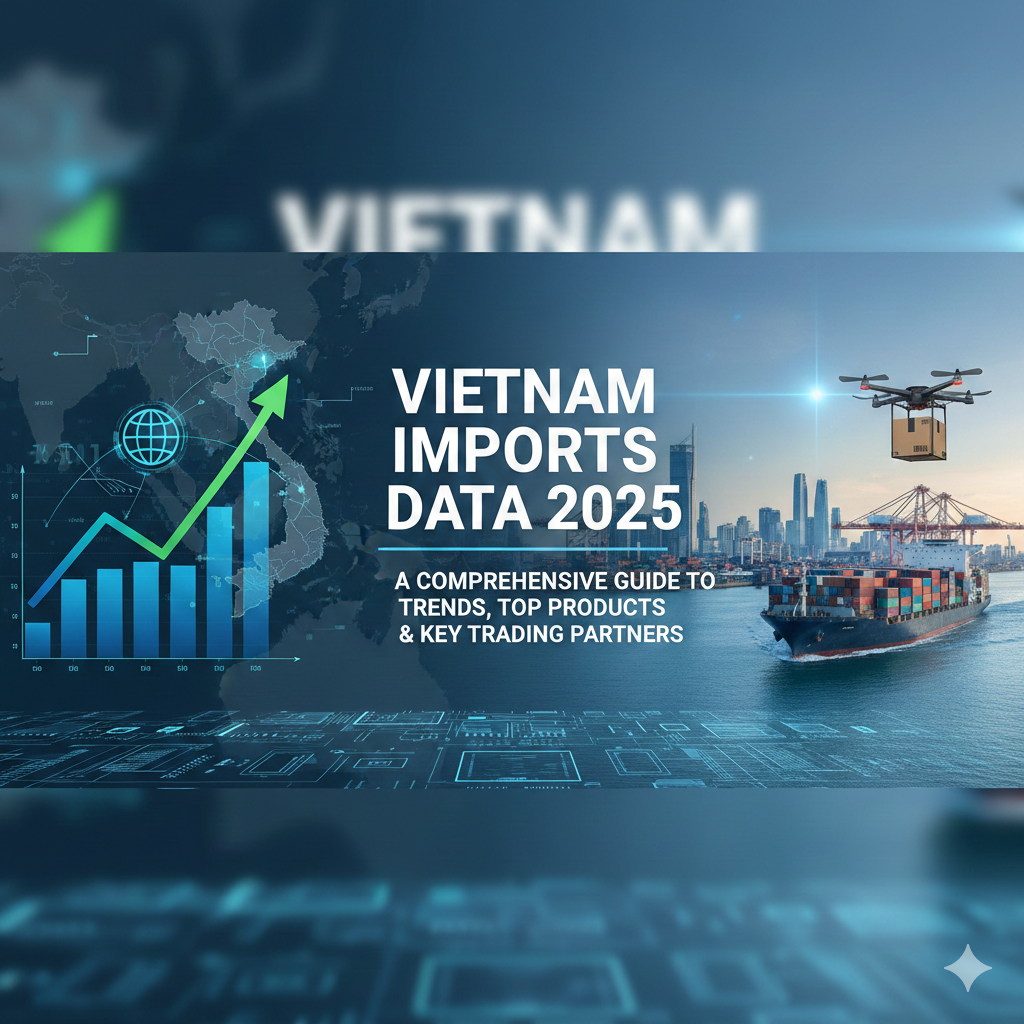
In today’s fast-paced global economy, Vietnam has grown into one of the most dynamic and rapidly expanding markets in Asia. As a nation that relies significantly on imported goods to support its manufacturing, infrastructure, and consumer-driven sectors, understanding Vietnam imports is essential for businesses looking to expand into this promising market. With industries scaling rapidly and domestic consumption rising, import activity in Vietnam has become a crucial indicator of the country’s broader economic trajectory.
According to Vietnam customs data, the total value of Vietnam’s imports reached $379 billion in 2024, up 7.2% from the previous year. This performance reaffirmed Vietnam’s position as the 20th largest importer in the world, highlighting its pivotal role in global trade flows. In just the first five months of 2025, imports surged to $175.56 billion, a notable 17.4% increase compared to the same period in 2024. Production materials—essential for Vietnam’s booming manufacturing sector—comprised 93.8% of all imports during this period, underscoring Vietnam’s role as a major global production hub.
This guest post examines the latest Vietnam imports data for 2025, explores the top import categories, analyzes Vietnam imports by country, and highlights the Top importers in Vietnam shaping the country’s trade profile. In addition, we will look at long-term trends, challenges, and opportunities that businesses must consider when entering the Vietnamese market.
Understanding Vietnam’s Import Structure in 2025
Vietnam’s import ecosystem is wide-ranging and diversified, driven largely by industrial needs and robust consumer demand. The country’s rapid economic growth, foreign direct investment (FDI), and strong manufacturing capabilities have created a fertile environment for global suppliers.
Major Categories Driving Growth
Based on recent trade reports and Vietnam shipment data, several key industries dominate the country’s import composition:
1. Electronics & Electrical Machinery (HS 85) – $116.54 billion (34.79%)
Electronics remain the backbone of Vietnam imports, reflecting the country’s position as a global electronics assembly hub. Foreign-invested giants like Samsung, Intel, and LG heavily rely on imported components to fuel their production lines. High demand for integrated circuits, processors, micro-assemblies, and semiconductors continues to drive import volumes.
2. Machinery & Nuclear Reactors (HS 84) – $29.10 billion (8.69%)
Vietnam's rapidly industrializing economy depends on advanced machinery for manufacturing, construction, and energy needs. The strong inflow of machinery not only supports infrastructure expansions but also enhances productivity across industries.
3. Plastics & Articles Thereof (HS 39) – $16.48 billion (4.92%)
Plastics are an essential input for Vietnam’s manufacturing sector—from electronics to packaging to textiles. Steady growth in this category reflects rising output in downstream industries.
4. Mineral Fuels, Oils (HS 27) – $16.03 billion (4.79%)
As industrial activity ramps up, energy demands have risen sharply. Vietnam continues to import significant quantities of fuel to support production, logistics, and nationwide transportation needs.
5. Iron & Steel (HS 72) – $12.21 billion (3.65%)
Steel demand remains high due to ongoing infrastructure projects, construction growth, and heavy industries requiring raw materials.
Other key contributors include vehicles (HS 87), medical instruments (HS 90), knitted fabrics (HS 60), cereals (HS 10), and cotton (HS 52).
Vietnam Imports by Country: Top 10 Trading Partners in 2024–25
Understanding Vietnam imports by country is crucial for businesses evaluating sourcing strategies or entering Vietnam’s trade ecosystem. Based on official Vietnam customs data, here are the top import partners:
1. China – $144.3 billion (37.9%)
China is Vietnam’s largest trading partner, supplying electronics, machinery, metals, and raw materials. As neighboring countries with strong logistical ties, Vietnam depends heavily on China for manufacturing inputs.
2. South Korea – $79.7 billion (20.9%)
South Korea is Vietnam’s second-largest supplier, driven largely by electronics and machinery. Korean FDI has played a vital role in turning Vietnam into a global electronics production center.
3. Japan – $35.8 billion (9.4%)
Japan exports high-quality machinery, electronics, automotive parts, and energy-related equipment, supporting Vietnam’s industrial growth.
4. Taiwan – $32 billion (8.4%)
Taiwan’s contributions include technology components, telecommunications goods, and advanced machinery, with machinery being the top import segment.
5. United States – $14.3 billion (3.8%)
The US remains a key supplier of agricultural products, machinery, equipment, and high-value technology.
Other important partners include Thailand, Malaysia, Indonesia, India, and Australia, each contributing significantly to sectors like agriculture, energy, chemicals, and machinery.
These Vietnam imports by country patterns emphasize Vietnam’s strategic collaborations with leading industrial economies, ensuring a steady flow of high-quality products.
Top Importers in Vietnam: Key Companies Shaping the Landscape
The Top importers in Vietnam are dominated by multinational tech manufacturers operating large facilities across the country. Their demand for electronic components, semiconductors, and machinery drives a significant share of national imports.
Below are the top 10 import companies as per the latest Vietnam import export data and importers' database:
| Rank | Company | Approx. Import Value ($) | Key Imports | Top Source Countries |
|---|---|---|---|---|
| 1 | Intel Vietnam | $9.9B | Micro-assemblies, ICs | China, Korea, Taiwan |
| 2 | Hanyang Vina | $8.5B | Electronic components | China, Korea |
| 3 | Samsung Thai Nguyen | $7.9B | Chips, semiconductors | China, Korea |
| 4 | Samsung HCMC | $5B | Electronic parts | China, Korea |
| 5 | Compal Vietnam | $2.9B | ICT components | China, Korea |
| 6 | FuyU Tech | $2.1B | Circuits, assemblies | China, Korea |
| 7 | Luxshare Van Trung | $1.7B | Electronics parts | China, Korea |
| 8 | Fukang Tech | $1.7B | Components | China, Korea |
| 9 | Hana Micron | $1.6B | Semiconductors | China, Korea |
| 10 | Wistron Vietnam | $1.6B | ICT parts | China, Korea |
These leading companies demonstrate Vietnam’s continued dependence on imported technology components to sustain its export-oriented production model. Understanding these buyers can help international suppliers tap into Vietnam’s evolving supply chain.
Historical Trends: Vietnam Imports Over the Last Decade
Examining historical Vietnam customs data reveals a consistent upward trajectory:
-
2014: $147.83B
-
2018: $236.86B
-
2021: $330.75B
-
2024: $379B
The pattern shows Vietnam’s transformation into a high-tech manufacturing hub with increasing dependence on imported production materials.
Vietnam Shipment Data & 2024–25 Import Statistics
Vietnam shipment data confirms accelerated growth in critical sectors:
-
Electronics & components: $107.1B (+21.7%)
-
Machinery & parts: $48.9B (+17.6%)
-
Fabrics & textiles: $14.9B (+14.5%)
-
Plastics: $11.8B (+11.8%)
-
Iron & steel: $12.6B (+20.6%)
This surge is driven by both domestic manufacturers and FDI-backed factories seeking to expand production capacity.
Impact of U.S. Tariffs on Vietnam (2025)
Several tariff measures implemented by the US in 2025 have influenced Vietnam’s import-export ecosystem:
-
25% tariffs on steel & aluminum (from Feb 2025)
-
10% universal tariff on all non-USMCA countries (from April 2025)
-
46% reciprocal tariff specifically affecting Vietnam (briefly applied)
-
Solar panel tariffs reaching up to 800%
These measures pushed Vietnam to further diversify its sourcing strategies and accelerate supply chain realignment.
Emerging Import Trends & Market Outlook for 2025
Several key trends are shaping Vietnam imports going forward:
1. Rise in High-Tech Import Demand
With Apple’s supply chain expansion and Samsung’s ongoing investments, demand for advanced electronics and components continues to rise.
2. Growth in EV-Related Imports
Electric vehicle components from China, Thailand, and Korea are expected to surge.
3. Renewable Energy Equipment Demand
Growing green initiatives are boosting imports of solar, wind, and clean-energy equipment.
4. Agricultural Import Dependence
Climate challenges have increased imports of cereals, fruits, and essential food products.
5. Supply Chain Diversification
Vietnam is reducing reliance on China by strengthening trade with ASEAN, India, and Europe.
Conclusion
The Vietnam imports landscape in 2025 reflects a rapidly growing economy deeply interconnected with global supply chains. With import values climbing steadily, Vietnam continues to solidify its position as one of Asia’s most attractive trade and investment destinations. From high-tech electronics and machinery to essential agricultural and industrial goods, the country’s import structure highlights a thriving manufacturing and consumption-driven market.
For businesses aiming to capitalize on this growth, leveraging Vietnam import export data, Vietnam shipment data, and understanding Vietnam imports by country can offer strategic advantages. Access to detailed datasets—including customs records and importer lists—can empower companies to identify new opportunities, target the right buyers, and make informed market-entry decisions.
As Vietnam continues to expand its global trade footprint, the opportunities for collaboration, supply chain integration, and market expansion are greater than ever.
Categorias
Leia mais
"In-Depth Study on Executive Summary Edema Treatment Market Size and Share The global edema treatment market size was valued at USD 3.14 billion in 2025 and is expected to reach USD 5.60 billion by 2033, at a CAGR of 7.50% during the forecast period Trustworthy sources such as websites, journals, mergers, newspapers and other authentic sources have been...

Everything seems fine—until it suddenly isn’t. A small irregularity turns into a stop, and before you know it, production is interrupted. These moments rarely come at a convenient time. This is where a Three Phase Electric Motor and a First Class Energy Efficient Motor offer a more reliable solution. Older motor systems often operate under hidden stress. They manage daily tasks, but...
In the field of structural engineering and high-rise construction, the durability of any Reinforced Cement Concrete (RCC) structure depends on the symbiotic relationship between concrete and steel. While concrete offers exceptional compressive strength, it is inherently brittle and performs poorly under tensile, shear, and bending forces. To absorb these structural stresses, engineers introduce...

The Global Radiopharmaceutical Market Report presents an in-depth analysis, merging qualitative and quantitative insights to provide a holistic understanding of the market's dynamics. The report evaluates growth drivers, challenges, and constraints while forecasting revenue trends across key segments. It offers both historical and projected data, giving stakeholders a clear view of market...

Raising a large amount of money—whether for business growth, education, or emergencies—often leads people toward high-interest unsecured loans. But if you own property, there’s a more efficient option: a Loan Against Property (LAP). With digital platforms now simplifying the process, you can apply for a loan against property online without the usual delays, paperwork hassles,...