


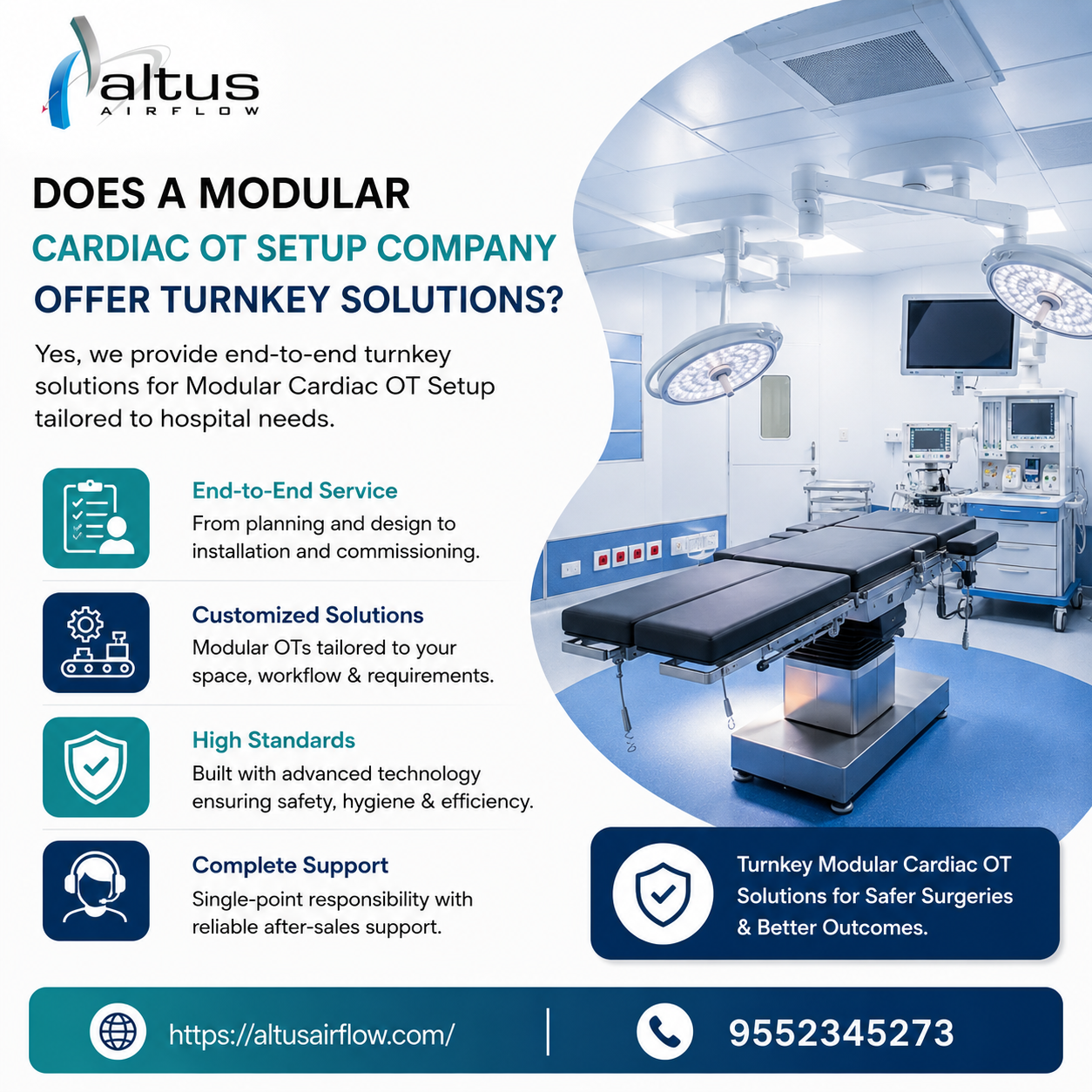
Does a Modular Cardiac OT Setup Company Offer Turnkey Solutions?
Introduction
A Modular Cardiac OT Setup Company can offer turnkey solutions for hospitals that require a complete and coordinated cardiac operation theatre environment. Turnkey solutions can integrate planning, modular interiors, HVAC systems, HEPA filtration, laminar airflow, medical gas systems, electrical infrastructure, surgical lighting, flooring, doors, equipment coordination, testing, and commissioning into a single project framework. Altus Airflow provides modular cardiac OT solutions designed around the technical, clinical, and infrastructure requirements of healthcare facilities.
Cardiac operation theatres require carefully controlled environments because cardiovascular procedures involve specialized surgical equipment, advanced monitoring systems, anesthesia infrastructure, and highly coordinated clinical workflows. The OT must therefore support appropriate environmental conditions, infection-control measures, reliable utilities, and efficient movement of medical staff and equipment.
This article explains what turnkey cardiac OT solutions include, how the implementation process works, and why integrated project planning is important for modern cardiac surgical facilities.
What Is a Turnkey Cardiac OT Solution?
A turnkey cardiac OT solution involves coordinating the major stages of an operation theatre project under one structured implementation process.
The scope may include:
-
Site assessment
-
OT layout planning
-
Modular wall systems
-
Modular ceiling systems
-
HVAC installation
-
HEPA filtration
-
Laminar airflow
-
Medical gas systems
-
Electrical infrastructure
-
Surgical lighting
-
Flooring
-
Specialized doors
-
Testing and commissioning
The exact scope depends on the hospital's requirements, existing infrastructure, room size, equipment specifications, and applicable project requirements.
Why Cardiac OTs Need Integrated Planning?
Cardiac surgery requires specialized equipment and carefully organized clinical workflows.
An OT may need to accommodate:
-
Operating tables
-
Surgical lights
-
Anesthesia systems
-
Patient monitoring equipment
-
Perfusion equipment
-
Cardiac surgical equipment
-
Medical gas outlets
-
Electrical connections
-
Emergency systems
All these components must be positioned without obstructing staff movement or compromising the operating environment.
Integrated planning helps coordinate these requirements before installation begins.
Initial Site Assessment
A detailed site assessment is generally the first stage of a turnkey project.
The project team evaluates:
-
Available floor area
-
Room dimensions
-
Ceiling height
-
Structural conditions
-
Existing HVAC systems
-
Electrical capacity
-
Medical gas infrastructure
-
Utility connections
-
Access routes
-
Equipment movement pathways
The assessment helps determine which existing systems can be reused, upgraded, or replaced.
Cardiac OT Layout Planning
The OT layout should be developed according to clinical workflow and equipment requirements.
Planning can consider the location of:
-
Operating tables
-
Surgical lights
-
Anesthesia equipment
-
Patient monitors
-
Perfusion systems
-
Cardiac equipment
-
Medical gas outlets
-
Electrical outlets
-
Storage systems
A well-planned layout can reduce unnecessary movement and provide staff with efficient access to essential equipment.
Modular Wall Systems
Modular wall panels are an important component of a modern cardiac OT.
They can provide:
-
Smooth surfaces
-
Easy cleaning
-
Durable finishes
-
Sealed joints
-
Hygienic interiors
-
Integration of technical services
Wall systems can also be designed to accommodate electrical outlets, medical gas connections, data points, monitoring systems, and other services.
Proper joint sealing is important to maintain the intended environmental characteristics of the room.
Modular Ceiling Systems
The ceiling provides a platform for several critical OT systems.
A modular ceiling may integrate:
-
HEPA filter modules
-
Laminar airflow systems
-
Surgical lights
-
Air distribution components
-
Medical service connections
-
Inspection panels
Coordinating these components during the design stage helps avoid installation conflicts and creates a cleaner, more organized ceiling structure.
HVAC System Integration
HVAC is one of the most important systems in a cardiac operation theatre.
The system may be designed to control:
-
Temperature
-
Relative humidity
-
Air changes
-
Air distribution
-
Filtration
-
Room pressure
The HVAC design should be based on the room's intended use, equipment loads, project specifications, and applicable requirements.
Proper airflow management can support the controlled environment required for surgical procedures.
HEPA Filtration
HEPA filtration can be integrated into the HVAC and ceiling system where required.
HEPA filters are designed to remove very small airborne particles from supplied air.
Installation planning should consider:
-
Filter housing
-
Sealing
-
Airflow distribution
-
Maintenance access
-
Filter replacement
-
Testing requirements
After installation, filter integrity testing may be performed to verify that the system has been installed correctly.
Laminar Airflow Integration
Laminar airflow systems may be incorporated into selected cardiac operation theatres according to clinical and engineering requirements.
The system can be integrated with the ceiling and HVAC infrastructure.
Proper design considers:
-
Air supply
-
Filter placement
-
Critical operating area
-
Air distribution
-
Ceiling-mounted equipment
The final configuration should be determined through appropriate engineering assessment rather than using the same arrangement for every OT.
Temperature and Humidity Control
Stable temperature and humidity conditions contribute to a controlled OT environment.
Modern HVAC controls can monitor and manage:
-
Room temperature
-
Relative humidity
-
Pressure
-
Ventilation
Environmental sensors can provide information to facility personnel and help identify deviations from specified conditions.
Medical Gas Systems
A turnkey cardiac OT project may include medical gas infrastructure according to hospital requirements.
Systems can include:
-
Oxygen
-
Medical air
-
Vacuum
-
Other gases required by the facility
Outlet locations should be coordinated with the operating table, anesthesia equipment, and other medical devices.
Medical gas pipelines and outlets should be appropriately tested and documented before clinical use.
Electrical Infrastructure
Cardiac operation theatres can have significant electrical requirements because of the number of critical medical devices used during procedures.
Electrical infrastructure may include:
-
Dedicated circuits
-
Equipment outlets
-
Emergency power
-
UPS systems
-
Earthing
-
Distribution boards
-
Data connections
Electrical planning should be coordinated with equipment locations and future requirements.
Surgical Lighting
Surgical lighting is another important part of OT infrastructure.
Modern LED surgical lights can provide:
-
High illumination
-
Adjustable intensity
-
Reduced heat generation
-
Energy efficiency
-
Improved visibility
Lighting positions should be planned around the operating table and other ceiling-mounted equipment.
OT Flooring
Flooring should support hygiene, durability, safety, and routine cleaning.
Possible solutions may include:
-
Seamless resin flooring
-
Healthcare-grade PVC
-
Conductive flooring where required
-
Other specialized healthcare flooring
Floor-to-wall junctions can also be designed with appropriate coving to make cleaning easier and reduce difficult-to-maintain corners.
Specialized OT Doors
Specialized doors may be included to support the environmental requirements of the operation theatre.
Depending on the project, door systems can provide:
-
Improved sealing
-
Reduced air leakage
-
Easy cleaning
-
Durable surfaces
-
Controlled movement
Door selection should consider room pressure, traffic frequency, equipment movement, and available structural space.
Equipment Coordination
A turnkey approach can include coordination with the hospital's cardiac OT equipment requirements.
The project team may review:
-
Equipment dimensions
-
Electrical requirements
-
Medical gas requirements
-
Data connections
-
Equipment access
-
Maintenance clearance
-
Installation pathways
Early equipment coordination reduces the risk of placing utilities in unsuitable locations.
Infection-Control Infrastructure
A cardiac OT should be designed with infection-control objectives in mind.
Engineering features may include:
-
HEPA filtration
-
Controlled airflow
-
Hygienic wall panels
-
Seamless flooring
-
Cleanable ceilings
-
Sealed doors
-
Environmental monitoring
These systems support the hospital's broader infection-control procedures and cleaning protocols.
Testing and Commissioning
Testing is an essential stage of a turnkey OT project.
Depending on the scope, testing may include:
-
Airflow measurements
-
HVAC balancing
-
Temperature verification
-
Humidity verification
-
Differential pressure testing
-
HEPA filter integrity testing
-
Electrical testing
-
Medical gas testing
-
Environmental monitoring verification
Testing helps determine whether installed systems perform according to their specified requirements.
Corrective Actions
Testing may identify areas that require adjustment.
Examples can include:
-
Airflow balancing
-
Damper adjustment
-
Sensor calibration
-
Filter replacement
-
Door seal correction
-
Electrical modifications
-
Control-system adjustments
After corrective work, relevant tests can be repeated to confirm that the system is operating as intended.
Documentation and Handover
Documentation is an important part of turnkey implementation.
The project handover may include:
-
As-built drawings
-
HVAC test reports
-
HEPA filter reports
-
Electrical test records
-
Medical gas test documentation
-
Equipment information
-
Maintenance instructions
-
Commissioning records
Proper documentation supports future maintenance and facility management.
Benefits of Turnkey Cardiac OT Solutions
A turnkey approach can provide several advantages for hospitals.
These may include:
-
Centralized project coordination
-
Integrated engineering
-
Better system compatibility
-
Streamlined installation
-
Reduced coordination conflicts
-
Simplified testing
-
Clearer project responsibility
-
Organized handover
The actual benefits depend on the project's scope, design quality, execution, and coordination.
Upgrading Existing Cardiac OTs
Turnkey solutions can also be considered for renovation projects.
An existing cardiac OT can be assessed to determine whether its:
-
HVAC system
-
Electrical infrastructure
-
Medical gas system
-
Walls
-
Ceiling
-
Flooring
-
Doors
can be upgraded or replaced.
Selective renovation can help modernize an existing facility while making use of suitable infrastructure that is already available.
Future-Ready Infrastructure
A cardiac OT should be designed with potential future requirements in mind.
Infrastructure can be planned for:
-
Additional medical equipment
-
Digital monitoring
-
New electrical loads
-
Advanced imaging systems
-
HVAC modifications
-
Future technology upgrades
Modular construction can provide flexibility for selected future modifications.
Role of a Modular Cardiac OT Setup Company
A Modular Cardiac OT Setup Company can coordinate multiple technical disciplines within one project framework.
The project team may work with:
-
Architects
-
HVAC engineers
-
Electrical engineers
-
Medical gas specialists
-
Validation professionals
-
Hospital clinical teams
-
Equipment suppliers
This multidisciplinary approach helps ensure that engineering systems are coordinated with clinical requirements.
How Turnkey Solutions Simplify Project Management?
Managing different systems through multiple independent contractors can create coordination challenges.
A turnkey implementation can establish a structured project sequence:
-
Requirement assessment
-
Site survey
-
Concept design
-
Detailed engineering
-
Material selection
-
Modular fabrication
-
Site installation
-
System integration
-
Testing
-
Commissioning and handover
This approach can provide clearer responsibilities and better coordination throughout the project.
Why Professional Expertise Matters?
A Modular Cardiac OT Setup Company understands that a cardiac operation theatre is an integrated healthcare environment rather than simply a specially finished room.
HVAC, laminar airflow, HEPA filtration, modular walls, ceilings, medical gases, electrical systems, lighting, flooring, doors, monitoring systems, and equipment must be coordinated carefully.
Conclusion
A modular cardiac operation theatre can be delivered through a turnkey approach that integrates design, modular construction, HVAC, HEPA filtration, laminar airflow, medical gases, electrical infrastructure, surgical lighting, flooring, specialized doors, equipment coordination, testing, commissioning, and documentation. This integrated process provides a structured way to coordinate multiple technical systems and prepare the OT for clinical operations.
Altus Airflow provides integrated modular cardiac OT solutions covering modular construction, HVAC engineering, airflow management, filtration, healthcare interiors, and technical infrastructure. Altus Airflow focuses on coordinated project execution to help hospitals develop controlled, efficient, and future-ready cardiac operating theatres.
FAQs
1. Does a Modular Cardiac OT Setup Company offer turnkey solutions?
Yes, a Modular Cardiac OT Setup Company can offer turnkey solutions covering OT design, modular interiors, HVAC, HEPA filtration, laminar airflow, medical gases, electrical infrastructure, lighting, flooring, testing, commissioning, and handover.
2. What does a turnkey cardiac OT project include?
It can include site assessment, design, modular construction, HVAC, filtration, medical gases, electrical infrastructure, interiors, testing, commissioning, and documentation.
3. Is HVAC included in turnkey cardiac OT solutions?
Yes. HVAC can be designed and integrated according to the environmental and airflow requirements of the cardiac OT.
4. Can laminar airflow be installed in a cardiac OT?
Yes. Laminar airflow can be incorporated when required by the clinical and engineering design.
5. Are HEPA filters included in turnkey OT projects?
HEPA filtration can be integrated into the HVAC and ceiling system according to project requirements.
Read Our Previous Blog ---------------> What is the implementation process for Turnkey Modular IVF Lab Solutions?
Κατηγορίες
Διαβάζω περισσότερα
You can go on a date with one of our Call Girls in Islamabad. You can book one of our high-class Call Girls In Islamabad for a low price and have a smart chat, an erotic tryst, or just some time to relax. Talking to guys who have used an Islamabad model Call Girl is the best thing you can do. Tell them what you need and ask if they think their service is good. You don't need to look any further...

Planning a successful event requires attention to detail, creativity, and the right resources. Whether it’s a birthday celebration, wedding, corporate gathering, or backyard party, having access to quality equipment and décor can make all the difference. This is where Party Rentals Pittsburgh, PA services come into play, offering everything from tents and tables to lighting and...

A bedroom is more than four walls and a mattress. It’s your private corner after a long day. It’s where you switch off the noise. If you are searching for a luxury bed in Noida, you’re not just buying furniture. You’re choosing comfort, design, and a little bit of pride. At Anurama Furnico, we’ve seen how the right bed can change the whole mood of a room. People...
Relocating to a new home is an exciting chapter, but it can also be one of life's most challenging experiences. From packing treasured belongings to transporting bulky furniture, every step requires careful planning and professional handling. This is why choosing a Trusted Moving Company Dubai has become the preferred option for families looking for a smooth and stress-free relocation. With...

The dream of seeing an Anthony Joshua Vs Tyson Fury match is closer than ever this month. Big fight dates are now locked into the calendar. Top fighters are final their summer training camps right now. Great champions must prove their worth in the ring soon. Every single bout leads to the ultimate prize. The entire sports world watches these athletes with great focus. Lock in your important...
