NFC Payment Devices Are Turning the Checkout Counter Into a Connected Infrastructure Layer

NFC Payment Devices Are Turning the Checkout Counter Into a Connected Infrastructure Layer
The payment terminal used to be the final point in a retail transaction. Today, it is becoming a connected infrastructure node. NFC Payment Devices sit at the center of that transition because the same tap can connect a bank card, smartphone, smartwatch, payment ring, merchant terminal and digital wallet within seconds. The change is not simply about replacing cash or inserting a card. It is about compressing the physical distance between consumer identity, payment credentials and merchant acceptance into a transaction that typically occurs within a few centimeters.
That physical constraint is actually one of the technology's strengths. NFC communication operates at very short range, reducing the opportunity for unintended connections while enabling secure device-to-device communication. EMVCo's contactless architecture supports both contactless cards and NFC-enabled mobile devices, while tokenization and transaction-specific security mechanisms help prevent the actual payment credential from being repeatedly exposed.
The terminal is becoming the infrastructure
Consider a supermarket with 500 checkout lanes across 50 stores. If each lane requires one payment acceptance point, the retailer is effectively operating a 500-node payment infrastructure. Replacing a conventional terminal with an NFC-capable smart terminal does more than add tap functionality. It creates a node capable of accepting cards, smartphones and wearables while also connecting to cloud-based merchant software.
This is why NFC Payment Devices are increasingly being designed as multifunctional hardware rather than standalone card readers.
Modern Android-based payment terminals can combine:
-
NFC reader hardware
-
EMV contactless kernels
-
touchscreen interfaces
-
Wi-Fi and cellular connectivity
-
barcode scanning
-
receipt management
-
merchant applications
-
remote device management
-
security modules
A restaurant with 100 tables illustrates the infrastructure opportunity. Instead of directing every customer toward one fixed checkout point, a merchant can deploy mobile payment devices across dining areas. If a device reduces each payment interaction by even 10–15 seconds, 1,000 daily transactions could theoretically release several hours of cumulative customer and staff time.
That makes payment speed an operational metric, not merely a convenience feature.
The economics of a two-second tap
The value proposition becomes clearer at high transaction volumes.
Suppose a convenience store processes 2,000 transactions a day. If contactless acceptance saves an average of 8 seconds against a slower payment interaction, the theoretical time released is about 4.4 hours per day.
Across 1,000 stores, that becomes more than 4,400 operating hours of transaction capacity every day.
The number does not mean every saved second becomes additional revenue. Queue behavior, staffing and checkout design determine the actual benefit. But the calculation shows why retailers are willing to invest in faster acceptance infrastructure.
This is also where NFC Payment Devices move beyond the consumer electronics category. The device becomes part of store productivity infrastructure.
The same logic applies to stadiums, airports, metro stations, cinemas, pharmacies and quick-service restaurants. In environments where transaction volumes peak within narrow time windows, reducing payment friction has disproportionate value.
A stadium processing 20,000 purchases during a three-hour event faces a very different infrastructure requirement from a specialty retailer processing 200 transactions throughout a full business day.
Wearables are changing where payment happens
The second infrastructure shift is happening on the consumer side.
The payment credential is no longer restricted to a plastic card or smartphone. Smartwatches, payment wristbands and smart rings can place the payment interface on the wrist or finger.
That matters because every additional form factor expands the number of potential payment touchpoints.
A smartphone may already contain multiple payment cards. A smartwatch can remove the need to reach for the phone. A ring can reduce the interaction further by eliminating a screen altogether.
The result is a movement from device-based payment toward ambient payment behavior.
For NFC Payment Devices, this creates an interesting hardware chain. A payment transaction may involve an NFC antenna, secure element or software-based secure credential, biometric authentication on the originating device, a merchant reader, an acquiring platform and the payment network. The visible action is one tap, but the infrastructure underneath it is distributed across multiple layers.
NFC Forum's recent work also points toward more reliable NFC interactions. Its Release 15 increased the specified operating range from the traditional 0.5 cm baseline toward 2 cm, improving tolerance to alignment and making smaller form factors such as rings and wearables easier to use.
That fourfold increase in specified range is technically small in absolute distance but significant in user experience.
The India paradox: QR dominance can coexist with NFC
India provides an important example of why payment infrastructure cannot be measured only through transaction volume.
UPI has built an enormous QR-based payment ecosystem. Yet NFC remains relevant in premium cards, smartphones, wearables, transit and merchant acceptance.
The two technologies solve different problems.
QR payments depend on cameras, displays and network-connected applications. NFC can create a much shorter interaction between a credential and an acceptance point.
For a transit gate handling thousands of passenger movements during a peak hour, minimizing interaction time is critical. A contactless tap can eliminate several steps associated with opening an application, scanning a code and confirming a payment.
This is one reason NFC Payment Devices can develop alongside QR infrastructure rather than simply replace it.
India's National Common Mobility Card ecosystem also demonstrates the broader role of contactless credentials in transportation. NFC-enabled cards can support transit applications where speed at entry and exit points is more important than a conventional retail checkout experience.
The infrastructure equation changes from "payment terminal per merchant" to "contactless acceptance point per mobility node."
Security is an infrastructure investment
Every additional contactless device also increases the importance of security architecture.
The physical NFC exchange may take milliseconds, but authentication, tokenization, transaction authorization and fraud controls operate behind it. EMVCo notes that contactless transactions use transaction-specific security mechanisms, while its 2026 work continues to address evolving payment architectures and emerging digital identity applications.
For a retailer deploying 10,000 terminals, security therefore becomes a fleet-management issue.
If each device receives software updates, security patches and configuration changes remotely, centralized device management can eliminate thousands of manual interventions.
This creates another measurable infrastructure advantage: fewer physical service visits.
If remote management avoids even one technician visit per terminal annually across a 10,000-device estate, the deployment can eliminate 10,000 individual maintenance events. The actual saving depends on geography, labor cost and failure rates, but the operational principle is clear.
NFC Payment Devices are therefore becoming part of the merchant's cybersecurity and IT infrastructure, not just its checkout equipment.
The market is moving with the hardware ecosystem
The financial scale is following that infrastructure expansion. According to Staticker, the NFC Payment Devices market is valued at USD 70.72 billion in 2026 and is forecast to reach USD 294.08 billion by 2034, representing a 19.5% CAGR over 2026–2034. The important theme behind that trajectory is not simply more NFC chips. It is the multiplication of payment endpoints across smart POS terminals, mobile devices, wearables, retail environments and transportation infrastructure.
That expansion is already visible across the supplier ecosystem. Ingenico, Verifone and PAX are developing smart payment terminals, while companies such as NXP Semiconductors supply NFC and secure-connectivity technologies used across payment hardware. Device manufacturers are increasingly combining NFC acceptance with Android operating systems, cloud connectivity and merchant applications.
The terminal is consequently evolving from a payment box into a small edge-computing device.
Request for customization: https://staticker.com/reports/nfc-payment-devices-market/
Κατηγορίες
Διαβάζω περισσότερα
"Key Drivers Impacting Executive Summary Destination Spa Market Size and Share CAGR Value Global destination spa market was valued at USD 22554.00 million in 2021 and is expected to reach USD 39926.19 million by 2029, registering a CAGR of 7.40% during the forecast period of 2022-2029. The Destination Spa Market report contains market insights and analysis for Destination Spa...

According to the latest report published by Data Bridge Market Research, the Optical Biometry Devices Market The global optical biometry devices market size was valued at USD 351.01 billion in 2025 and is expected to reach USD 545.26 billion by 2033, at a CAGR of 5.66% during the forecast period Optical Biometry Devices Market research report has been structured. The report...

Emulsifier Free Skincare Market is gaining attention as natural beauty, ingredient awareness, and simplified skincare routines continue influencing the personal care industry. Consumers are increasingly interested in products that reflect their individual preferences regarding formulation, transparency, and beauty practices. This trend is encouraging manufacturers to explore alternative product...
e Have you ever been on vacation and couldn’t pass stool for the first couple of days? Or do you notice that your bowel movements become less frequent during stressful times? These situations are very common. Almost everyone has experienced occasional constipation. And it becomes really challenging when constipation persists for several weeks and becomes a constant undesirable part...

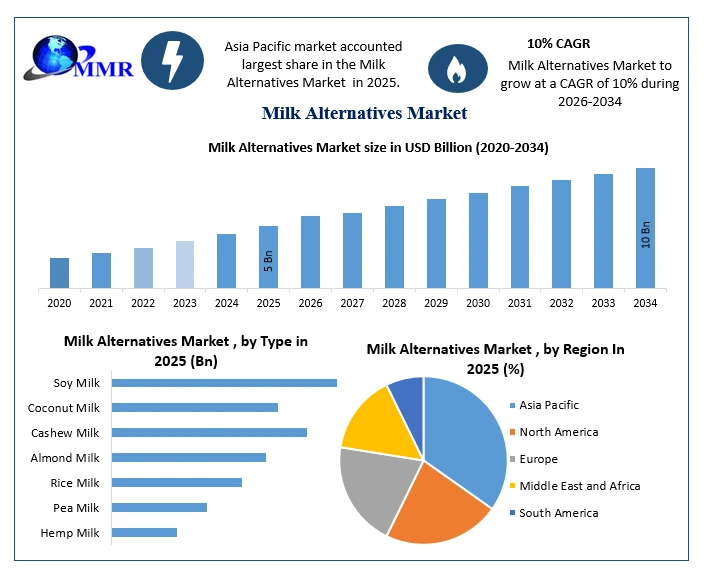
Global Milk Alternatives Market to Reach USD 72.10 Billion by 2032 from USD 33.63 Billion in 2024 at 10% CAGR. The Global Milk Alternatives Market is entering a period of accelerated transformation as plant-based nutrition, clean-label innovation, and premium consumer preferences reshape the future of the global food and beverage industry. According to Maximize Market Research...