


Radome Market Growth Accelerates with Rising Defense and Aerospace Investments
Market overview
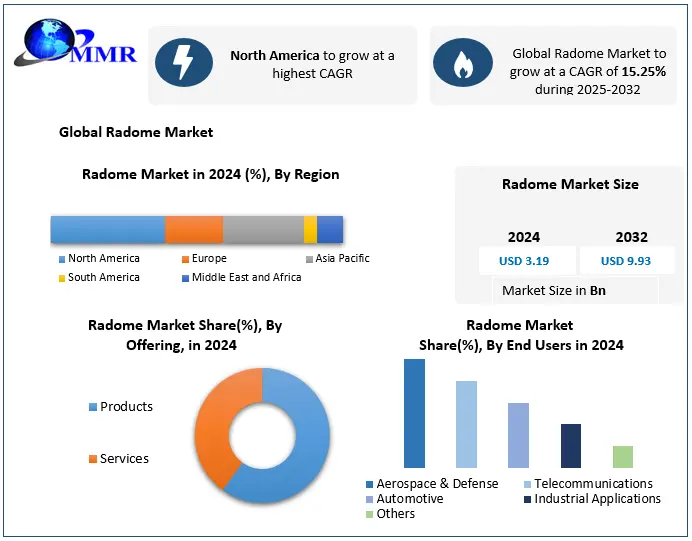
The Radome Marketis entering a high-growth phase as aerospace, defense, telecommunications, satellite communication and advanced radar applications increase their reliance on high-performance protective structures. According to Maximize Market Research, the global Radome Market was valued at USD 3.19 billion in 2024 and is projected to reach USD 9.93 billion by 2032, expanding at a 15.25% CAGR from 2025 to 2032. Radomes protect radar and communication antennas from rain, snow, dust, wind and other environmental conditions while maintaining electromagnetic signal transmission.
The principal growth driver is the expansion of aerospace and defense programs, particularly aircraft modernization, unmanned aerial vehicles, missile-defense systems and next-generation radar platforms. Rising defense expenditure and geopolitical risks are encouraging governments to modernize surveillance, communication and electronic warfare capabilities. At the same time, the deployment of 5G networks, satellite communications and phased-array radar is creating opportunities beyond traditional aircraft applications. Advanced composites, fiberglass, quartz, carbon fiber and silicon nitride are enabling lighter, stronger and more heat-resistant structures. GaN-based radar systems, AESA antennas, additive manufacturing and reduced size, weight, power and cost requirements are also creating demand for technically advanced radomes.
U.S. Market Trends and Investment
The United States remains a critical growth center because North America held the largest regional share of the Radome Market in 2024. U.S. defense modernization and investment in radar infrastructure are particularly important demand catalysts. In 2025, Raytheon, an RTX business, received a $646 million U.S. Navy contract for continued production and sustainment of SPY-6 radars, following an earlier contract valued at up to $3 billion over five years. RTX also reported more than $800 million invested in SPY-6 infrastructure and capacity enhancements, including automation at its Radar Development Facility in Andover, Massachusetts. In addition, the U.S. government funded advanced radome research: BNNT received a 2025 U.S. Navy SBIR Phase II award of $1.198 million for enhanced-performance radome materials designed for hypersonic environments, while Canopy Aerospace received a U.S. Air Force award for additive-manufactured silicon-nitride radomes. These investments point toward increasing demand for thermally stable, lightweight and RF-transparent materials.
Request To Free Sample of This Strategic Report ➤ https://www.maximizemarketresearch.com/request-sample/221366/
Radome Market Segmentation
-
By Offering
-
Product
-
Service
-
-
By Platform
-
Ground
-
Airborne
-
Naval
-
-
By Application
-
Communication
-
Radar
-
Satellite Communication
-
Aircraft
-
UAVs
-
Other Applications
-
-
By Frequency Band
-
HF/VHF/UHF
-
L-Band
-
S-Band
-
C-Band
-
X-Band
-
Ku-Band
-
Ka-Band
-
Other Frequency Bands
-
-
By Material
-
Fiberglass
-
Quartz
-
Ceramic
-
PTFE
-
Polycarbonate
-
Other Materials
-
-
By Region
-
North America
-
Europe
-
Asia Pacific
-
Middle East & Africa
-
South America
-
Competitive Analysis
The global competitive environment includes L3Harris Technologies, General Dynamics Corporation, Saint-Gobain Performance Plastics, Cobham and Raytheon Technologies, among other established suppliers. The market is characterized by investments in customized designs, lightweight structures, advanced composites and electromagnetic-performance optimization.
L3Harris Technologies is a major supplier of advanced radome solutions for airborne, ground and maritime platforms. Its broad defense and sensing portfolio positions it to benefit from modernization of radar and electronic systems.
General Dynamics Mission Systems has focused on customized defense and aerospace radomes. The company introduced lightweight, multilayered military radomes designed to improve radar clarity and durability under extreme conditions, supporting the industry's shift toward lower-weight and higher-performance structures.
Saint-Gobain Performance Plastics differentiates itself through advanced material technologies. Its connectivity radome portfolio supports Ku/Ka-band applications for commercial aircraft, with certified solutions designed for Airbus fleets. Its emphasis on radar transparency, durability and connectivity creates opportunities as aircraft communications become increasingly sophisticated.
Cobham remains an important participant in communication, radar and electronic-warfare radomes. Its focus on lightweight and aerodynamic designs is aligned with aircraft and satellite communication requirements, where low weight and reliable RF transmission are essential.
Raytheon Technologies/RTX is strengthening the radar ecosystem through substantial manufacturing investment and advanced technology. In 2025, Raytheon highlighted military-grade gallium-nitride technology, which can deliver significantly higher performance than earlier semiconductor approaches. Its software-defined aperture architecture also enables flexible, multi-mission radar capabilities, potentially increasing demand for radomes capable of supporting wider and more complex operating requirements.
Regional Analysis
United States: The U.S. is the leading country within the dominant North American regional market. Strong defense budgets, aircraft modernization, missile-defense programs, naval radar deployment and 5G/satellite communication infrastructure support sustained demand. The 2025 investments in SPY-6, LTAMDS and hypersonic radome materials demonstrate the country's strong technology pipeline.
United Kingdom: The UK's defense spending expansion is supporting advanced radar and aerospace technologies. In 2025, the government committed £204.6 million toward the next-generation ECRS Mk2 radar for Eurofighter Typhoon aircraft. The government also announced an increase in defense spending to 2.5% of GDP from April 2027.
Germany: Germany's investment in air and missile defense is creating opportunities for radar-related technologies. The Bundeswehr reported infrastructure progress for the Arrow missile-defense system, including infrastructure for radar installations, with initial operational capability declared in December 2025.
France: France is strengthening domestic and European radar capabilities. In 2025, its DGA ordered the Aurore low-Earth-orbit surveillance radar from Thales and advanced the DRAGON next-generation airborne radar program. France also signed an agreement with Bulgaria for joint procurement of radar surveillance and air-defense systems.
Japan: Japan's 2025 defense budget allocated ¥8.4748 trillion on an expenditure basis, with priorities including integrated air and missile defense, unmanned systems, satellite constellations and next-generation defense communications. These priorities support long-term demand for radar protection and high-performance radome technologies.
China: China represents an important Asia-Pacific opportunity because of its expanding aerospace, defense, radar and satellite capabilities. Increasing demand for advanced surveillance, communications and unmanned systems is expected to support radome adoption, particularly where lightweight and high-temperature-resistant materials are required.
Request To Free Sample of This Strategic Report ➤ https://www.maximizemarketresearch.com/request-sample/221366/
Radome Market Key Players
-
General Dynamics Mission Systems, Inc.
-
Atlanta Aerospace
-
Infinite Technologies
-
Nordam
-
Royal Engineered Composites
-
Starwin Industries
-
HEICO Corporation
-
Astronics Corporation
-
Diamond Antenna and Microwave Corporation
-
L3Harris Technologies, Inc.
-
Lockheed Martin Corporation
-
Raytheon Technologies Corporation
-
Northrop Grumman Corporation
-
Saint-Gobain
-
Meggitt PLC
-
Cobham SATCOM
-
BAE Systems
-
Airbus Defence and Space
-
KYOCERA Corporation
-
Hindustan Aeronautics Limited (HAL)
-
Infinite Technologies Pvt. Ltd.
-
China Aerospace Science and Industry Corporation (CASIC)
-
Israel Aerospace Industries (IAI)
-
Elbit Systems Ltd.
-
Rafael Advanced Defence Systems Ltd.
-
Paramount Group
-
Avibras Indústria Aeroespacial S.A.
-
Embraer S.A.
-
Indústria de Aviação e Serviços (IAS)
-
EL Sistemas S.A.
Conclusion
The Radome Market has strong long-term growth potential, supported by a projected increase from USD 3.19 billion in 2024 to USD 9.93 billion by 2032 at a 15.25% CAGR. In our view, the strongest opportunities will come from the convergence of defense modernization, advanced radar, hypersonic platforms, UAV deployment, satellite communications and 5G infrastructure. Material innovation will be equally important: silicon nitride, quartz, advanced composites, carbon fiber, hydrophobic coatings and additive manufacturing can improve thermal resistance, durability, weight and RF performance. Companies that combine material science with multifunctional, lightweight and digitally optimized radome designs are likely to capture the greatest opportunities as radar systems become faster, smaller, more powerful and increasingly multifunctional.
About Maximize Market Research
Maximize Market Research Pvt. Ltd. (MMR) is a global market research and consulting company that provides reliable, data-focused, and practical business insights. The firm serves a wide range of industries, including healthcare, pharmaceuticals, technology, automotive, electronics, chemicals, personal care, and consumer goods. Through market forecasts, competitive analysis, strategic consulting, and industry impact assessments, MMR helps organizations understand changing market conditions, identify growth opportunities, and make informed business decisions for long-term success.
Contact Us
Maximize Market Research Pvt. Ltd.
2nd Floor, Navale IT Park Phase 3
Pune Bangalore Highway, Narhe
Pune, Maharashtra 411041, India
Phone: +91 9607365656
Email: sales@maximizemarketresearch.com
Categorieën
Read More
SEO Company in New Jersey has become a crucial phrase for businesses aiming to compete in today’s crowded online landscape. Companies are no longer relying on outdated methods to gain visibility. Instead, they are embracing smarter, more adaptive strategies that reflect how people search, think, and make decisions online. The digital space has evolved into an environment where relevance,...

Buying a home is one of the biggest financial decisions most people will make. From finding the right neighborhood to negotiating the best price, every step requires careful planning and expert guidance. Whether you are a first-time buyer or looking to upgrade to a new property, working with a Buyer's Agent in Boulder, CO can make the process smoother, less stressful, and more...

Benefits of Using Certification Exam Preparation Material Certification exams help people grow in their careers. They help you get better jobs. They also help you earn more money. Many students want to pass the BCABA exam on the first attempt. This exam is offered by BACB. However, exam preparation can feel difficult. There are many books to read and many topics to cover. This is why using...

The lemon essential oil market is experiencing a remarkable transformation as wellness-conscious consumers increasingly turn to nature for holistic health solutions. As per Market Research Future, the global demand for lemon essential oil is climbing steadily, fueled by a deep-rooted shift toward preventive self-care and emotional well-being. At the heart of this evolution lies the soaring...
According to the latest report published by Data Bridge Market Research, the Edible Cutlery Market The global edible cutlery market size was valued at USD 38.20 million in 2024 and is expected to reach USD 76.79 million by 2032, at a CAGR of 9.12% during the forecast period This Edible Cutlery Market research report has been formed with a nice...