


How to Choose a Shopify Development Agency Without Getting Burned
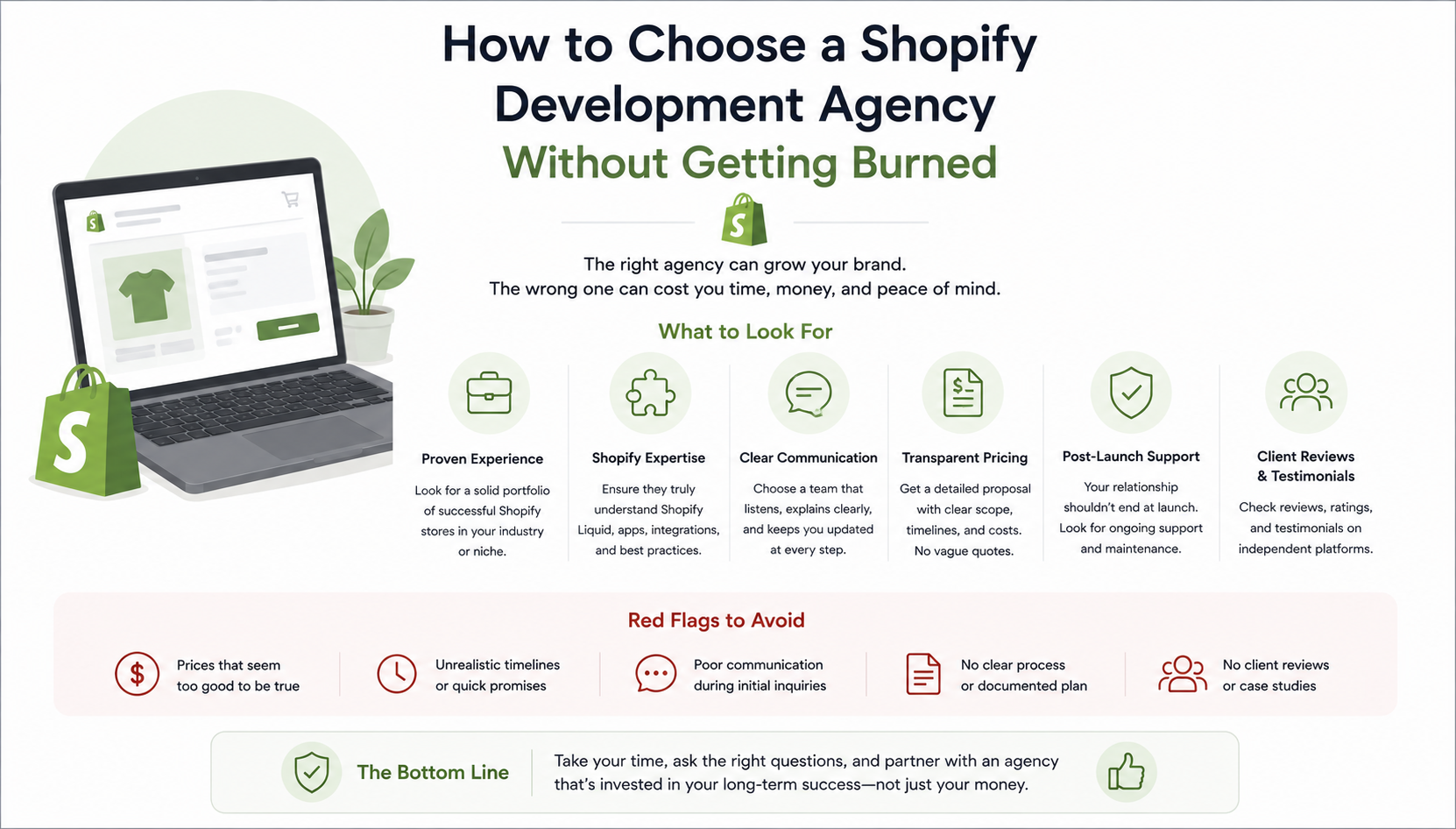
We inherited a store last year from a client who'd already been through two agencies before us. The first one disappeared halfway through a rebuild. The second one delivered something that technically worked but broke every time an order came in with more than three line items. By the time she found us, she'd spent nearly $50,000 and had nothing usable to show for it.
That story isn't rare. It's common enough that we could tell you five more just like it. So let's talk about how to actually avoid becoming one.
Why Shopify Agency Hiring Goes Wrong So Often
Shopify has a low barrier to entry, and that cuts both ways. It's great because it means small, genuinely skilled shops can compete with big agencies. It's bad because it also means anyone with a theme license and a portfolio site can call themselves a Shopify agency, take a deposit, and vanish.
The merchants who get burned almost always made the same mistake: they evaluated the agency's sales pitch instead of the agency's actual process. Pitches are easy to fake. Process is not.
The Questions That Actually Separate Real Agencies From Risky Ones
Skip the portfolio review for a minute. Ask these questions first, and pay attention to how specifically they're answered.
"Walk me through how you'd scope my project." A real agency asks you questions before quoting a price: your product catalog complexity, your integrations, your growth plans, your current pain points. If you get a flat number within minutes of a first call with no real discovery, that's a red flag, not efficiency.
"Who will actually be doing the work?" A shocking number of agencies sell you a senior strategist on the sales call, then quietly hand the build to a junior contractor or an offshore team they've never worked with before. Ask directly who touches the code, and ask to talk to that person before signing anything.
"What happens if we need to change scope halfway through?" Every real project changes scope at some point. Agencies that get defensive about this question, or promise zero changes ever, are usually the ones who'll either overcharge you for the change later or refuse to make it at all.
"Can I own the code and see documentation as we go?" This is the single most important question on this list. If an agency is vague about code ownership or documentation, walk away. We'll come back to this one.
"Can you show me a project similar to mine, not just any project?" A store selling forty simple SKUs and a store running complex B2B pricing tiers require completely different skill sets. General Shopify experience isn't the same as experience with your specific type of complexity.
Red Flags Worth Walking Away From
Some warning signs are subtle. Others are not, and you'd be surprised how often merchants ignore the obvious ones because the price was tempting.
A quote that's dramatically cheaper than everyone else's for the exact same scope. There's almost always a reason, and it's rarely "we're just more efficient."
No clear communication cadence agreed upon before work starts. If nobody tells you when to expect updates, you'll be chasing them by week three.
Pressure to sign quickly, or a deal that "expires" in 24 hours. Legitimate agencies don't need artificial urgency to close a $20,000 contract.
Reluctance to put deliverables and timelines in writing. A verbal promise means nothing when the project is three months late.
An agency that only talks about Shopify and can't speak intelligently about the underlying web fundamentals. A lot of genuinely hard Shopify problems are actually general Web Development Services problems wearing a Shopify costume: performance, data structure, integration architecture. If they can only talk theme settings, that's a limited toolkit.
What Code Ownership Actually Protects You From
This deserves its own section because it's the thing that burns people most often and gets talked about least.
If an agency builds custom functionality for your store and you don't own the code, or there's no documentation explaining how it works, you are locked into that agency forever. Not because you love working with them. Because nobody else can safely touch what they built without risking breaking it.
We've taken over stores where the previous developer refused to hand over credentials until an outstanding invoice was paid in full, holding a client's own store hostage. That's an extreme case, but milder versions happen constantly: undocumented custom code, no comments, cryptic app configurations nobody explained. Ask for documentation and code access in writing before the project starts, not after you're already unhappy.
Matching the Agency to the Actual Job
Not every project needs the same kind of agency, and this is where a lot of merchants overpay or underhire.
If you need a theme setup with light customization, you want a smaller, focused Shopify specialist. Fast, affordable, good at exactly one thing.
If you need custom functionality, integrations with outside systems, or anything approaching what would normally be called Custom Software Development Services, you want a team with actual software engineering depth, not just theme editing experience. Those are genuinely different skill sets, even though both get sold under the same "Shopify agency" label.
If your project spans both, which is common, you want a team that can flex between the two without handing you off to three different subcontractors along the way.
A Simple Filter Before You Sign Anything
Before committing to any agency, get a short pilot project or paid discovery phase first. It's usually a small percentage of the full project cost, and it tells you everything a sales call can't: how they communicate under real deadlines, whether their estimates hold up against reality, and whether the people on the sales call are the same people doing the actual work.
At North Rose Technologies, we treat this stage as non negotiable, partly because it protects the client and partly because it protects us. A rushed scoping process is how both sides end up disappointed six weeks in. Good Shopify Development Services work starts with an honest, sometimes uncomfortable conversation about what your store actually needs, not a polished sales deck.
FAQ
How much should I expect to pay for a Shopify development agency?
It depends entirely on scope. Simple theme setups often run $3,000 to $10,000. Custom builds with integrations typically start around $15,000 and scale from there based on complexity.
Should I hire a Shopify specialist agency or a general web development agency?
It depends on your project. Pure storefront work favors a Shopify specialist. Projects involving custom integrations or complex backend logic favor a team with broader software development experience.
What's the biggest mistake merchants make when hiring a Shopify agency?
Choosing based on price and portfolio alone without asking about process, code ownership, and who actually does the work. Those three things predict outcomes far better than a pretty case study page.
How do I protect myself if the relationship goes badly midway through?
Get code ownership, documentation, and a defined communication cadence in writing before the project starts. If something goes wrong, you'll at least have a store another developer can pick up without starting from zero.
Categorias
Leia mais
In recent years, fitness enthusiasts and health professionals have increasingly recognized the transformative effects of water‑based exercise. Among these aquatic workouts, AquaFit stands out as a powerful approach to achieving fitness goals while minimizing stress on the body. Whether you’re a beginner, an athlete, or someone recovering from injury, AquaFit offers a comprehensive fitness...

" According to the latest report published by Data Bridge Market Research, the Advanced Analytics Market The global advanced analytics market size was valued at USD 37.38 billion in 2025 and is expected to reach USD 190.92 billion by 2033, at a CAGR of 22.61% during the forecast period Advanced Analytics Market report is a window to the industry...

What Is VittaBurn? VittaBurn is a daily dietary supplement formulated to support metabolism, balanced energy, appetite awareness, and overall wellness. The formula combines plant-based extracts traditionally used to promote metabolic activity, physical vitality, and antioxidant support. Rather than relying on harsh stimulants or restrictive approaches, VittaBurn is designed to complement...

The online gaming industry has experienced remarkable growth over the past decade, offering players a wide range of entertainment options. Among the many number-based games available today, ColokSGP remains a popular choice for enthusiasts who enjoy prediction-style gameplay. Its simple mechanics, multiple betting options, and easy accessibility have helped maintain its appeal among...
Keyword Market Summary: According to the latest report published by Data Bridge Market Research, the North America Tannin Market The North America Tannin Market size was valued at USD 753.04 million in 2024 and is expected to reach USD 454.49 million by 2032, at a CAGR of 6.66% during the forecast period The market growth is largely driven by the...