Common Uses of a Chamfer Tool in Metalworking
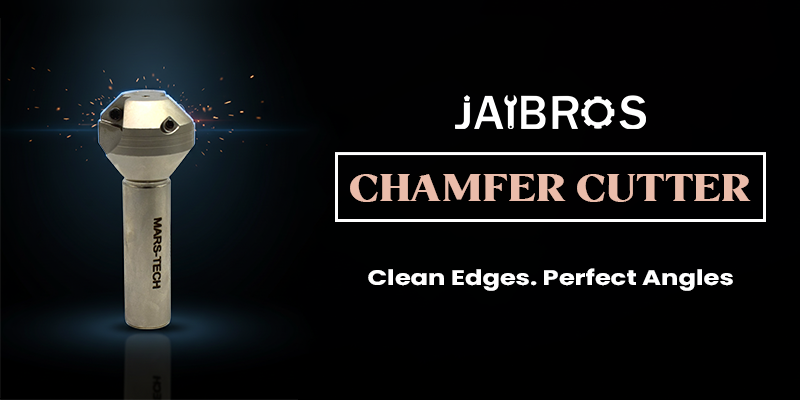
Discover the common uses of a chamfer tool in metalworking, including edge breaking, hole chamfering, stress reduction, and finishing.
How Chamfering Tools Are Used in Modern Metalworking
Metalworking is not only about cutting material to size; it is also about finishing components so they are safe, functional, and ready for assembly. Sharp edges and unfinished corners can lead to poor fit ment, faster wear, and handling risks. This is where a chamfer tool becomes an essential part of modern metalworking operations. Chamfering improves edge quality, enhances performance, and ensures consistency across machined parts.
Why Chamfering Matters in Metalworking
Chamfering is the process of creating a beveled edge between two surfaces. In metalworking, this operation is applied to remove sharp corners, reduce burrs, and improve part usability. Chamfered edges make components safer to handle and easier to assemble, especially in precision-driven industries.
A chamfer tool allows machinists to perform this operation accurately on CNC lathes, milling machines, and drilling centers, reducing the need for manual finishing.
Edge Breaking and Deburring
One of the most common uses of chamfering in metalworking is edge breaking. After cutting or drilling, metal parts often have sharp edges or burrs that can cause injury or interfere with assembly.
Chamfering helps to:
-
Remove sharp edges after machining
-
Reduce burr formation
-
Improve handling safety
-
Create a clean and professional finish
A chamfer cutter tool is often used for quick and controlled edge breaking in both manual and CNC operations.
Chamfering Holes for Better Assembly
Hole chamfering is a critical operation in metalworking, especially when parts require fasteners, pins, or shafts. A small chamfer at the hole entrance helps guide components into position and prevents damage during assembly.
Using a chamfer tool for hole chamfering ensures:
-
Easier fastener insertion
-
Reduced risk of cross-threading
-
Improved alignment during assembly
-
Better surface finish around holes
The 45-degree chamfer cutter is commonly preferred for this application due to its balanced bevel angle.
Preparing Parts for Welding and Coating
Chamfering is also widely used to prepare metal parts for welding, coating, or painting. Sharp edges can cause poor weld penetration and uneven coating thickness.
Common benefits include:
-
Improved weld strength and penetration
-
Uniform paint or coating coverage
-
Reduced risk of coating failure at edges
-
Enhanced durability of finished parts
In such applications, chamfering improves both structural integrity and appearance.
Chamfering for Precision and Stress Reduction
Sharp internal and external corners can create stress concentration points, which may lead to cracking or premature failure under load. Chamfering helps distribute stress more evenly across the part.
A chamfer tool is often used in precision metalworking to:
-
Reduce stress concentration
-
Improve fatigue resistance
-
Enhance part longevity
-
Maintain dimensional stability
This is especially important in automotive, aerospace, and heavy machinery components.
Chamfering in Milling Operations
In milling processes, chamfering is applied to flat surfaces, pockets, and complex profiles. A chamfer milling cutter is commonly used when larger chamfers or contoured edges are required.
These tools offer:
-
Better rigidity
-
Consistent chamfer with the
-
Smooth surface finish
-
High repeatability in production
Chamfer milling is ideal for components that require both functional and aesthetic edge finishing.
High-Volume Production and Cost Efficiency
In high-volume manufacturing environments, efficiency and tool life are critical. An insert chamfer tool is often chosen for such applications because it uses replaceable inserts instead of a solid cutting edge.
Advantages include:
-
Lower tooling costs
-
Quick insert replacement
-
Consistent cutting performance
-
Reduced machine downtime
This makes insert-based tools suitable for repetitive chamfering operations.
Applications Across Metalworking Industries
Chamfering is widely used across various metalworking sectors, including:
-
Automotive manufacturing
-
Aerospace components
-
Industrial machinery
-
Mold and die production
-
General fabrication and tooling
In each of these industries, a chamfer tool plays a key role in improving safety, assembly accuracy, and product quality.
Best Practices for Chamfering in Metalworking
To achieve consistent and accurate results, machinists should follow these best practices:
-
Select the correct chamfer angle
-
Maintain proper tool alignment
-
Avoid excessive cutting depth
-
Use stable feed rates
-
Apply coolant when required
A properly applied chamfer tool ensures clean, burr-free edges without compromising part dimensions.
Conclusion
Chamfering is a vital finishing operation in metalworking, with applications ranging from deburring and hole preparation to stress reduction and surface improvement. By choosing the right tools and following correct machining practices, manufacturers can achieve higher quality and more reliable components. A well-selected chamfer tool helps improve safety, performance, and overall production efficiency.
For dependable machining tools and metalworking solutions, jaibros offers a range of high-quality cutting tools designed to meet modern manufacturing requirements.
FAQs
1. What is the most common use of chamfering in metalworking?
Edge breaking and deburring are the most common chamfering applications.
2. Why is hole chamfering important?
It improves assembly accuracy and prevents damage to fasteners and mating parts.
3. Which chamfer angle is most widely used?
The 45-degree angle is the standard choice for most metalworking applications.
4. Are insert-based tools suitable for production work?
Yes, they are ideal for high-volume operations due to cost efficiency and consistency.
5. Does chamfering affect part dimensions?
When done correctly, chamfering improves edge quality without affecting critical dimensions.
Categorie
Leggi tutto
Mumbai is a city that pulses with life, ambition, and excitement. Among its many vibrant neighborhoods, Andheri stands out as a hub for entertainment, business, and cosmopolitan living. This lively suburb is home to multinational offices, media studios, shopping malls, and a flourishing nightlife—making it a magnet for people seeking new experiences and connections. In this context, the...

Online cricket betting has become extremely popular among cricket fans who want to add extra excitement to their favorite matches. With the growth of digital platforms, users can now enjoy fast and secure betting opportunities from anywhere. However, choosing the right platform is very important for a safe and smooth experience. This is where Shivaay Bharat stands out as a trusted platform for...

The rapid advancement of smart technology has transformed the way people interact with their homes. What was once limited to basic alarms and locks has now evolved into fully connected ecosystems that offer control, automation, and real-time monitoring. This shift is having a major impact on the home security...

A recent leak from Honkai: Star Rail suggests significant improvements are on the horizon for Kafka's abilities, hinting at a powerful upgrade to her follow-up attack mechanism. As one of the initial characters confirmed to receive buffs, Kafka's role in the game is expected to evolve in upcoming updates. Initially, Kafka was highly anticipated among the early roster of Honkai: Star Rail,...

Keyword research in 2026 is no longer about finding high-volume keywords and stuffing them into content. Search engines and AI systems have become much smarter. They now focus on intent, context, and relevance. The good news is you don’t need expensive tools to get started. With the right approach, you can do effective keyword research using free tools and build a strong SEO (Search...