2026 Will Redefine Hospital Credentialing: Green Security CEO Shares Five Predictions for Healthcare Leaders
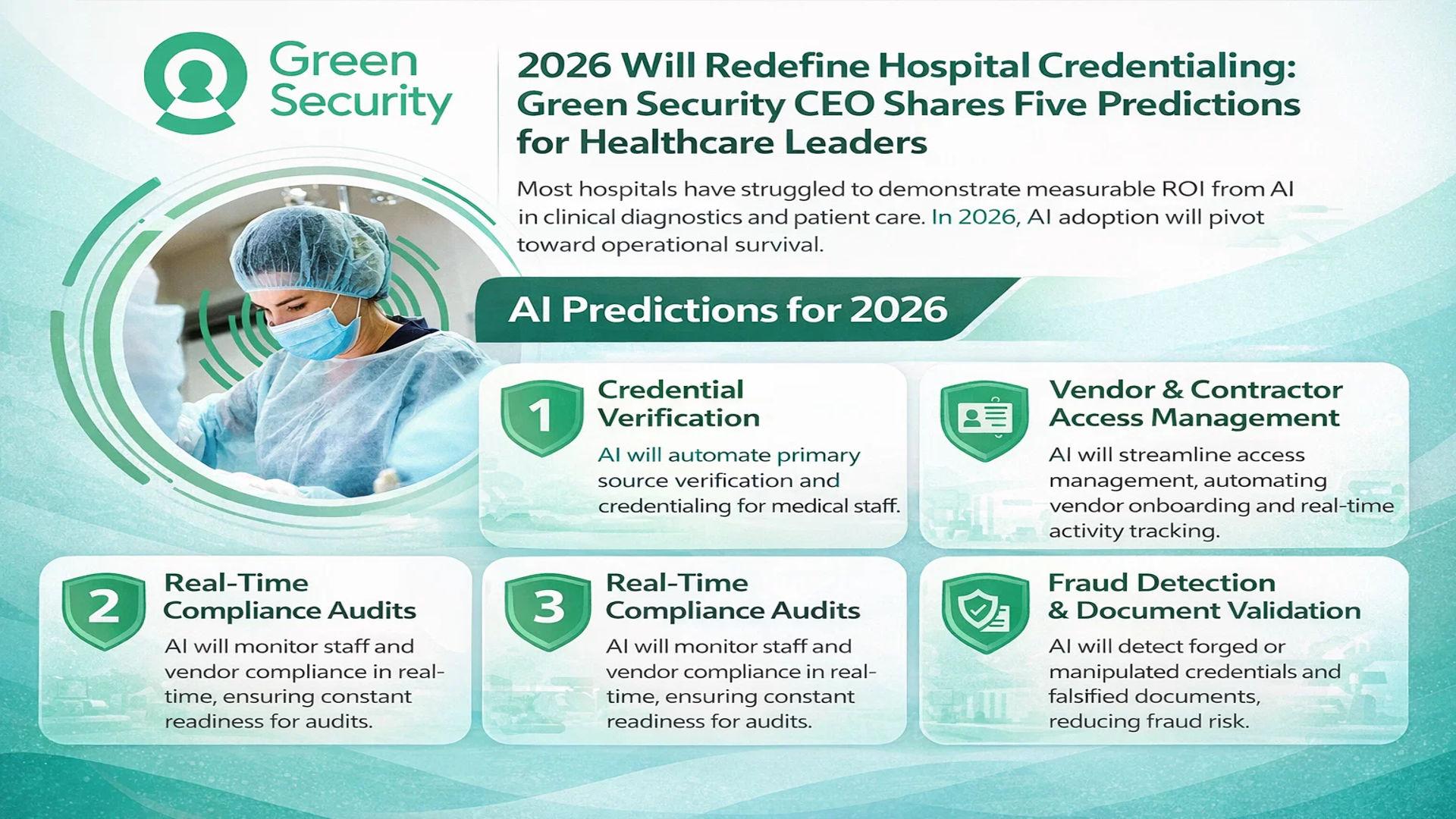
Clearwater, FL – As healthcare systems navigate rising financial strain, regulatory complexity, and accelerating technological change, hospital credentialing is emerging as one of the most strategic operational priorities of 2026. According to Mickey Meehan, CEO of Green Security, the year ahead will fundamentally reshape how healthcare organizations manage vendor and contractor access, compliance governance, and operational risk.
In his latest industry outlook, Meehan outlines five key predictions that signal a permanent shift from static, back-office credentialing processes to AI-driven, continuous compliance systems.
Healthcare leaders can explore Green Security’s vendor credentialing solutions at:
https://gogreensecurity.com/vendor-credentialing
AI Will Move from Clinical Hype to Operational Necessity
While artificial intelligence has been widely promoted for clinical diagnostics and patient care innovation, most hospitals have struggled to demonstrate measurable ROI in those areas. In 2026, AI adoption will pivot toward operational survival.
Hospitals will deploy AI to automate:
-
Credential verification
-
Real-time compliance audits
-
Vendor and contractor access management
-
Fraud detection and document validation
Operational resilience is becoming the foundation for scalable healthcare innovation. Without stable, compliant operations, clinical transformation cannot succeed.
Compliance Will Become a Board-Level Risk Metric
Healthcare organizations face increasing oversight from regulatory bodies such as:
-
The Joint Commission
-
Centers for Medicare & Medicaid Services
-
National Fire Protection Association
Fragmented reporting requirements and evolving standards have created significant exposure for hospitals. In 2026, credentialing programs will no longer sit quietly in administrative departments. They will be elevated to board-level discussions alongside cybersecurity, financial risk, and patient safety metrics.
Organizations that modernize credentialing governance will gain a measurable compliance advantage.
Learn more about modern credentialing governance best practices here:
https://tinyurl.com/yfxwas4m
AI Will Become Healthcare’s Most Powerful Fraud Defense
Generative AI has introduced new fraud risks, including synthetic identities and convincingly forged credentials. However, the same technology now enables hospitals to detect manipulated documents, altered certifications, and suspicious submissions in real time.
By leveraging intelligent verification systems, healthcare facilities can close long-standing vulnerabilities in vendor and contractor oversight — protecting patient safety, data security, and institutional integrity.
Continuous Monitoring Will Replace Static Credentialing
Traditional credentialing models rely on annual verification cycles. But licenses expire, sanctions change, and workforce risks evolve daily.
In 2026, the standard will shift to continuous credential monitoring — including:
-
Real-time license validation
-
Automated sanction screening
-
Ongoing background verification
-
Expiration alerts and compliance drift detection
This mirrors the cybersecurity industry’s move from periodic audits to continuous assurance.
Hospitals seeking operational modernization can explore continuous vendor credential monitoring solutions at:
https://gogreensecurity.com/vendor-credentialing
Cyber Insurance Will Require Active Credential Monitoring
Cyber insurers are expanding underwriting requirements beyond ransomware preparedness to include third-party access controls. As outsourcing and contractor activity increase, insurers view unmonitored vendor access as a high-risk vulnerability.
In 2026, healthcare organizations without proof of continuous credential monitoring may face:
-
Higher insurance premiums
-
Reduced coverage
-
Policy exclusions
As a result, CFOs are joining CISOs and compliance leaders in prioritizing credentialing modernization as both a financial and operational safeguard.
Additional insights on emerging healthcare credentialing trends can be found here:
https://tinyurl.com/j7uy7xja
The Expanding Role of Contractors in Hospital Credentialing
A critical but often overlooked element of credentialing governance is contractor inclusion.
Contractors — including biomedical engineers, HVAC technicians, IT specialists, and service providers — regularly access sensitive hospital environments. Whether on-site or remote, these individuals must meet the same verification standards as permanent staff and vendors.
Failure to credential contractors properly introduces risks including:
-
Patient safety incidents
-
Regulatory violations
-
Operational disruption
-
Reputational damage
A standardized, centralized credentialing framework ensures every non-employee meets documented compliance standards.
Healthcare leaders can review contractor-inclusive credentialing strategies at:
https://tinyurl.com/yfxwas4m
Best Practices for Vendor & Contractor Credentialing Governance
To build a future-ready credentialing program, healthcare organizations should:
-
Develop standardized credentialing policies
-
Centralize verification processes
-
Include contractors in full compliance protocols
-
Conduct ongoing audits and automated renewals
-
Leverage AI-powered verification technology
-
Provide real-time reporting for board oversight
Modern credentialing governance enhances transparency across subcontractors, improves billing oversight, and strengthens supply chain accountability.
About Green Security
Green Security is a healthcare-focused vendor credentialing and facility access compliance provider that helps hospitals automate verification, manage non-employee access, and maintain continuous regulatory readiness.
By combining AI-driven monitoring with centralized governance tools, Green Security empowers healthcare organizations to transition from reactive credentialing to proactive compliance management.
Frequently Asked Questions (FAQs)
FAQs by Technology
Q: How does AI improve hospital credentialing?
AI automates license verification, detects fraudulent documents, performs sanction screening, and enables real-time compliance monitoring.
Q: Can AI detect forged or AI-generated credentials?
Yes. Advanced verification systems can identify manipulated documents and inconsistencies that manual review often misses.
Q: What is continuous credential monitoring?
It is an automated system that verifies credentials in real time rather than relying on annual or periodic reviews.
FAQs by Compliance & Risk
Q: Why is credentialing becoming a board-level issue?
Because credentialing directly impacts regulatory compliance, cybersecurity exposure, patient safety, and insurance risk.
Q: What regulations require contractor credentialing?
Healthcare facilities must meet standards set by accrediting and regulatory bodies including The Joint Commission, CMS, and NFPA.
Q: Can poor credentialing impact cyber insurance coverage?
Yes. Insurers increasingly require proof of monitored third-party access as part of underwriting criteria.
FAQs by Contractor Inclusion
Q: Should contractors be credentialed like vendors and employees?
Yes. Contractors often access critical systems and patient environments, making equal verification essential.
Q: What credentials should contractors provide?
Background checks, immunizations, licenses, training certifications, and policy compliance documentation.
Q: How does centralized credentialing benefit general contractors?
It provides transparency into subcontractor compliance, reduces billing disputes, and enhances operational accountability.
Categorias
Leia Mais
Online entertainment has become a big part of everyday life for many people in Asia. Players now look for platforms that are safe, fast, and easy to use. DEBET stands out as a leading online entertainment platform that brings multiple gaming options under one reliable system. With a modern design, smooth performance, and strong security, debet offers a comfortable experience for both new and...

Spring caliper set is a simple workshop tool used to compare internal and external sizes accurately, helping machinists maintain proper dimensions. What Is a Spring Caliper Set? A spring caliper set is a manual measuring tool used to compare dimensions of workpieces. It does not give direct readings like a digital caliper. Instead, it transfers measurement from a job to a scale or from one...

Stussy has always been the kind of brand that understands what the streets want before the streets even ask for it, and nowhere is that clearer than in its hoodies. “Urban cool” isn’t just a style—it’s a rhythm, an attitude, and a presence you carry when you step out, and Stussy hoodies lock into that vibe perfectly. They’re built with the right blend of...

Discount Brokers in India | Firstock – A Simple Guide for Every Trader Introduction Have you ever wondered why more Indians are opening trading accounts today than ever before? The answer is simple—discount brokers in India have changed the way people invest. Gone are the days when trading felt like a VIP-only club with high fees and confusing processes. Today, anyone with a...

Dubai’s fast-paced lifestyle, luxury living, and modern architecture demand interior solutions that offer both comfort and style. One of the most essential window treatments for homes and offices is blackout blinds. Designed to block external light completely, blackout blinds provide privacy, temperature control, and enhanced comfort. Choosing the right blackout blinds shop in Dubai...