


Networking, Storage, and Power HATs: Maximizing Raspberry Pi Efficiency
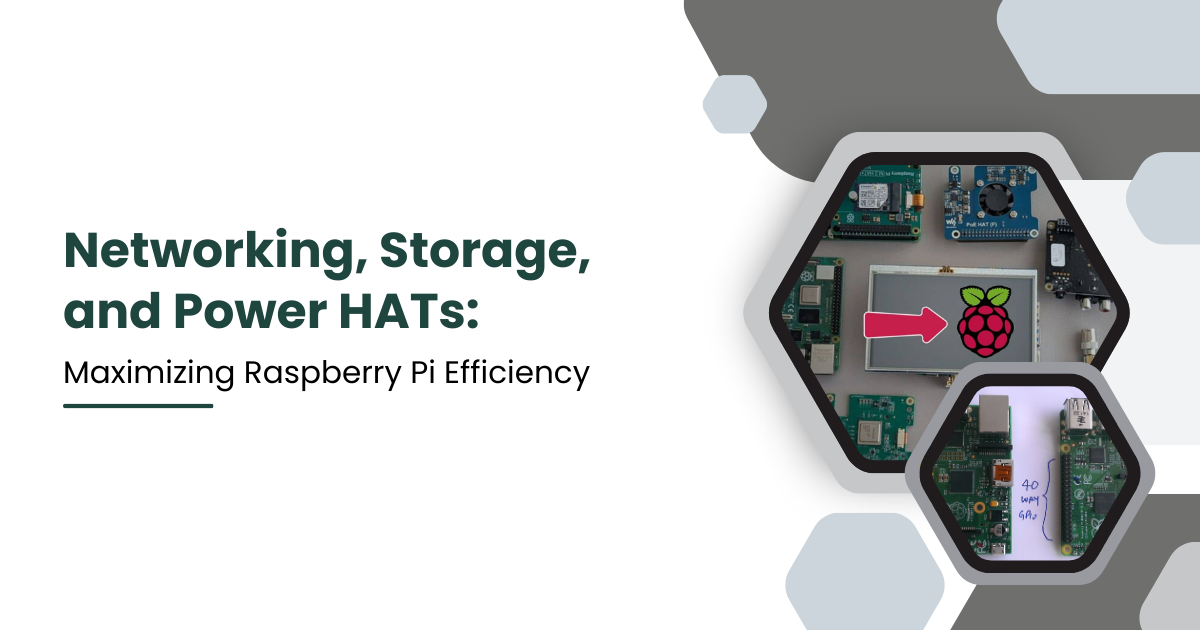
Single-board computers now drive many industrial and edge computing projects. Raspberry Pi leads this shift due to cost, size, and flexibility. Recent IoT analysts estimate that more than 18 billion devices were connected in 2024, with projections reaching nearly 39 billion by 2030. Edge computing significantly lowers latency by processing data locally, often reducing response times from tens of milliseconds to single-digit milliseconds. Processing data locally can reduce bandwidth consumption by more than half in data-intensive deployments.
These trends push engineers to design compact yet powerful systems. The Raspberry Pi alone cannot meet all industrial needs. Engineers extend their capabilities using Raspberry Pi HATs. Hardware Attached on Top (HAT) modules add networking, storage, and power features without redesigning the baseboard.
What Are Raspberry Pi HATs?
A HAT is an add-on board designed for the Raspberry Pi GPIO header. It follows a defined mechanical and electrical specification.
The board sits directly on the Pi and communicates through GPIO, I2C, SPI, or UART interfaces.
Key Characteristics
-
Plug-and-play hardware expansion
-
Automatic configuration through EEPROM identification
-
Compact integration without external wiring
-
Reliable mechanical mounting for industrial setups
-
Standardized compatibility across Raspberry Pi models
HATs convert a general-purpose computer into an application-specific device.
Why Efficiency Matters in Edge Computing
Edge systems often run in remote or resource-limited environments. Efficiency affects both performance and operational cost.
Common Edge Challenges
-
Limited power availability
-
Unstable network connectivity
-
Storage wear due to continuous logging
-
Space constraints inside enclosures
-
Need for always-on operation.
HAT-based architectures solve these issues with targeted hardware acceleration.
Networking HATs: Enabling Reliable Connectivity
Connectivity defines the value of an edge device. Data must move securely and consistently to backend systems.
Standard Ethernet or Wi-Fi does not always meet industrial demands. Engineers use networking HATs to add advanced communication methods.
Types of Networking HATs
Networking HATs expand the communication capabilities of a Raspberry Pi by adding wired, wireless, and cellular connectivity options suited for industrial and remote deployments.
1. Cellular Communication HATs
A Raspberry Pi 4G LTE HAT enables wide-area connectivity using mobile networks.
It works well in locations without wired infrastructure.
Key Features
-
LTE Cat-4 or higher data speeds
-
SIM-based authentication
-
GNSS support for location tracking
-
Remote deployment capability
-
Lower latency than satellite communication
Use Cases
-
Smart agriculture monitoring
-
Fleet tracking systems
-
Remote asset management
-
Environmental sensing stations
Cellular HATs reduce downtime caused by local network failures.
2. Industrial Ethernet HATs
Industrial environments require deterministic communication. Ethernet HATs support protocols such as:
-
Modbus TCP
-
PROFINET (via gateways)
-
EtherCAT bridges
-
Time-sensitive networking support
These HATs include isolation circuits that protect against voltage spikes.
3. LoRa and LPWAN HATs
Low-power wide-area networking HATs support long-range communication with minimal energy use.
Advantages
-
Communication ranges above 10 km in rural areas.
-
Extremely low power consumption
-
Ideal for sensor-driven deployments
These HATs suit smart city and environmental monitoring systems.
Storage HATs: Improving Data Reliability and Speed
MicroSD cards work well for hobby projects. Industrial systems require more reliable storage solutions.
Continuous writes degrade flash memory quickly. Storage HATs provide endurance, speed, and redundancy.
Problems With Standard MicroSD Storage
-
Limited write cycles
-
High corruption risk during power loss
-
Slower I/O under heavy logging
-
Difficult lifecycle management
Storage HATs address these weaknesses.
Types of Storage HATs
Different types of storage HATs include:
1. NVMe SSD HATs
NVMe-based HATs connect through PCIe interfaces available on newer Raspberry Pi models. Performance gains include read speeds that exceed 800 MB/s, faster boot times, lower latency for databases, and improved multitasking. Applications that process video or AI inference benefit greatly from NVMe storage.
2. SATA Storage HATs
SATA HATs support traditional SSDs and hard drives. Advantages include large storage capacity, proven reliability, suitability for on-site backups, and strong performance in edge gateways. These HATs work well in data logging or surveillance systems.
3. RAID-Enabled Storage HATs
RAID-capable HATs allow mirrored storage for fault tolerance. Benefits include data redundancy, continuous operation during disk failure, and increased system lifespan. Industrial automation systems often rely on RAID HAT configurations.
Power Management HATs: Ensuring Stable Operation
Power instability causes the majority of embedded system failures. Edge deployments often operate in harsh electrical environments.
Power HATs regulate, monitor, and protect energy flow to the Raspberry Pi.
Challenges in Edge Power Design
-
Voltage fluctuations damage electronics
-
Sudden outages corrupt data
-
Battery-based systems require monitoring.
-
Solar deployments need charge control.
Power HATs integrate these capabilities into a compact form factor.
Types of Power HATs
These HATs control power input, provide backup support, and maintain stable performance during continuous operation.
1. UPS (Uninterruptible Power Supply) HATs
UPS HATs provide backup power using lithium batteries.
Functions
-
Automatic switchover during outages
-
Safe shutdown signaling
-
Battery health monitoring
-
Runtime prediction
These HATs prevent filesystem corruption and extend hardware lifespan.
2. PoE (Power over Ethernet) HATs
PoE HATs deliver both power and data through a single Ethernet cable.
Advantages
-
Reduced wiring complexity
-
Centralized power management
-
Cleaner installations
-
Remote reboot capability
PoE solutions dominate smart building deployments.
3. Solar Power Management HATs
Solar HATs regulate charging from photovoltaic panels.
Capabilities
-
MPPT charge control
-
Battery protection circuits
-
Energy usage analytics
-
Autonomous operation
These HATs enable off-grid IoT deployments.
Combining Networking, Storage, and Power HATs
Real efficiency emerges when engineers integrate multiple HAT categories into a unified system.
Example Architecture: Remote Industrial Monitoring Node
Components
-
Raspberry Pi baseboard
-
Raspberry Pi 4G LTE HAT for connectivity
-
NVMe Storage HAT for data logging
-
UPS Power HAT for resilience
System Behavior
-
Sensors feed data to the Raspberry Pi.
-
Data writes to high-speed NVMe storage.
-
LTE transmits summarized insights to the cloud.
-
UPS maintains uptime during outages.
This architecture ensures continuous operation even in remote environments.
Thermal and Mechanical Considerations
Stacked HAT configurations increase thermal density. Engineers must manage heat to avoid throttling.
Recommended Practices
-
Use active cooling solutions.
-
Select metal enclosures for heat dissipation.
-
Maintain airflow clearance above stacked boards.
-
Monitor CPU temperature through software tools.
Mechanical stability also matters in vibration-prone locations. Mounting spacers and industrial connectors improve durability.
Software Integration With HAT Hardware
Hardware alone cannot deliver efficiency. Proper software configuration ensures reliable operation.
Key Software Practices
-
Use optimized Linux distributions for embedded workloads.
-
Enable watchdog timers to recover from crashes.
-
Implement journaling filesystems for data safety.
-
Monitor hardware telemetry through I2C sensors.
-
Automate updates using secure OTA mechanisms
Efficient drivers reduce CPU overhead and improve real-time response.
Security Considerations in Expanded Systems
Expanded hardware increases the attack surface. Engineers must design secure communication paths.
Security Measures
-
Use VPN tunnels for cellular communication.
-
Encrypt stored data using hardware acceleration.
-
Disable unused GPIO interfaces
-
Apply certificate-based authentication
-
Monitor device integrity with secure boot methods.
Security planning must start during hardware selection.
Cost-to-Performance Benefits of HAT-Based Design
Custom embedded boards require long development cycles. HAT-based solutions shorten deployment timelines.
Economic Advantages
-
Lower prototyping costs
-
Faster time to market
-
Replaceable modules reduce maintenance expenses
-
Scalability across multiple deployments
-
Reduced engineering complexity
Organizations often achieve operational systems within weeks instead of months.
Real-World Applications
Here are some real-world examples.
1. Smart Agriculture
Sensors collect soil and climate data. Cellular HATs transmit insights to analytics platforms. Solar power HATs sustain operation in fields without grid access.
2. Transportation Systems
Fleet gateways use LTE connectivity and NVMe storage for telematics logging. UPS HATs maintain uptime during vehicle ignition cycles.
3. Industrial Automation
Factories deploy Ethernet HATs for deterministic communication with PLC networks. RAID storage protects production data.
4. Environmental Monitoring
Remote stations operate for years using solar-managed power and LPWAN networking HATs.
Design Guidelines for Selecting the Right HAT Stack
Choosing compatible hardware ensures long-term reliability.
Selection Checklist
-
Validate the power budget before stacking modules.
-
Confirm driver support in Linux kernel versions.
-
Evaluate thermal requirements under full load.
-
Select industrial-grade connectors when needed.
-
Plan maintenance access for storage replacement.
Testing under real conditions prevents unexpected failures.
Future Trends in Raspberry Pi Hardware Expansion
Edge computing continues to evolve toward distributed intelligence. HAT ecosystems also advance rapidly.
Emerging Directions
-
AI accelerator HATs for local inference
-
5G-enabled connectivity modules
-
Integrated edge security chips
-
Software-defined radio expansion boards
-
Energy-aware computing designs
These innovations will further reduce dependence on centralized infrastructure.
Conclusion
Raspberry Pi systems now operate far beyond educational or hobby environments. Engineers deploy them in mission-critical edge roles across industries.
Raspberry Pi HATs transform the platform into a modular industrial solution.
Networking HATs deliver resilient communication. Storage HATs ensure fast and reliable data handling. Power HATs provide operational stability in unpredictable environments.
Catégories
Lire la suite
Hoover Concrete Company is a trusted name in providing high-quality concrete services in Hoover, Alabama, and the surrounding areas. We are proud to have a team of skilled professionals and certified concrete experts who are dedicated to delivering strong, durable, and visually appealing results. Our company focuses on customer satisfaction, and because of our consistent quality work, people in...

Introduction ISO 13485 Peru is an internationally recognized quality management standard designed specifically for organizations involved in the medical device industry. It provides a structured framework for establishing and maintaining a Quality Management System (QMS) that ensures medical devices consistently meet customer expectations and regulatory requirements. In Peru,...

Attention all computer users: consider these scenarios carefully. If you receive an urgent call or email claiming your computer has issues and the person asks for remote access to fix them, should you allow it? The answer is no. Imagine a pop-up warning on your screen stating “suspicious activity” or “security threat detected” that instructs you to call a specific...
DC-DC converters are critical power electronics devices that convert direct current (DC) from one voltage level to another while maintaining high efficiency and reliability. In aircraft, they are essential for powering avionics, flight control systems, entertainment systems, lighting, sensors, and electric actuation systems, ensuring stable power supply under extreme operating conditions. The...
Vitamins are vital nutrients that play a crucial role in maintaining overall health, supporting immunity, and promoting growth and development. They are organic compounds that the body requires in small amounts but cannot always synthesize in sufficient quantities, making dietary intake essential. Understanding the importance of vitamins, their types, sources, and benefits helps...