


Must-Read Health & Fitness Books for Aspiring Trainers – FGIIT
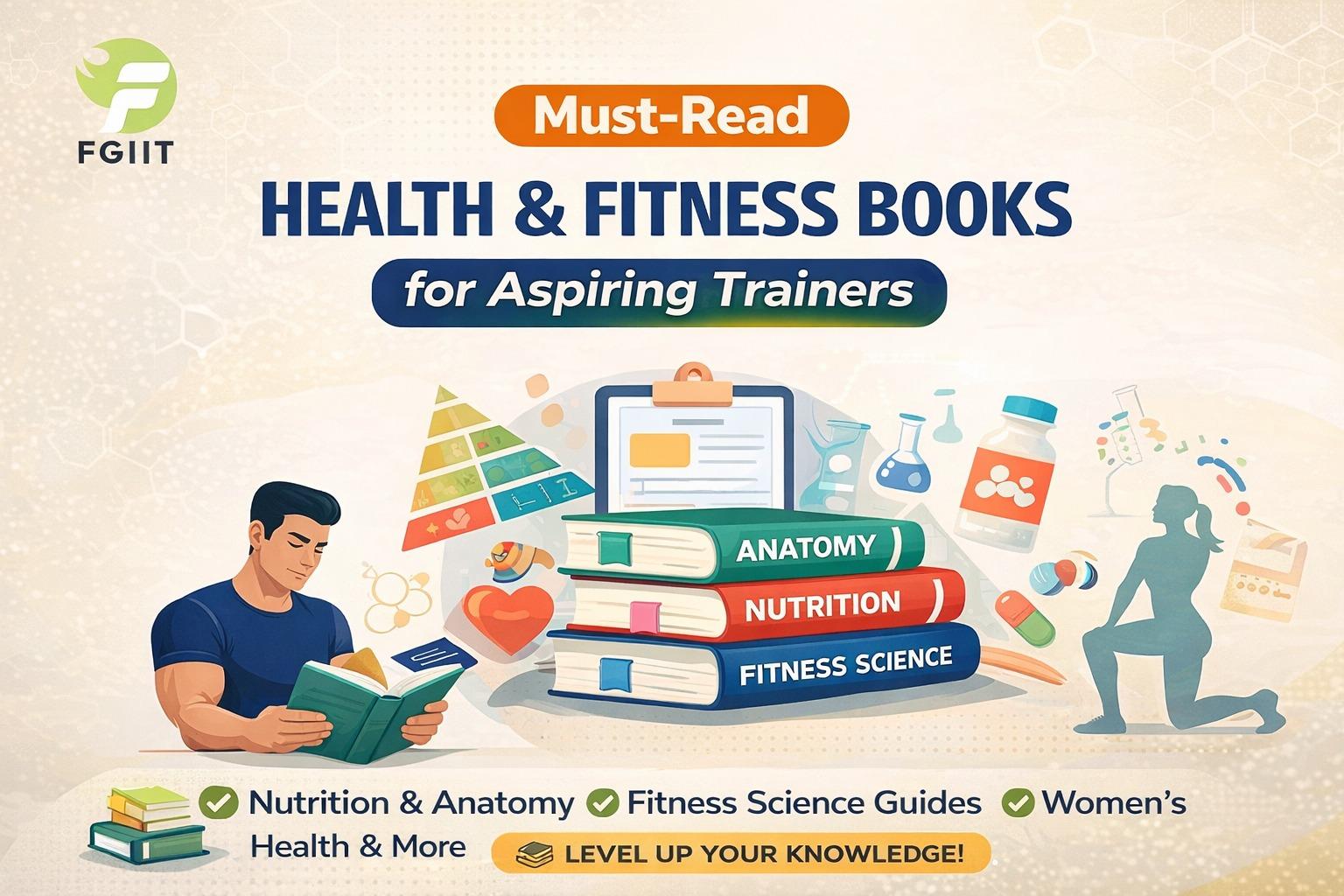
If you think becoming a fitness trainer is only about lifting heavy weights and shouting “one more rep,” think again.
The real power of a trainer lies in knowledge.
Great trainers understand how the human body grows, adapts, heals, and transforms. They know how nutrition changes from childhood to old age. They understand recovery, hormones, metabolism, and even psychology. And that level of understanding doesn’t come from Instagram reels; it comes from reading the right books.
If you are an aspiring trainer at FGIIT or planning to build a serious career in fitness, here is a carefully curated list of must-read health and fitness books that will shape you into a confident and credible professional.
1. Nutrition Across the Life Cycle – Learn How the Body Evolves
Most trainers focus only on fat loss and muscle gain. But the human body is not static. It changes constantly.
From pregnancy to infancy, from teenage growth spurts to middle age and senior years, nutritional needs are never the same. A strong foundation in life cycle nutrition teaches you:
-
Why do calorie needs change during different life stages
-
How protein requirements increase during growth and recovery
-
Why micronutrients become critical in pregnancy and aging
-
How metabolism shifts with age
When you understand how the body develops over time, you stop giving “generic diet plans.” Instead, you start designing plans based on age, physiology, and lifestyle.
This knowledge makes you more than a trainer. It makes you a health guide.
2. Sports Nutrition Science – Fueling Performance the Right Way
Every transformation depends on energy balance. But energy is not just about calories — it is about how those calories work inside the body.
Reading sports nutrition books will help you understand:
-
How carbohydrates fuel high-intensity workouts
-
Why protein supports muscle repair and growth
-
The real role of fats in hormone production
-
How hydration affects strength and endurance
-
The difference between cutting and bulking nutrition
A trainer who understands nutrition timing and macro distribution can dramatically improve client results.
Instead of guessing, you coach with clarity.
3. Anatomy & Biomechanics – Master the Human Machine
You cannot train what you do not understand.
Anatomy books teach you how muscles attach, how joints move, and how force is transferred through the body. When you understand biomechanics:
-
Squats become safer
-
Deadlifts become stronger
-
Shoulder pain becomes preventable
-
Posture becomes correctable
This knowledge allows you to identify movement errors before they turn into injuries.
Clients notice when a trainer corrects posture with precision. That level of expertise builds trust instantly.
4. Strength Training Principles – Program with Intelligence
Training is not random. It is a structured adaptation.
Books on strength science explain concepts like:
-
Progressive overload
-
Periodization
-
Volume versus intensity
-
Recovery cycles
-
Neuromuscular adaptation
When you understand how the body responds to stress, you stop overtraining clients. You start programming smart phases — strength phase, hypertrophy phase, and deload weeks.
Professional trainers plan. Amateurs guess.
5. Injury Prevention & Corrective Exercise
A good trainer builds muscle.
A great trainer protects joints.
Corrective exercise books teach you how to:
-
Fix muscle imbalances
-
Improve mobility
-
Strengthen weak stabilizers
-
Reduce lower back pain
-
Address knee and shoulder issues
In today’s world, most clients sit for long hours and carry postural imbalances. If you can solve their pain problems, you automatically become more valuable than trainers who only focus on aesthetics.
6. Women’s Health & Prenatal Fitness
The fitness industry is evolving. Women’s health coaching is becoming one of the fastest-growing segments.
Understanding topics like:
-
Hormonal changes
-
Menstrual cycle-based training
-
Pregnancy nutrition
-
Postpartum recovery
-
Safe exercise modifications
can open new career opportunities.
A trainer who understands female physiology can design safe and effective programs for every stage of life. This knowledge builds credibility and long-term client loyalty.
7. Psychology of Transformation – The Mind Behind the Muscle
Fitness is not just physical. It is mental.
Reading books on behavior change and psychology helps you understand:
-
Why clients quit after two weeks
-
How habits are formed
-
How emotional eating works
-
How to motivate without pressure
-
How to build discipline gradually
The best workout plan fails if the client does not follow it. When you understand psychology, you improve adherence.
Results improve. Retention improves. Income improves.
8. Recovery, Sleep & Hormonal Health
Many new trainers focus only on training intensity. But growth happens during recovery.
Books on recovery science explain:
-
The role of sleep in muscle repair
-
How stress increases cortisol
-
Why does overtraining reduce performance?
-
The importance of rest days
-
How hydration impacts metabolism
Understanding recovery makes you a smarter coach. Instead of pushing harder, you learn when to pause.
That balance separates professionals from beginners.
9. Habit of Continuous Learning
Reading should not stop after certification.
The fitness industry changes rapidly. New research emerges every year. Trends come and go. But scientific understanding remains powerful.
When you keep reading:
-
Your communication becomes stronger
-
Your explanations become clearer
-
Your confidence grows naturally
-
Your authority increases
Clients can feel the difference between a trainer who memorized a course and one who deeply understands the science.
10. Why Knowledge Builds Your Brand
In today’s competitive fitness market, everyone calls themselves a trainer. What makes you different?
Knowledge.
When you explain why protein matters…
When you correct posture scientifically…
When you design personalized programs…
When you answer client doubts confidently…
You stand out.
Books do not just give information. They give identity.
Frequently Asked Questions (FAQs)
1. Why should aspiring fitness trainers read health and fitness books?
Reading health and fitness books helps trainers understand the science behind training, nutrition, recovery, and human physiology. It builds deeper knowledge, improves confidence, and allows trainers to design safer and more effective programs for clients.
2. How does reading improve client results?
When trainers understand nutrition science, recovery, and training adaptations, they can personalize programs instead of giving generic plans. This leads to better fat loss, muscle gain, injury prevention, and long-term results for clients.
3. Should fitness trainers study nutrition deeply?
Yes. Nutrition plays a major role in transformation. Trainers who understand macronutrients, micronutrients, hydration, and life stage nutrition can guide clients more effectively and responsibly.
4. Can reading books help increase income as a trainer?
Yes. Knowledge builds authority. Clients trust trainers who explain concepts clearly and confidently. Better knowledge leads to better results, a stronger reputation, and higher earning potential.
Final Words for Aspiring Trainers
If you want a long-term career in fitness, build your mind before you build your physique.
Lift weights.
Practice coaching.
But also read.
Read about nutrition.
Read about anatomy.
Read about psychology.
Read about recovery.
Because when knowledge meets passion, excellence is created.
At FGIIT, your certification is the beginning.
Your learning journey is what turns you into a respected fitness professional.
Invest in books.
Invest in understanding.
Invest in becoming unstoppable.
Kategoriler
Read More
The market research for the global Retort Pouch market is an accumulation of first-hand facts and quantitative and qualitative evaluation and analysis for the forecast period (2024-2032). The report offers a comprehensive assessment of macro-economic indicators, parent market trends, and several factors influencing the market dynamics. In addition, it also assesses the latest...

Poker is not just about the cards you hold. It is a game of strategy, timing, and psychological control. One of the most powerful skills in poker is bluffing, which allows players to win even when they do not have the strongest hand. Many online gaming enthusiasts explore poker through platforms like Mahadev Book Online, where various table formats and gameplay options are available. Learning...

Understanding the Modern Reality of Fake IDs in a Digital World Fake identification has existed for decades, often associated with underage access to restricted venues or activities. However, in 2026, the landscape has drastically changed. IDs are no longer just physical cards—they are tied to complex digital systems, biometric verification, and interconnected databases. This evolution...

Executive Summary Automotive Glove Box Market Size and Share Across Top Segments Global automotive glove box market was valued at USD 152.5 million in 2021 and is expected to reach USD 196.20 million by 2029, registering a CAGR of 3.20% during the forecast period of 2022-2029. Automotive Glove Box Market research report comprises of fundamental, secondary and advanced information...

"Pet Oral Care Products Market Summary: According to the latest report published by Data Bridge Market Research, the Pet Oral Care Products Market Data Bridge Market Research analyzes that the global pet oral care products market which was USD 9.8 billion in 2022, would rocket up to USD 16.4 billion by 2030, and is expected to undergo a CAGR of 6.4% during the forecast period...