What is BIS? Complete Guide for Manufacturers in India
Introduction
If you are a manufacturer, importer, or business owner in India, you must have heard about What is BIS and why it is important. Many products in India require certification before they can be sold in the market. This certification ensures safety, quality, and reliability.
In this blog, we will explain in simple language:
-
What is BIS
-
BIS Certificate full form
-
BIS Logo
-
BIS Standards
-
BIS Mark
Let’s understand everything step by step.
What is BIS?
What is BIS? BIS stands for the Bureau of Indian Standards. It is the national standards body of India. BIS works under the Ministry of Consumer Affairs, Government of India. It was established under the BIS Act, 2016. The main purpose of BIS is to ensure that products sold in India meet quality and safety standards.
In simple words, BIS makes sure that products are:
-
Safe to use
-
Good in quality
-
Reliable and durable
-
As per Indian regulations
If a product is not certified where required, it cannot be legally sold in India.
BIS Certificate Full Form
The BIS Certificate full form is “Bureau of Indian Standards Certificate.”
This certificate is issued to manufacturers whose products comply with the required Indian Standards.
Once a product is tested and approved, BIS grants a license to use the standard mark on that product. This is commonly known as the BIS certification.
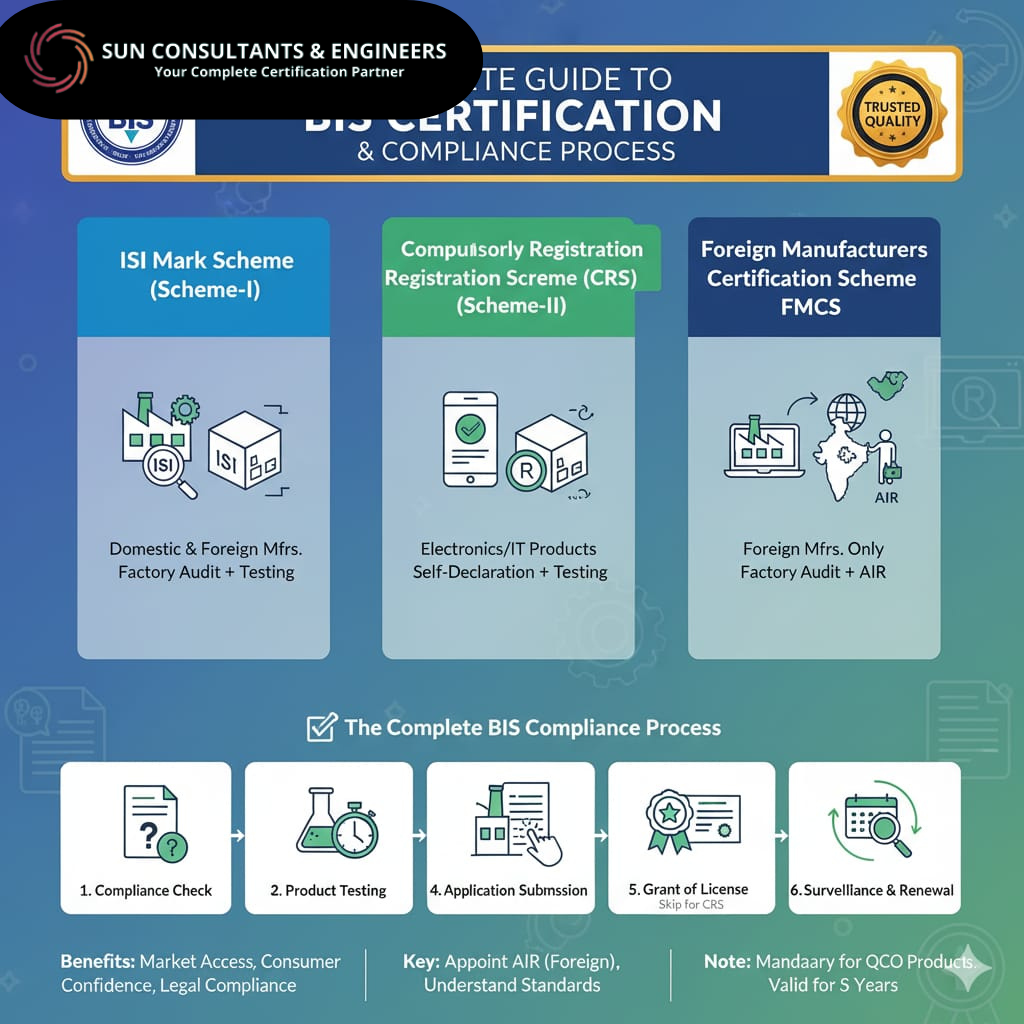
There are different types of BIS certifications, such as:
-
ISI Certification (for domestic manufacturers)
-
Compulsory Registration Scheme (CRS)
-
FMCS (Foreign Manufacturers Certification Scheme)
The type of certificate depends on the product category.
BIS Standards
BIS Standards are officially approved technical guidelines for products and services in India.
These standards cover:
-
Product quality
-
Safety requirements
-
Testing methods
-
Packaging and labeling
-
Performance requirements
Each product category has a specific Indian Standard (IS number). For example:
-
Electrical appliances
-
Steel products
-
Cement
-
Packaged drinking water
-
Electronics
Manufacturers must follow the applicable BIS Standards before applying for certification.
Why are BIS Standards important?
-
They protect consumers from unsafe products
-
They maintain product quality
-
They reduce risk of accidents
-
They promote fair trade
Without following BIS Standards, approval cannot be granted.
BIS Logo
The BIS Logo is the official standard mark provided by the Bureau of Indian Standards.
After certification, manufacturers can print the BIS Logo on their product along with:
-
IS number
-
License number (CM/L number)
The BIS Logo indicates that the product complies with Indian safety and quality standards.
For customers, the BIS Logo builds trust. When buyers see this logo, they know:
-
The product is tested
-
The product meets Indian Standards
-
The product is approved by the government
Using the BIS Logo without a valid license is illegal and may lead to penalties.
BIS Mark
The BIS Mark is another term used for the standard mark issued by BIS. Many people also call it the ISI Mark (for certain products).
The BIS Mark is proof that:
-
The product has been tested in a BIS-approved lab
-
The factory inspection has been completed
-
The manufacturer follows quality control procedures
Products like electrical cables, helmets, LPG cylinders, cement, and many electronics require a BIS Mark before sale.
If a product falls under mandatory certification and does not have a BIS Mark, it cannot be sold legally in India.
Why is BIS Certification Important?
Understanding What is BIS also means understanding its importance.
1. Legal Requirement
Many products require mandatory BIS certification under Indian law.
2. Consumer Safety
BIS ensures products do not harm consumers.
3. Market Access
Without BIS certification, products cannot enter the Indian market.
4. Brand Reputation
Having a BIS Mark increases customer trust.
5. Quality Assurance
It ensures consistent manufacturing quality.
Who Needs BIS Certification?
BIS certification is required for:
-
Indian manufacturers
-
Foreign manufacturers exporting to India
-
Importers (for regulated products)
If your product is listed under mandatory certification, you must apply for a BIS license before selling it in India.
Basic Process of BIS Certification
Here is a simple overview of the process:
-
Identify applicable BIS Standards
-
Get product tested in a BIS-approved laboratory
-
Submit application with required documents
-
Factory inspection (if applicable)
-
Grant of BIS license
-
Use of BIS Logo and BIS Mark
The process may vary depending on product category and certification type.
Documents Required for BIS Certification
Generally required documents include:
-
Company registration documents
-
Manufacturing process details
-
Test reports
-
Quality control details
-
Authorized signatory details
For foreign manufacturers, additional documents and an Authorized Indian Representative (AIR) are required.
Common Mistakes to Avoid
-
Applying under the wrong standard
-
Incomplete documentation
-
Incorrect labeling of BIS Logo
-
Selling products before approval
Proper guidance can help avoid delays and rejection.
Conclusion
Now you clearly understand sunconsultants.co.in., the BIS Certificate full form, the importance of BIS Standards, and the role of the BIS Logo and BIS Mark. The Bureau of Indian Standards plays a crucial role in maintaining product quality and consumer safety in India. Whether you are a domestic manufacturer or a foreign exporter, BIS certification is essential if your product falls under mandatory regulations.
Catégories
Lire la suite
Looking to eliminate unpleasant smells naturally and effectively? The Azuna All-Natural Odor Remover Gel Refill Pouch is your go-to solution. With fast shipping across the USA, you can conveniently buy Azuna odor gel refill online today. Plus, you can save even more by using the latest azuna coupon code from DealsZo, offering exclusive discounts to make your...

Aircraft tow bars are specialized GSE devices designed to attach towing vehicles to the nose landing gear, allowing aircraft to be moved on the ground efficiently and safely without engine power. Aircraft Tow Bar Market Overview The Aircraft Tow Bar Market is witnessing steady growth as global aviation activity continues to recover and expand. Aircraft tow bars are essential ground...

Streetwear continues to shape modern fashion by blending comfort with bold self-expression. One brand that has quickly gained recognition in this space is Spider Clothing. Known for its creative designs and strong visual identity, Sp5der Clothing has become a popular choice for those who want something different from traditional fashion. At the center of this trend is...

تُعد عطور أجمل من الأسماء العريقة في عالم العطور، حيث نجحت عبر السنوات في تقديم روائح أيقونية تجمع بين الفخامة الشرقية واللمسة العصرية. ومع توفر Ajmal Perfumes Online في الكويت، أصبح بإمكانك الاستمتاع بتجربة تسوق سهلة وآمنة لاختيار عطرك المفضل من راحة منزلك. سواء كنت تبحث عن عطر يعبر عن شخصيتك أو عن بوكسات هدايا أنيقة للمناسبات، ستجد في أجمل الخيار بيرفكت لكل ذوق ومناسبة. لماذا التسوق من Ajmal...
If you’re looking to buy Fab CBD oil with coupon code, the FabCBD Anytime + Sleep Gummy Bundle offers a convenient, two-step approach to wellness. Designed to support calm and focus during the day and promote restful sleep at night, this bundle combines two gummies formulated for different times, making it easy to maintain a balanced routine without juggling multiple products....