


Mobile CSR Data Collection: The 2025 Guide to Proving Your Impact
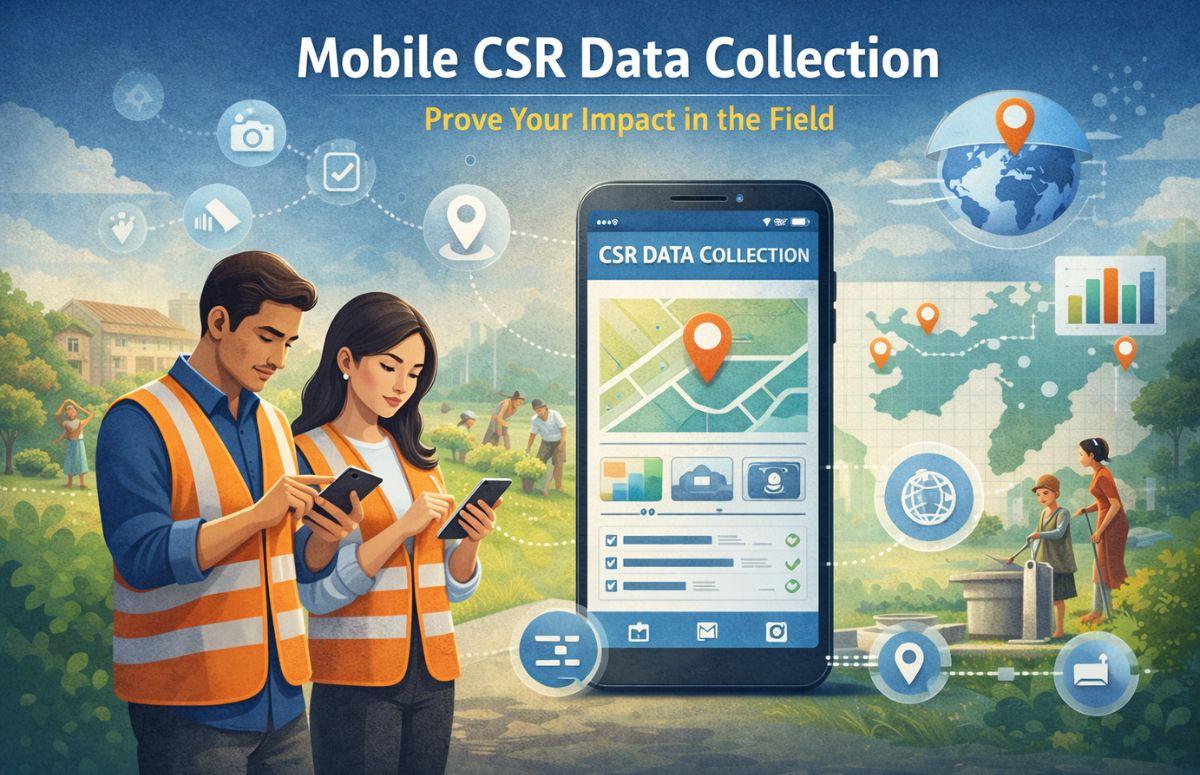
Mobile CSR Data Collection: The Future of Proving Impact
Corporate Social Responsibility (CSR) is rapidly shifting toward accountability and measurable outcomes. Organizations today are expected not just to invest in social initiatives but to clearly demonstrate the results. Traditional paper-based reporting methods are slow, prone to errors, and difficult to validate. Mobile-based CSR data collection tools are reshaping this process by enabling companies to capture and verify impact instantly and present credible evidence of their work.
What Is Mobile-Based CSR Data Collection?
Mobile CSR data collection involves using smartphone or tablet applications to record field activities in real time. These tools allow teams to capture geo-tagged photos, videos, timestamps, and reports even without internet connectivity. By replacing manual processes with digital systems, organizations improve data accuracy, transparency, and stakeholder confidence.
In India and worldwide, many organizations face challenges in proving the effectiveness of their CSR spending due to unreliable data. Collecting information directly at the project site closes this gap, ensuring accountability and strengthening trust.
Why Traditional Reporting Is Ineffective
Paper files and desktop reporting systems often cause delays and provide limited insight into field operations. A mobile-first approach brings reporting closer to the actual activity, enabling continuous tracking instead of occasional updates.
Mobile applications reduce manual entry mistakes, support offline usage in remote areas, and allow instant submission of geo-tagged evidence. This results in quicker decisions and better evaluation of project outcomes.
Geo-location features further enhance credibility by attaching exact coordinates to each activity. Managers can monitor projects by region, detect gaps in service delivery, and take timely corrective action.
Major Benefits of Mobile CSR Tools
Mobile data collection platforms offer several significant advantages:
Instant Reporting: Real-time dashboards allow leadership teams to monitor progress and make informed decisions quickly.
Improved Accuracy: Standard digital formats ensure consistent data collection supported by visual proof and authentication.
Remote Functionality: Offline capabilities enable uninterrupted work in areas with weak or no connectivity.
Operational Efficiency: A single system can manage multiple initiatives without increasing administrative complexity.
Better Impact Communication: Multimedia evidence helps convert raw data into compelling stories for stakeholders.
These tools shift the focus from reporting activities to demonstrating real outcomes.
How Geo-Location Enhances Measurement
Geo-location technology makes CSR monitoring more reliable by confirming where and when activities occur. Each project becomes traceable, reducing uncertainty and increasing transparency for donors, regulators, and communities.
Mapping and spatial analysis also help identify underserved regions, track coverage, and evaluate progress over time, enabling smarter planning and resource allocation.
Making CSR a Strategic Advantage
CSR is evolving from a compliance obligation into a strategic business function. Verified data allows organizations to showcase how their initiatives mitigate risks, strengthen brand image, and create measurable value.
Digital tracking shortens reporting cycles from weeks to days, allowing teams to concentrate on expanding impact rather than managing paperwork. Real-time insights also help detect issues early and improve operational performance.
Challenges and Solutions
Successful implementation of mobile CSR tools requires addressing several factors:
Data Protection: Ensuring privacy through secure systems and responsible data handling.
Technology Access: Providing devices, offline tools, and training for field staff in remote areas.
User Adoption: Offering continuous guidance to encourage effective usage.
With thoughtful planning, these challenges can be effectively managed.
The Future of CSR Is Digital and Mobile
Advances in mobile technology, geo-tagging, and analytics are transforming CSR into a data-driven discipline. Organizations that adopt these solutions gain transparency, efficiency, and credibility, while those relying on outdated methods risk falling behind.
Today, CSR success is measured not only by good intentions but by verifiable impact supported by real-time data. Mobile CSR data collection empowers organizations to demonstrate authentic change and build lasting stakeholder trust.
Conclusion
Mobile-based CSR data collection represents a major shift in how social impact is tracked and communicated. By enabling real-time monitoring, verified field reporting, and geo-location insights, these tools turn CSR into a strategic asset. As demands for transparency continue to grow, adopting mobile solutions is becoming essential for organizations committed to meaningful and measurable impact.
Categorias
Leia mais
Best Architectural Designer in Rajapalayam – Premium Design Services by Magic Homes And Properties When it comes to creating beautiful, functional, and modern spaces, choosing the Best Architectural Designer in Rajapalayam is the key to successful construction. Magic Homes And Properties is recognized as the Best Architectural Designer in Rajapalayam for...

Vaginal health and wellness have become an important part of overall self-care. Many women seek effective solutions to improve vaginal tightness, enhance confidence, and support intimate health. Dubai offers advanced, Vaginal tightening in Dubai that are safe, non-invasive, and highly effective. These treatments cater to women of all ages who want to restore elasticity, improve sexual...

The 52nd ACE Eddie Awards have unveiled their contenders across film and television editing categories. Dramatic feature nominees showcase epic storytelling with "Harry Potter and the Sorcerer’s Stone" and "The Lord of the Rings: The Fellowship of the Ring" joining cerebral dramas "A Beautiful Mind," intense war film "Black Hawk Down," and nonlinear thriller "Memento." Comedy and musical...

Food Blenders and Mixers Market Transforms Through Automation, Food Innovation, and Smart Manufacturing Technologies Food Processing Evolution Creates New Opportunities for Blending and Mixing Technologies The global food blenders and mixers market is undergoing a significant transformation as food manufacturers, processors, bakeries, beverage companies, dairy producers, and ingredient...
Polaris Market Research has introduced the latest market research report titled Varicose Vein Treatment Market Size, Share, Trends, Industry Analysis Report: By Type (Endovenous Ablation, Sclerotherapy, and Surgical Ligation & Stripping), Products, End Use, and Region (North America, Europe, Asia Pacific, Latin America, and Middle East & Africa) – Market Forecast,...
