In today’s low- and medium-voltage distribution networks, utilities and EPC contractors are under increasing pressure to deliver safer, more reliable, and more compact cable systems. One solution that continues to grow in importance across underground and service-drop applications is the concentric cable.
As a global manufacturer of overhead conductors and power cables, HNBF Power supplies engineered concentric cable solutions for power utilities, grid contractors, and industrial power infrastructure projects worldwide.
This guide explains what concentric cable is, how it is constructed, where it is used, and how engineers and procurement teams can select the right design for long-term network performance.
What Is a Concentric Cable?
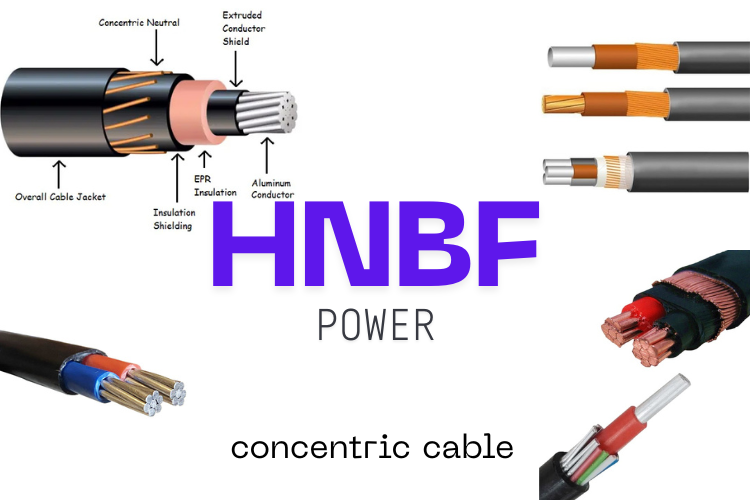
A concentric cable is a power cable design in which the neutral or return conductor is arranged concentrically around the insulated phase conductor.
In simple terms:
-
The core conductor carries the main current.
-
A layer of concentric neutral wires is helically wound around the insulation.
-
An outer sheath provides mechanical and environmental protection.
This concentric conductor configuration delivers both electrical symmetry and mechanical balance, making it especially suitable for underground distribution systems and utility service connections.
Concentric cables are commonly specified for:
-
Low-voltage distribution networks
-
Service drop connections
-
Secondary distribution feeders
-
Industrial and commercial power supply systems
Typical Construction of Concentric Cable
Central Phase Conductor
The central conductor is usually aluminum or copper, selected based on ampacity requirements, voltage class, and installation constraints.
Primary Insulation Layer
Cross-linked polyethylene (XLPE) or similar polymer insulation is applied to ensure electrical separation and thermal stability.
Concentric Neutral Wires
Multiple smaller aluminum or copper wires are applied evenly around the insulated core. These wires form the concentric neutral and provide:
Outer Jacket
The outer sheath protects the cable against moisture, chemicals, abrasion, and mechanical damage during installation and operation.
Why Utilities Specify Concentric Cable in Distribution Networks
From an engineering and procurement perspective, concentric cable offers several technical advantages compared with traditional single-core cables with separate neutrals.
Enhanced Fault Performance
The concentric neutral layer provides a low-impedance return path for fault current, improving protection system performance and supporting faster fault clearing.
Compact Installation
Because the neutral conductors are integrated into the cable structure, trench width and duct space can be reduced an important benefit in congested urban and industrial environments.
Improved Mechanical Stability
The symmetrical design distributes mechanical stress evenly around the cable, which reduces deformation during pulling and minimizes long-term mechanical fatigue.
Better Electromagnetic Balance
Concentric conductor arrangements help control electromagnetic fields, contributing to stable electrical performance and reduced interference with nearby infrastructure.
Common Applications of Concentric Cable
Underground Power Distribution
Concentric neutral cables are widely used in secondary underground distribution systems for residential, commercial, and light-industrial networks.
Service Drop and Service Lateral Installations
Utilities frequently use concentric cable to connect distribution transformers to customer service points due to its integrated neutral and grounding path.
Industrial Facilities and Camp Power Systems
Temporary and permanent power installations in industrial plants, camps, and utility-owned substations benefit from the robustness and simplified installation of concentric designs.
Concentric Cable vs. Split Neutral and Bare Neutral Designs
Concentric Cable
-
Neutral wires fully surround the insulated conductor
-
Uniform electrical and mechanical structure
-
Superior fault return path symmetry
Split or Separate Neutral Cable
-
Neutral conductors are arranged externally or in separate cores
-
Larger overall installation footprint
-
Less uniform mechanical behavior
For modern distribution projects where installation efficiency and long-term reliability are critical, concentric cable is increasingly the preferred solution.
Engineering Considerations When Selecting Concentric Cable
Conductor Material and Size
Engineers must evaluate aluminum versus copper conductors based on:
Neutral Wire Configuration
The number and cross-section of concentric neutral wires directly influence:
-
Fault current rating
-
Grounding performance
-
Thermal stability
Insulation and Sheath Performance
Environmental exposure, soil conditions, moisture levels, and chemical resistance should drive the selection of insulation and outer jacket compounds.
Compliance with Utility Specifications
Distribution projects typically require strict compliance with local utility technical specifications, installation practices, and qualification testing.
How HNBF Power Supports Utility and EPC Buyers
HNBF Power designs and manufactures a full range of concentric cable solutions for utility-scale distribution systems, EPC contractors, and grid modernization projects.
By integrating in-house conductor manufacturing, insulation extrusion, and final cable assembly, HNBF Power ensures:
-
Stable conductor quality and dimensional accuracy
-
Custom neutral wire configurations for fault level requirements
-
Consistent electrical and mechanical performance
-
Scalable production for large utility tenders
In addition to concentric cables, the company supplies AAC, AAAC, ACSR, ABC, LV power cables, and concentric cable systems for integrated overhead and underground network projects.
Quality, Testing, and Long-Term Reliability
For utilities and infrastructure owners, long-term reliability is the primary commercial driver. High-quality concentric cable must undergo:
-
Conductor resistance testing
-
Insulation integrity and voltage withstand testing
-
Mechanical tension and bending tests
-
Dimensional and concentricity inspections
These processes help ensure predictable installation behavior and stable performance throughout the asset lifecycle.
Frequently Asked Questions (FAQs)
1. What is the main purpose of the concentric neutral in a concentric cable?
The concentric neutral provides a continuous fault current return path and grounding conductor while maintaining a balanced and compact cable structure.
2. Is concentric cable suitable for direct burial?
Yes. With the correct insulation and outer jacket materials, concentric cables are widely used for direct-buried underground distribution applications.
3. Can concentric cable be used for both residential and industrial networks?
Absolutely. The same concentric cable concept is used across residential, commercial, and industrial distribution systems, with conductor size and insulation selected according to load and voltage requirements.
4. How does concentric cable improve installation efficiency?
The integrated neutral eliminates the need for separate grounding or neutral conductors, reducing installation time, trench space, and handling complexity.
Power Your Next Distribution Project with HNBF Power
Selecting the right concentric cable is a strategic decision that directly impacts network safety, fault performance, and long-term operating cost.
If you are planning a new distribution project, service upgrade, or utility expansion, contact HNBF Power today to discuss your technical requirements and receive customized concentric cable solutions engineered specifically for your power network.