Mastering Projection Welding: Industrial Solutions for High-Precision Manufacturing
In modern manufacturing, efficiency, precision, and repeatability are paramount. For industries relying on metal-joining processes, projection welding has emerged as a critical solution for joining complex components quickly and reliably. As a leading global provider of industrial welding systems, Heron Welder delivers advanced projection welders, welding guns, and automated solutions engineered to meet the demands of OEMs, manufacturing engineers, and automation integrators.
In this guide, we explore projection welding principles, applications, advantages over other welding techniques, and best practices for optimizing productivity in industrial environments.
What Is a Projection Welder?
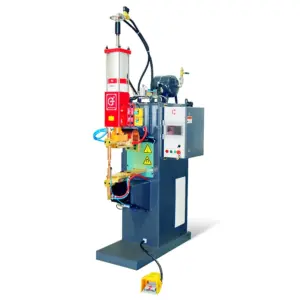
A projection welder is a type of resistance welding machine designed to join two or more metal components at predefined points, known as projections. Unlike traditional spot welding, projection welding focuses electrical current on small raised areas, enabling the simultaneous formation of multiple welds in a single cycle.
Key components of a projection welder include:
-
Electrodes: Precisely shaped to accommodate projections and ensure consistent current flow.
-
Transformer and control system: Provides the necessary current and timing control.
-
Workholding fixtures: Ensure correct alignment and pressure distribution across weld points.
-
Cooling system: Maintains optimal operating temperatures for prolonged production cycles.
This configuration allows manufacturers to achieve strong, repeatable welds with minimal distortion, even on thin or dissimilar metals.
How Projection Welding Works
Projection welding operates on the principle of resistance heating. The raised projections on the workpiece concentrate electrical current and mechanical pressure at specific points. As current flows, the projections heat up due to electrical resistance and melt, forming a localized weld nugget.
The process typically follows these steps:
-
Positioning: Parts are placed with projections aligned to contact points.
-
Clamping: Electrodes apply uniform pressure on the assembly.
-
Current Application: A high-intensity current passes through the projections.
-
Cooling: Once the weld nugget forms, the current stops, and the joint cools under pressure to solidify.
Because the weld is concentrated at projections, projection welding minimizes heat spread, reducing the risk of warping or damaging delicate components.
Applications of Projection Welders
Projection welding is widely used across various industrial sectors, particularly where high-volume, high-precision assembly is required. Common applications include:
-
Automotive Manufacturing: Welding nuts, studs, and brackets to panels for structural assemblies.
-
Electrical and Electronics Industry: Attaching connectors, terminals, or small hardware to metallic frames.
-
Appliance Production: Joining sheet metal parts in washing machines, refrigerators, and HVAC units.
-
Heavy Machinery: Fabricating frames, brackets, and reinforcing components with precision weld points.
By delivering consistent welds at multiple points simultaneously, projection welders improve throughput and reduce labor costs.
Projection Welding vs. Spot Welding
While projection and spot welding share the principle of resistance heating, they differ in application and capability:
| Feature | Projection Welding | Spot Welding |
|---|---|---|
| Contact Area | Focused on projections, multiple points at once | Single weld point per electrode |
| Weld Precision | High, minimal distortion | Moderate, may cause warping on thin sheets |
| Material Flexibility | Suitable for complex assemblies and thicker parts | Best for uniform sheet metal |
| Automation Integration | Easily incorporated into automated production lines | Can be automated but often limited by single-point welding |
For high-volume, complex assemblies requiring multiple welds per cycle, projection welding offers superior efficiency and repeatability.
Best Practices for Optimizing Projection Welding
Achieving consistent results with projection welding requires attention to machine setup, electrode condition, and process parameters. Here are some expert tips:
-
Regular Electrode Maintenance: Inspect and dress electrodes to maintain proper shape and conductivity.
-
Correct Projection Design: Ensure projections are uniform in height and shape for consistent weld quality.
-
Optimize Welding Parameters: Adjust current, pressure, and weld time according to material type and thickness.
-
Fixture Accuracy: Use high-quality workholding fixtures to prevent misalignment and ensure repeatable weld placement.
-
Cooling Efficiency: Maintain adequate cooling to prevent overheating and electrode degradation during continuous production.
Heron Welder systems provide advanced controls and automated monitoring to help engineers achieve consistent weld quality while reducing downtime.
Why Choose Heron for Projection Welding Solutions
As a global leader in industrial welding, Heron Welder combines decades of expertise in resistance welding, automation integration, and production optimization. Our projection welders are designed for:
-
High-volume, repeatable industrial applications
-
Integration with robotic or automated assembly lines
-
Precision welding of thin and complex sheet metal parts
-
Customizable configurations tailored to OEM and factory requirements
With Heron’s solutions, manufacturers gain not only reliable machinery but also expert support for process optimization and automation integration.
FAQs About Projection Welding
1. Can projection welding join different metal types?
Yes. Projection welding can join similar and some dissimilar metals, provided electrical and thermal parameters are carefully controlled.
2. How does projection welding reduce material distortion?
By concentrating current at raised projections and minimizing heat spread, the process limits warping and preserves part integrity.
3. Is projection welding suitable for high-speed production?
Absolutely. Multiple welds per cycle allow high-volume production while maintaining consistent quality.
4. How often should electrodes be maintained?
Electrodes should be inspected and dressed daily or according to production load to ensure precision and consistent current flow.
5. Can projection welders be integrated into robotic lines?
Yes. Heron Welder projection systems are designed for seamless integration with automated and robotic production lines, improving efficiency and reducing manual labor.
Take Your Welding to the Next Level
For manufacturers seeking reliable, high-precision welding solutions, projection welding offers unmatched speed, consistency, and versatility. With Heron Welder, you gain access to industry-leading projection welders, custom automation, and expert support designed to optimize your production processes.
Contact Heron today to request a quote or consult with our engineers on customized projection welding and automation solutions tailored to your factory’s needs.
Категории
Больше
In a global city like Dubai, where time is valuable and lifestyles are fast-paced, everyday tasks need smarter solutions. Laundry is one such task that has evolved significantly over the years. Today, more residents and businesses are actively searching for a laundry service near me, a trusted laundry shop near me, or a professional laundry service Dubai that delivers quality,...

Hybrid Powertrain Market According to the latest report published by Data Bridge Market Research, the Hybrid Powertrain Market hybrid powertrain market size was valued at USD 126.04 billion in 2024 and is expected to reach USD 364.62 billion by 2032, at a CAGR of 14.2% during the forecast period The market growth is primarily driven by increasing demand...

مقدمة يشهد قطاع علوم الحياة والأدوية ثورةً متسارعة بفضل تداخل البيانات الضخمة والحوسبة السحابية والذكاء الاصطناعي والتحليلات. ويشمل سوق تحليلات علوم الحياة الصيدلانية العالمي، المعروف عمومًا باسم سوق تحليلات علوم الحياة، برمجياتٍ وخدماتٍ ومنصاتٍ تستخدمها مؤسسات الأدوية والتكنولوجيا الحيوية والبحوث السريرية لمعالجة مجموعات البيانات الضخمة والمعقدة (مثل الجينوميات، وتحليل البروتينات، وبيانات...

" According to the latest report published by Data Bridge Market Research, the Anterior Cruciate Ligament (ACL) Graft Market Global anterior cruciate ligament (ACL) graft market size was valued at USD 313.69 million in 2024 and is projected to reach USD 353.37 million by 2032, with a CAGR of 1.50% during the forecast period of 2025 to 2032. Anterior Cruciate Ligament (ACL) Graft...

Mental health practices across Toledo are facing increasing administrative pressure while trying to deliver quality patient care. From insurance complexities to compliance requirements, billing has become one of the most critical yet time-consuming aspects of running a behavioral health practice. This is where mental health billing toledo ohio plays a vital role in ensuring financial stability...