


Automotive Fuel Injector Market Forecast 2026–2036: Global Market to Reach USD 25.5 Billion by 2036 at 6.1% CAGR
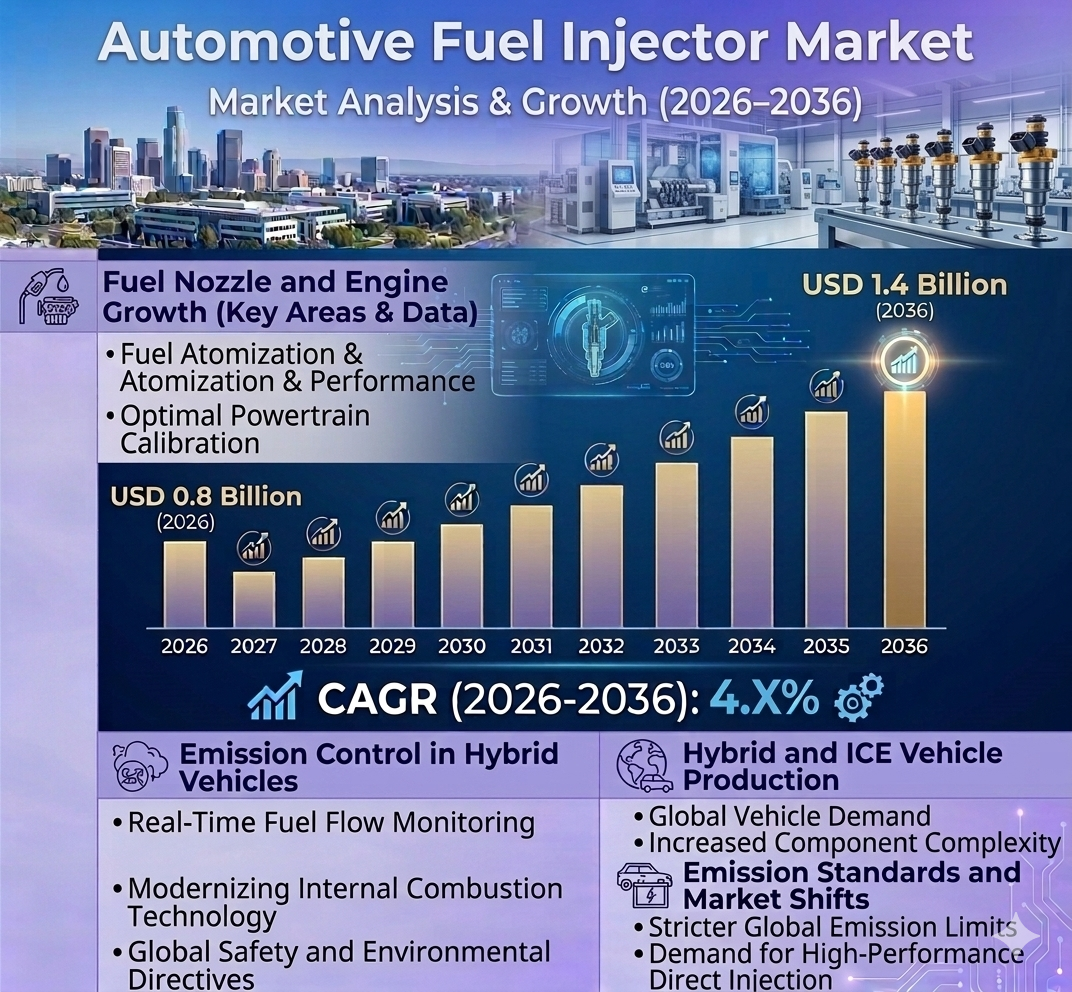
The global automotive fuel injector market is expected to witness consistent growth over the next decade, expanding as vehicle manufacturers increasingly prioritize fuel efficiency, performance optimization, and emission reduction technologies. According to analysis by Future Market Insights, the market is projected to grow from approximately USD 14.1 billion in 2025 to USD 25.5 billion by 2035, registering a CAGR of 6.1% during the forecast period.
Growth in the market is driven by stricter global emission regulations, advancements in fuel injection technology, and rising demand for improved engine efficiency across both passenger and commercial vehicles. Automotive manufacturers are increasingly adopting advanced injector systems capable of delivering precise fuel atomization and optimized combustion performance.
Although internal combustion engine (ICE) vehicles remain dominant in the global vehicle fleet, the integration of hybrid propulsion systems and improved electronic fuel injection technologies continues to create new opportunities for injector system manufacturers. As environmental regulations tighten and consumer expectations for fuel economy increase, fuel injector technologies are evolving to deliver better efficiency, durability, and emission control.
Automotive Fuel Injector Market Snapshot (2026–2036)
-
Market size in 2025: USD 14.1 billion
-
Forecast market size by 2035: USD 25.5 billion
-
CAGR (2025–2035): 6.1%
-
Leading vehicle segment: Passenger cars (~38.5% share)
-
Dominant mechanical system: Electronic fuel injectors (~55.2% share)
-
Key growth regions: Asia Pacific, North America, Europe
Momentum in the Market
Beginning with a valuation of USD 14.1 billion in 2025, the automotive fuel injector market is experiencing steady expansion as global vehicle production gradually increases and emission control standards become more stringent.
Between 2026 and 2030, technological innovation in fuel delivery systems—including gasoline direct injection (GDI), high-pressure injectors, and electronic control integration—will play a crucial role in improving engine efficiency. These advancements allow more accurate fuel delivery and improved combustion, leading to lower fuel consumption and reduced emissions.
From 2030 onward, demand is expected to remain strong as automakers continue upgrading engine platforms to meet global emission standards while maintaining performance. Even as electrification progresses, hybrid powertrains and fuel-efficient ICE vehicles will sustain long-term demand for advanced injector technologies.
The Reasons Behind the Market’s Growth
Demand for automotive fuel injectors is growing as manufacturers focus on delivering vehicles that balance performance, efficiency, and environmental compliance.
Fuel injectors play a vital role in modern engines by precisely controlling the amount and timing of fuel delivered into the combustion chamber. This precision improves fuel atomization and combustion efficiency, reducing emissions and increasing engine reliability.
Additionally, rising vehicle production—especially in emerging economies—continues to expand the installed base of vehicles requiring advanced fuel injection systems. The increasing adoption of hybrid vehicles further reinforces demand for efficient fuel delivery systems integrated with electronic control units.
Another important growth driver is the global regulatory push toward cleaner transportation. Emission standards such as Euro VI and similar regional regulations require more efficient combustion technologies, encouraging automakers to integrate advanced fuel injection systems capable of meeting these requirements.
Top Segment: Vehicle Type
Passenger Vehicles Lead with Around 38.5% Market Share
Passenger cars represent the largest segment in the automotive fuel injector market, accounting for approximately 38.5% of total demand. This dominance is primarily driven by the high global production volume of passenger vehicles and increasing consumer demand for fuel-efficient and technologically advanced automobiles.
Commercial vehicles also contribute significantly to market expansion, particularly with the growth of logistics, transportation, and e-commerce industries. These sectors rely heavily on reliable fuel delivery systems to support long-distance operations and heavy-duty engine performance.
Mechanical System Segment: Electronic Fuel Injectors Lead
Electronic fuel injectors represent the largest mechanical system category, commanding around 55.2% of the market share. These systems offer enhanced control over fuel delivery, improving engine efficiency and reducing emissions compared with traditional mechanical injection systems.
Electronic injectors also integrate seamlessly with modern engine management systems, enabling real-time fuel control based on driving conditions, load requirements, and emission control needs.
Regional Development: Asia Pacific, North America, and Europe Drive Expansion
The automotive fuel injector market shows strong growth across multiple regions, particularly those with large automotive manufacturing ecosystems.
-
Asia Pacific remains a major growth engine due to strong automotive production and expanding vehicle ownership in developing economies.
-
North America continues to see technological innovation and strong demand for performance-oriented vehicles.
-
Europe is driven by strict environmental regulations and continuous improvements in fuel-efficient vehicle technologies.
Increasing investments in automotive manufacturing infrastructure and technological innovation across these regions are expected to sustain long-term market growth.
Challenges, Trends, Opportunities, and Drivers
Drivers
-
Rising global vehicle production
-
Increasing focus on fuel efficiency and emission reduction
-
Technological advancements in fuel injection systems
Opportunities
-
Development of high-pressure and direct injection systems
-
Integration of injectors with advanced engine management systems
-
Expansion of hybrid vehicle platforms
Trends
-
Adoption of gasoline direct injection (GDI) technology
-
Increasing use of electronic fuel injection systems
-
Integration of smart engine control technologies
Challenges
-
Gradual transition toward fully electric vehicles
-
Increasing regulatory pressure on combustion engines
-
High R&D requirements for advanced injection technologies
Competitive Environment
The automotive fuel injector market remains highly competitive, with leading manufacturers focusing on innovation, efficiency improvements, and advanced fuel system technologies.
Major companies operating in the industry include:
-
Robert Bosch GmbH
-
Denso Corporation
-
Continental AG
-
Hitachi Astemo
-
Magneti Marelli
-
NGK Spark Plug Co., Ltd.
-
Stanadyne
These companies compete through research and development, advanced injector design, and strategic partnerships with global automakers to deliver next-generation fuel injection technologies that meet evolving performance and environmental standards - https://www.futuremarketinsights.com/reports/automotive-fuel-injector-market
Catégories
Lire la suite
In a remarkable display of fan influence, the Philadelphia Phillies' 2024 success story – 95 wins and a playoff berth – stands in sharp contrast to their challenging 2023 campaign. This dramatic shift in fortunes has become the subject of significant attention in baseball circles. The 2023 season began with high expectations following the Phillies' blockbuster signing of shortstop...

The Portable Metal Detectors market report is intended to function as a supportive means to assess the global Portable Metal Detectors market along with the complete analysis and clear-cut statistics related to this market. In other words, the report would provide an up-to-date study of the market in terms of its latest trends, present scenario, and the overall market situation....

Relocating to a new home or office can be both exciting and stressful. Whether you are moving within the city or shifting from one locality to another, professional door to door shifting in Bangalore makes the entire process smooth and worry-free. From careful packing to safe delivery at your new destination, expert packers and movers ensure that every step of your relocation is handled...

Netflix's Ultra HD Streaming Library Expands to 26 Titles For viewers equipped with the latest Ultra HD televisions, Netflix continues to enhance its premium offering with an expanding collection of 4K content. The streaming giant now features 26 titles available in stunning Ultra HD resolution. To access this premium content, subscribers need three key components: a compatible 4K television,...

Introduction to 부달 and Its Cultural Background The keyword 부달 has been gaining increasing 부산달리기 attention in online searches, digital communities, and regional discussions. While at first glance it may appear to be a simple abbreviation, 부달 carries contextual and thus depends heavily on cultural, linguistic, and digital environments. In Korean language usage, abbreviations are extremely...
