Cargo Vans Market Forecast 2026–2036: Global Market to Reach USD 237.7 Billion by 2036
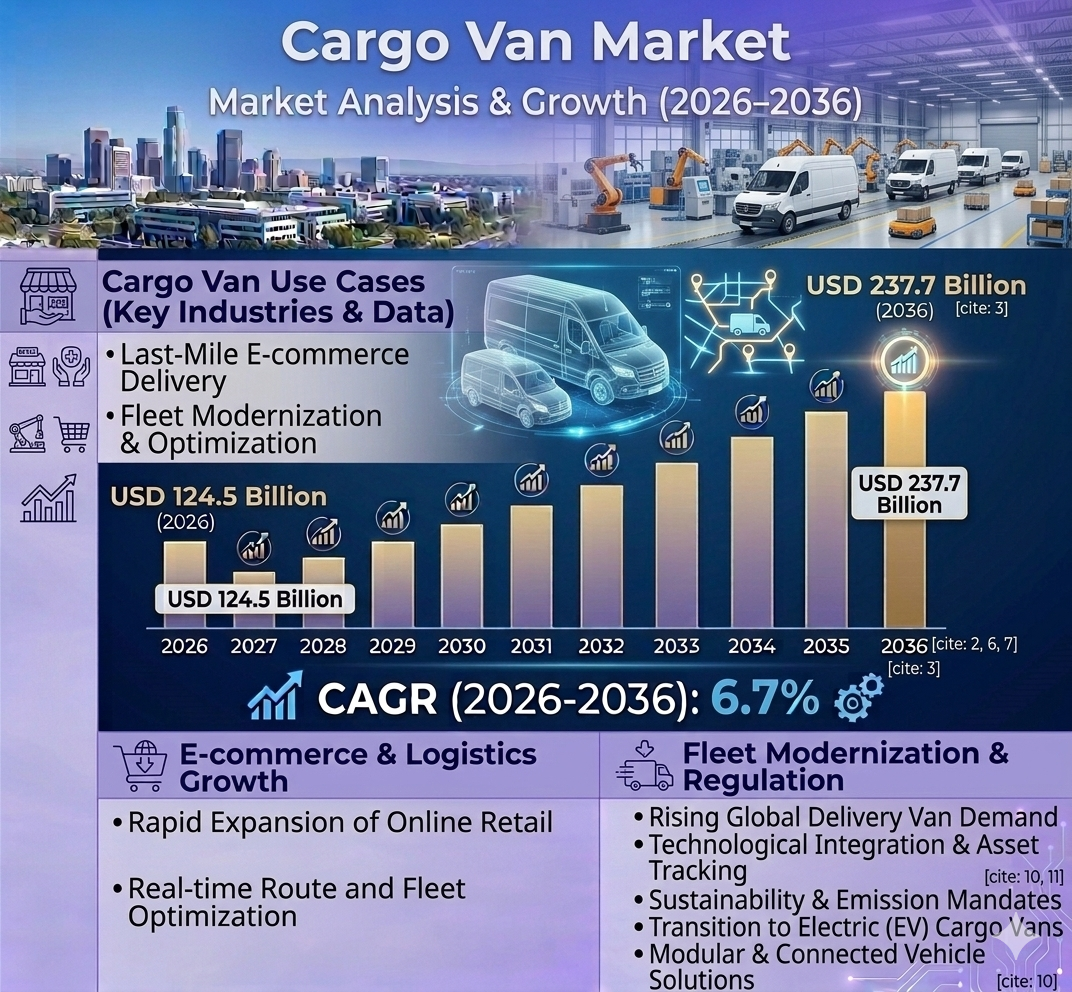
The global cargo vans market is expected to witness strong expansion over the next decade, increasing from approximately USD 124.5 billion in 2026 to USD 237.7 billion by 2036, registering a CAGR of 6.7%, according to analysis by Future Market Insights (FMI).
Market growth is being fueled by the rapid expansion of e-commerce, last-mile delivery services, and logistics infrastructure modernization. Businesses across logistics, retail distribution, and service industries are increasingly adopting cargo vans designed for high-frequency urban delivery cycles.
Manufacturers are also integrating connected vehicle technologies, telematics systems, and predictive maintenance platforms to enhance fleet efficiency and operational visibility. At the same time, the transition toward electric and hybrid cargo vans is accelerating, particularly in regions implementing low-emission zones and sustainability targets.
Although internal combustion engine vans still dominate due to established fueling infrastructure and lower upfront costs, the industry is gradually diversifying propulsion technologies to meet evolving regulatory and environmental requirements.
Cargo Vans Market Snapshot (2026–2036)
-
Market size in 2026: USD 124.5 billion
-
Market size in 2036: USD 237.7 billion
-
CAGR (2026–2036): 6.7%
-
Leading propulsion segment: Internal combustion engine vehicles
-
Dominant tonnage capacity: 2–3 tons (~61.4% share)
-
Leading end-use segment: Commercial fleets (~57.9% share)
-
Key growth regions: Asia Pacific, Europe, North America
-
Fastest-growing countries: China, India, Germany, United Kingdom, United States
Momentum in the Market
Beginning at USD 124.5 billion in 2026, the cargo vans market demonstrates consistent expansion as logistics providers invest in vehicles optimized for urban delivery operations. Increasing demand from parcel delivery companies, courier services, and retail distribution networks is strengthening market growth during the early years of the forecast period.
By the early 2030s, adoption of electric and hybrid cargo vans, along with integrated fleet management systems, is expected to reshape the competitive landscape. These innovations help operators reduce operational costs, improve fleet utilization, and comply with environmental regulations governing urban transportation.
Between 2030 and 2036, the market is projected to experience accelerated transformation as fleet operators transition toward digitally connected vehicles equipped with telematics and predictive maintenance capabilities. This shift will enable logistics providers to optimize delivery routes, reduce downtime, and improve fleet efficiency.
The Reasons Behind the Market’s Growth
Demand for cargo vans is rising as global supply chains and urban logistics networks become more complex. Cargo vans offer an ideal balance between payload capacity, maneuverability, and operational efficiency, making them essential for last-mile delivery operations.
Several factors are driving the expansion of the cargo vans market:
-
Rapid growth of e-commerce and online retail distribution
-
Rising demand for last-mile delivery solutions
-
Expansion of urban logistics infrastructure
-
Increasing adoption of connected vehicle technologies
-
Transition toward electric and hybrid delivery fleets
Government policies supporting low-emission vehicles and logistics modernization are also encouraging companies to replace aging fleets with technologically advanced cargo vans designed for urban environments.
Top Segment Analysis
Tonnage Capacity: 2–3 Ton Segment Leads with ~61.4% Share
The 2–3 ton cargo van segment dominates the market due to its optimal combination of payload capacity, maneuverability, and fuel efficiency. These vehicles are particularly suited for urban delivery operations where drivers must navigate dense city environments while carrying significant cargo loads.
This segment is widely used by parcel delivery companies, courier services, and small-to-medium logistics providers operating within metropolitan areas.
End-Use Segment: Commercial Fleets Lead Adoption (~57.9% Share)
Commercial fleet operators represent the largest end-use segment, accounting for nearly 57.9% of cargo van demand. Growth in this segment is strongly tied to expanding logistics networks, courier services, and e-commerce fulfillment operations.
Businesses are increasingly investing in cargo vans designed for high-frequency delivery routes, enabling faster order fulfillment and improved customer service in competitive retail markets.
Regional Development: Asia Pacific Drives Global Expansion
Regional growth patterns in the cargo vans market are shaped by urbanization, logistics infrastructure development, and e-commerce penetration. Asia Pacific remains the fastest-growing region, while North America and Europe maintain steady demand driven by fleet replacement and technology upgrades.
Country Growth Outlook (CAGR 2026–2036)
-
China: 9.0% CAGR driven by large-scale e-commerce and fleet electrification
-
India: 8.4% CAGR supported by courier network expansion and retail growth
-
Germany: 7.7% CAGR fueled by logistics hub development and low-emission delivery vehicles
-
United Kingdom: 6.4% CAGR driven by urban logistics demand
-
United States: 5.7% CAGR supported by fleet modernization and last-mile delivery expansion
-
Brazil: 5.0% CAGR linked to logistics and retail sector growth
Asia Pacific’s leadership in global cargo van demand is largely attributed to massive e-commerce volumes, expanding urban populations, and government investments in logistics infrastructure.
Challenges, Trends, Opportunities, and Drivers
Drivers
-
Rapid expansion of global e-commerce and parcel delivery networks
-
Increasing need for last-mile logistics vehicles
-
Growth of urban distribution hubs and courier services
Opportunities
-
Development of electric and hybrid cargo vans
-
Integration of telematics, predictive maintenance, and fleet optimization software
-
Expansion of connected vehicle ecosystems
Trends
-
Electrification of commercial delivery fleets
-
Adoption of data-enabled fleet management systems
-
Integration of digital logistics and route optimization technologies
Challenges
-
High initial investment in electric commercial vehicles
-
Infrastructure limitations in emerging markets
-
Regulatory pressures regarding vehicle emissions and urban mobility
The Competitive Environment
The cargo vans market is highly competitive, with manufacturers focusing on vehicle electrification, fleet connectivity, and logistics efficiency to differentiate their offerings.
Industry participants are investing in advanced powertrain technologies, telematics platforms, and modular cargo van designs to address the evolving requirements of logistics operators.
Competition is expected to intensify as companies develop electric delivery vans and connected fleet ecosystems, enabling operators to improve delivery performance, reduce operational costs, and meet environmental regulations.
For a comprehensive strategic outlook and deeper analysis of technological innovations shaping the industry through 2036, readers can explore the full report on the official Future Market Insights website:
https://www.futuremarketinsights.com/reports/cargo-vans-market
Categorie
Leggi tutto
"Smart Biopsy Devices Market Summary: According to the latest report published by Data Bridge Market Research, the Smart Biopsy Devices Market The global smart biopsy devices market size was valued at USD 3.04 billion in 2025 and is expected to reach USD 4.88 billion by 2033, at a CAGR of 6.12% during the forecast period The comprehensive Smart Biopsy Devices Market report offers a...

Best Hotels in Pollachi – The Surrya Max Residency When searching for the best hotels in Pollachi, travelers look for comfort, convenience, and value for money. The Surrya Max Residency stands out as one of the best hotels in Pollachi, offering a pleasant stay experience for families, couples, and business travelers. Located close to major attractions and transport...

Artificial Intelligence in Telecommunication Market Expands Rapidly as Operators Accelerate Network Automation and 5G Transformation The global Artificial Intelligence in Telecommunication Market is witnessing exceptional growth as telecom operators increasingly adopt AI-driven technologies to improve network efficiency, customer experience, predictive maintenance, and...

Finding the right retirement community is rarely just about choosing a building. For many families, the process becomes emotional, overwhelming, and deeply personal. While most people focus first on rooms, amenities, or pricing, the real quality of retirement living often comes down to something much more important — how seniors actually feel living there every day. This is why many...

In the quick-changing world of online gaming and sports betting, it is vital to discover a stable and sincere platform. The Gold365 Homepage Official Site – Secure Login in India has turned out to be a reliable place for people who need a smooth and secure betting experience. Gold365 is becoming increasingly more famous among Indian lovers who want comfort and reliability. It has a...