


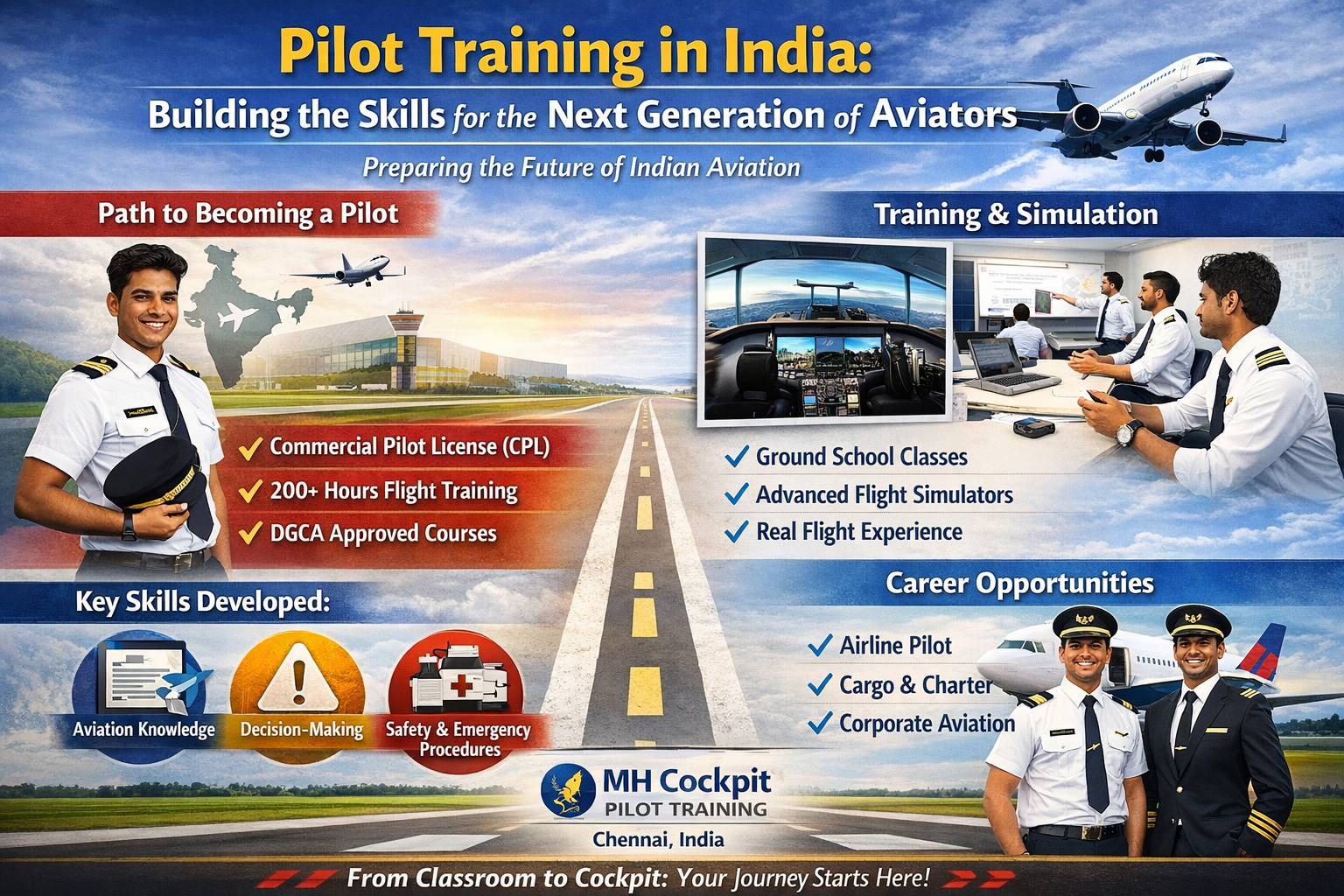
Pilot Training in India: Building the Skills for the Next Generation of Aviators
India’s aviation industry is entering a major growth phase. Airlines are expanding fleets, airports are being built across the country, and the demand for trained pilots is rising every year. As the aviation sector continues to grow, the need for high-quality pilot training institutions has become more important than ever.
Becoming a professional pilot is not simply about flying an aircraft. It requires structured training, technical knowledge, decision-making skills, and strict adherence to aviation safety standards. Aspiring pilots must complete rigorous academic preparation, simulator practice, and real flight training before they can qualify for professional roles in the aviation industry.
The Path to Becoming a Pilot
In India, individuals who want to pursue a professional flying career must obtain a Commercial Pilot License (CPL) issued by the Directorate General of Civil Aviation (DGCA). The CPL is the certification that allows pilots to fly commercial aircraft and pursue careers with airlines or aviation companies.
To qualify for a CPL, candidates must meet several requirements. They must complete their higher secondary education, usually with physics and mathematics, and meet the minimum age and medical fitness requirements defined by aviation authorities.
Training itself involves multiple stages. Students undergo ground school training, where they learn aviation theory including air navigation, meteorology, air regulations, and aircraft systems. After completing the theoretical portion, students move on to simulator training and real flight training.
DGCA regulations require students to complete around 200 hours of flying experience before they can obtain a Commercial Pilot License. These flying hours allow trainees to gain hands-on experience with navigation, instrument flying, cross-country operations, and emergency procedures.
The Importance of Choosing the Right Training Academy
Pilot training is one of the most demanding professional education programs. The quality of training facilities, instructors, simulators, and flight exposure plays a critical role in shaping a pilot’s skills and confidence.
This is why selecting the right aviation academy is one of the most important decisions an aspiring pilot can make. A well-structured training environment provides students with both theoretical understanding and practical flying competence.
Institutions such as MH Cockpit Pilot Training focus on providing structured aviation education that prepares students for real-world aviation careers. Based in Chennai, MH Cockpit offers aviation training programs that include pilot license preparation along with aviation degree pathways designed to support students throughout their aviation journey.
Skills Developed During Pilot Training
Professional pilot training builds several critical competencies that go far beyond technical flying ability. Students learn situational awareness, risk management, and cockpit decision-making skills that are essential for safe aircraft operations.
During training, pilots practice handling emergency scenarios, adverse weather conditions, and complex navigation procedures. Simulator training allows them to experience challenging flight situations in a controlled environment before performing them in actual aircraft.
These experiences help future pilots develop confidence, discipline, and precision — qualities that are essential in aviation where safety and accuracy are paramount.
Career Opportunities After Pilot Training
Completing a Commercial Pilot License opens the door to a wide range of aviation careers. Graduates may begin their careers as first officers or co-pilots, gradually building flight hours and experience before progressing to captain positions.
Beyond commercial airlines, trained pilots can also work in cargo aviation, charter operations, aerial surveying, and corporate aviation. As India’s aviation sector continues expanding, the demand for skilled pilots is expected to remain strong for many years.
Final Thoughts
The journey to becoming a professional pilot requires dedication, discipline, and the right training environment. With the aviation industry growing rapidly, aspiring aviators must focus on gaining high-quality education and practical flight experience.
Choosing the right training academy can make a significant difference in building a strong aviation career. For students looking to start their journey toward the cockpit, professional aviation training programs like those offered at MH Cockpit provide the foundation needed to turn the dream of flying into a reality.
Categories
Read More
Making Eccouncil 312-76 Exam Study Simple and Stress-Free Preparing for the Eccouncil 312-76 exam does not have to feel stressful or confusing. Many students struggle because they study too much without a clear plan. They read many resources but still feel unsure about what really matters for the exam. Choosing clear and trusted Eccouncil 312-76 study material makes preparation simple, focused,...

"Executive Summary Cleaner and Degreaser After Market: Share, Size & Strategic Insights The global Cleaner and Degreaser Aftermarket Market size was valued at USD 43.09 billion in 2025 and is projected to reach USD 50.09 billion by 2033, growing at a CAGR of 1.90% during the forecast period. This Cleaner and Degreaser After Market research report is a detailed...

E-Health Industry Insights: The “Global E-Health Market Professional Report 2025–2033” has been introduced by Straits Research to its research database. The report delivers a structured analysis covering market summary, product details, market size and share, value and volume metrics, segmentation, SWOT analysis, and key players, derived from rigorous primary...

Introduction The Banana Flour Market is rapidly gaining attention as a key player in the global alternative flour and functional food industry. Made from green, unripe bananas, banana flour is rich in resistant starch, dietary fiber, and essential nutrients, offering a gluten-free, health-driven alternative to traditional wheat flour. As consumers increasingly shift...

Benefits of Using Certification Exam Preparation Material Certification exams help people grow in their careers. They help you get better jobs. They also help you earn more money. Many students want to pass the 1Z0-083 exam on the first attempt. This exam is offered by Oracle. However, exam preparation can feel difficult. There are many books to read and many topics to cover. This is why using...