Automotive Glass Market Forecast 2026–2036: Global Market to Reach USD 62.5 Billion by 2036
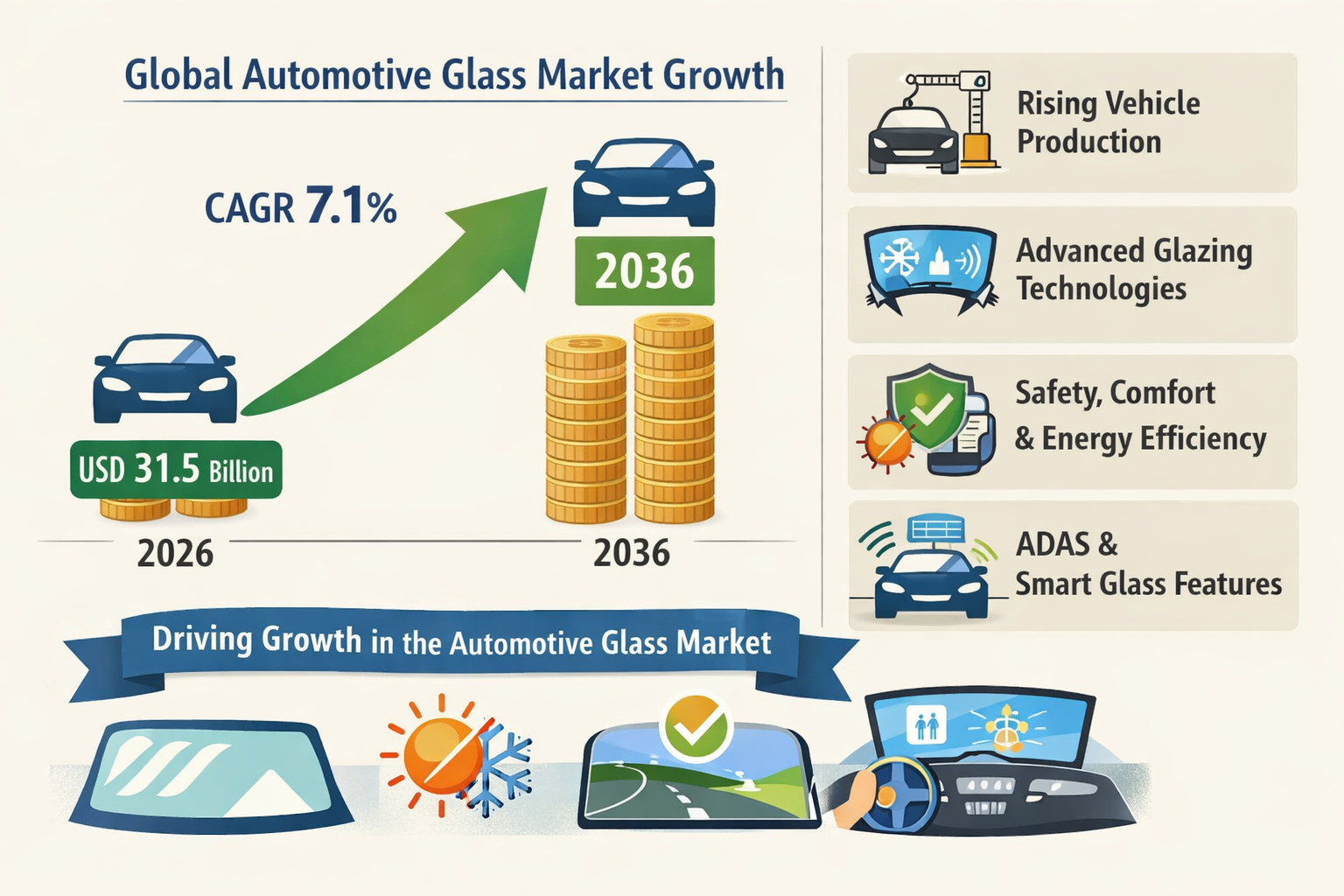
The global automotive glass market is entering a strong growth phase, projected to expand from approximately USD 31.5 billion in 2026 to USD 62.5 billion by 2036, registering a CAGR of 7.1% during the forecast period, according to analysis by Future Market Insights.
Market expansion is being driven by rising vehicle production, increasing adoption of advanced glazing technologies, and growing demand for enhanced safety, comfort, and energy efficiency in modern vehicles. Automotive glass is no longer just a structural component—it plays a vital role in vehicle aerodynamics, thermal insulation, and integration of advanced driver assistance systems (ADAS).
Automotive Glass Market Snapshot (2026–2036)
-
Market size in 2026: USD 31.5 billion
-
Market size in 2036: USD 62.5 billion
-
CAGR (2026–2036): 7.1%
-
Leading glass type: Laminated glass
-
Dominant vehicle segment: Passenger vehicles
-
Key growth regions: Asia Pacific, North America, Europe
-
Fastest-growing countries: India, China, United States, Germany, Japan
Momentum in the Market
Starting at around USD 31.5 billion in 2026, the automotive glass market is expected to witness consistent expansion fueled by technological innovation and increasing vehicle complexity.
Between 2026 and 2030, rising global vehicle production and the integration of features such as panoramic sunroofs, heads-up displays, and smart glass technologies are expected to significantly boost demand.
From 2030 to 2036, the market is projected to accelerate further as automakers increasingly adopt lightweight glazing materials, solar control glass, and acoustic glass solutions. These innovations help improve fuel efficiency, reduce cabin noise, and enhance passenger comfort—key priorities in next-generation vehicles.
The Reasons Behind the Market's Growth
The growing importance of automotive glass is closely tied to evolving automotive design and regulatory trends. Modern vehicles rely on high-performance glass solutions to meet safety standards and improve driving experience.
Key growth drivers include:
-
Rising demand for vehicle safety: Laminated glass improves impact resistance and reduces injury risks during collisions.
-
Integration of advanced technologies: Glass is increasingly used for embedded sensors, ADAS cameras, and heads-up displays.
-
Focus on energy efficiency: Solar control and infrared-reflective glass help regulate cabin temperature, reducing reliance on air conditioning.
-
Growth in electric vehicles (EVs): EV manufacturers emphasize lightweight materials and advanced glazing to maximize battery efficiency.
Additionally, stringent government regulations regarding passenger safety and emissions are pushing automakers to adopt advanced glazing technologies that meet compliance standards.
Top Segment Insights
Laminated Glass Leads the Market
Laminated glass remains the dominant segment due to its superior safety characteristics. It is widely used in windshields because it prevents shattering and enhances passenger protection.
Tempered glass also holds a significant share, particularly in side and rear windows, where strength and cost efficiency are key considerations.
Passenger Vehicles Drive Demand
Passenger vehicles account for the largest share of the automotive glass market. The segment benefits from:
-
Increasing global car ownership
-
Rising demand for premium features such as sunroofs and smart glass
-
Growing consumer preference for safety and comfort
Luxury and mid-range vehicles, in particular, are accelerating the adoption of advanced glazing solutions.
Regional Development: Asia Pacific, North America, and Europe Lead
Asia Pacific: The Growth Engine
Asia Pacific dominates the automotive glass market, driven by high vehicle production and strong manufacturing ecosystems.
-
India: Rapid growth supported by expanding automotive manufacturing and rising middle-class demand
-
China: Large-scale vehicle production and increasing adoption of advanced automotive technologies
-
Japan: Strong focus on innovation and high-quality automotive components
North America and Europe
-
United States: Growth driven by technological innovation and increasing EV adoption
-
Germany & United Kingdom: Strong regulatory frameworks and premium vehicle manufacturing support advanced glass demand
Challenges, Trends, Opportunities, and Drivers
Drivers
-
Increasing global vehicle production
-
Rising demand for advanced safety features
-
Growing adoption of electric and connected vehicles
Opportunities
-
Development of smart glass and electrochromic technologies
-
Expansion of lightweight glazing solutions
-
Integration of augmented reality and heads-up displays
Trends
-
Shift toward panoramic roofs and large glass surfaces
-
Increasing use of solar and acoustic glass
-
Integration of ADAS-compatible glass systems
Challenges
-
High manufacturing and replacement costs
-
Complex integration with advanced vehicle electronics
-
Strict safety and regulatory compliance requirements
Country Growth Outlook (CAGR 2026–2036)
-
India: Strong growth driven by manufacturing expansion and domestic demand
-
China: High-volume production and technology adoption
-
United States: Innovation-led growth in automotive technologies
-
Germany: Premium vehicle segment driving advanced glass adoption
-
Japan: Focus on quality and precision engineering
The Competitive Environment
The automotive glass market is highly competitive, with leading players focusing on innovation, product differentiation, and strategic partnerships.
Key companies include:
-
AGC Inc.
-
Saint-Gobain
-
NSG Group
-
Fuyao Glass Industry Group
-
Xinyi Glass Holdings Limited
These companies are investing heavily in R&D, focusing on smart glass technologies, lightweight materials, and advanced coatings to meet evolving automotive requirements - https://www.futuremarketinsights.com/reports/automotive-glass-market

Κατηγορίες
Διαβάζω περισσότερα
Modern electronic equipment relies on advanced interface technologies to ensure seamless interaction between users and devices. Industrial machines, medical instruments, consumer electronics, and automotive systems require control panels that are not only durable but also efficient and compact. Membrane switches have emerged as a widely adopted solution due to their lightweight structure,...

ALEXISTOGEL adalah agen slot terpercaya yang menghadirkan pengalaman bermain slot online aman, seru, dan menguntungkan. Dengan link slot gacor dan RTP tinggi, pemain memiliki peluang besar untuk memenangkan jackpot setiap hari. Platform ini dirancang agar mudah diakses dan ramah bagi semua pemain, baik pemula maupun yang sudah berpengalaman. Selain menyediakan berbagai jenis permainan slot,...

The Hydrogen Peroxide Market is a critical segment of the global specialty chemicals industry, driven by its wide-ranging applications across healthcare, pulp and paper, textiles, water treatment, and chemical manufacturing. Hydrogen peroxide is valued for its strong oxidizing, bleaching, and disinfecting properties, making it an essential chemical in both industrial and consumer...
Weight management has become a major health concern for many individuals across the world. Modern lifestyles often involve sedentary routines, high-calorie diets, stress, and limited physical activity. These factors make it difficult for many people to maintain a healthy weight. While dieting and exercise are essential components of weight management, many individuals still struggle with slow...
Netflix, the global streaming giant, has kicked off filming for its fresh Mexican production titled "Yankee" in Mexico City, as revealed on September 21, 2018, from Hollywood, California. The series is set for a 2019 debut. The narrative centers on Malcolm Moriarty, portrayed by Pablo Lyle, an American businessman who ventures across the Mexican border to safeguard his loved ones, ultimately...