Confused Between BBA Aviation and Aeronautical Engineering? Here’s What You Need to Know
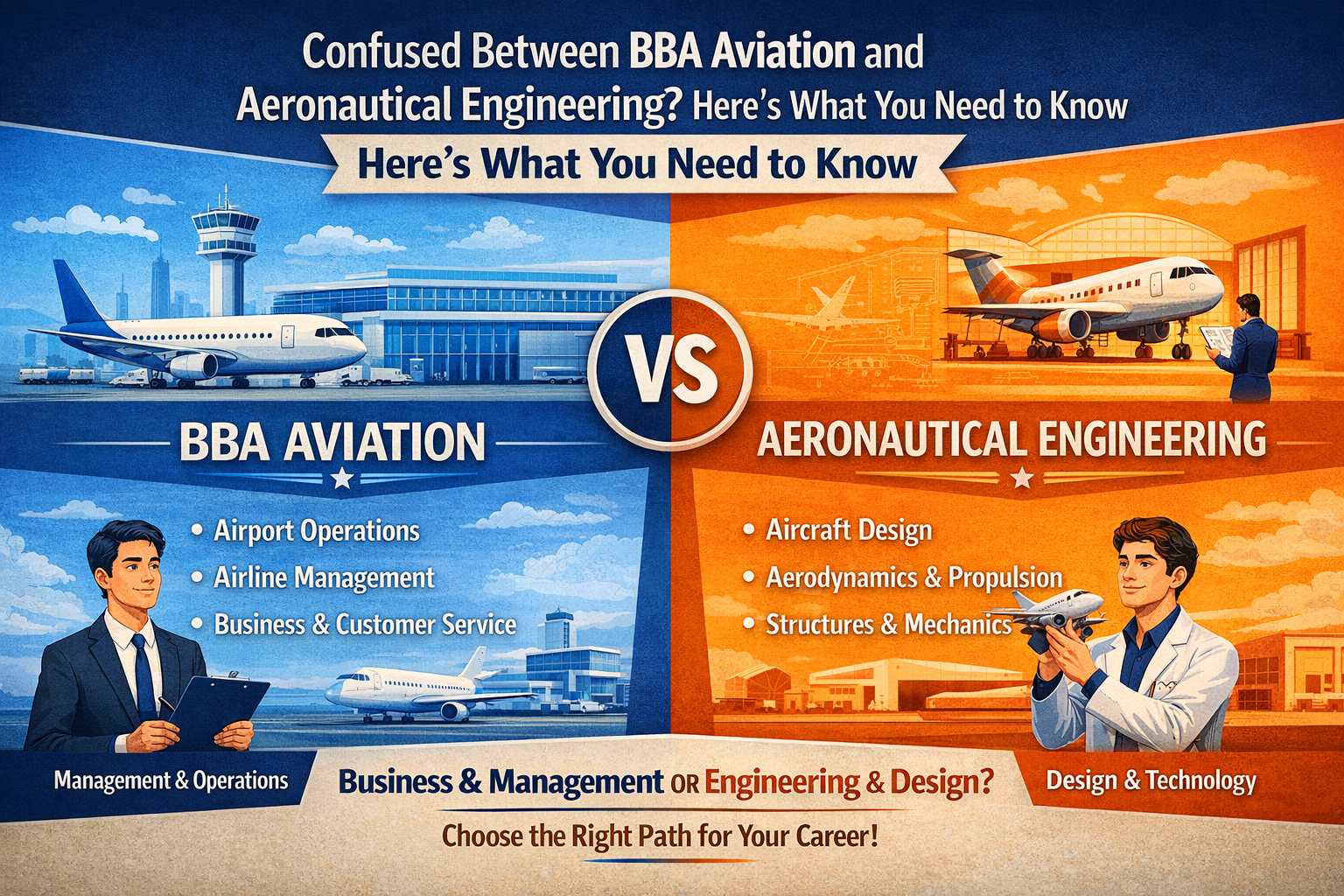
Choosing the right path in aviation or aeronautical engineering can feel confusing, especially when there are multiple courses like BBA Aviation, BSc Aviation, and Bsc Aeronautical Engineering. Each of these leads to very different career outcomes, so understanding the difference is important before selecting a college.
For students interested in management and operations within the aviation industry, a BBA in Aviation is often considered a practical starting point. It focuses on areas like airport operations, airline management, and customer handling. In cities like Chennai, options are relatively limited, so many students explore institutions such as Vels Institute of Science, Technology & Advanced Studies (VISTAS), which offers a structured BBA Aviation program. The course typically combines business fundamentals with aviation-specific subjects, helping students understand how the industry functions on the ground level.
However, one thing many students overlook is that the value of a BBA Aviation degree does not come from the syllabus alone. The real difference comes from exposure—internships, communication skills, and practical understanding of airport and airline operations. Without this, even a well-known college may not translate into strong career outcomes.
On the other hand, if a student is more inclined towards the technical side of aviation, Aeronautical Engineering is a completely different path. This field focuses on the design, development, and maintenance of aircraft. Subjects include aerodynamics, propulsion systems, aircraft structures, and flight mechanics. Colleges like Bharath Institute of Higher Education and Research (BIHER) and B.S. Abdur Rahman Crescent Institute of Science & Technology in Chennai are commonly considered for such programs. In Bangalore, Alliance University is another option that offers aerospace-related education with a mix of theoretical and design-based learning.
It’s important to understand that Aeronautical Engineering is highly technical and requires a strong foundation in physics and mathematics. Career opportunities are usually in aircraft manufacturing, research, defense organizations, and maintenance sectors rather than airline operations.
For students whose ultimate goal is to become a pilot, neither BBA Aviation nor Aeronautical Engineering is a direct requirement. Pilot training depends on DGCA exams, flight hours, and medical fitness. That said, many students still choose aviation-related degrees like BSc Aviation because it helps them build theoretical knowledge and also provides a backup career option in case pilot training is delayed or not feasible.
In recent years, there has been a growing awareness among students about choosing institutes that go beyond just classroom teaching. Some academies focus more on combining degree programs with practical exposure and clear career pathways. For example, institutes like MH Cockpit in Chennai are often mentioned by students for their approach toward integrating aviation training with real industry insights. While not a traditional university, such training-focused environments can complement a degree by helping students better understand career options within aviation.
Ultimately, the “best” college or course depends on the student’s career goal. If the interest lies in management and operations, BBA Aviation can be a good starting point. If the focus is on engineering and aircraft design, Aeronautical Engineering is the right path. And if the goal is to become a pilot, then flight training should be the primary focus, with a degree acting as a support system rather than the main requirement.
The key takeaway is simple: in aviation, skills and exposure matter more than just the degree name. Choosing the right environment that provides both knowledge and practical experience will make a significant difference in long-term career growth.
Категории
Больше
Panama Stem Cell Therap burgeoning hub for advanced medical treatments, and Panama Stem Cell Therapy stands at the forefront of this revolution. Specializing in regenerative medicine, this clinic offers stem cells in panama that aim to improve quality of life for patients suffering from a variety of degenerative conditions. With a focus on safety, efficacy, and personalized care, Panama Stem...

"Protein Hydrolysates Market Summary: According to the latest report published by Data Bridge Market Research, the Protein Hydrolysates Market The global protein hydrolysates market size was valued at USD 643.99 million in 2025 and is expected to reach USD 958.74 million by 2033, at a CAGR of 5.1% during the forecast period Market definition mentioned in...

Is Algo Trading Legal in India? A Complete Guide for Beginners Introduction Have you ever wondered if computers can trade stocks for you — faster, smarter, and without emotions? That’s exactly what Algorithmic Trading, or Algo Trading, does. It’s like having a tireless robot that follows your commands and executes trades at lightning speed. But here’s the million-dollar...

Verified Call Girls in Noida for Safe and Private Meetings Introduction: The modern era has changed the meaning of companionship for many individuals. These days, people not only look for casual company but prefer something more meaningful and subtle that they can enjoy comfortably without worrying about anything else. In this context, verified Call Girls in Noida are preferred by...

COME SPORTS Makes Fantasy EasierCOME SPORTS helps fantasy cricket fans compete smarter during IPL 2026. Expert predictions IPL 2026 coverage reduce confusion and save research time before every contest begins. Users receive useful guidance that supports stronger decisions and improves chances of winning real money through smart planning online daily with growing confidence now. Accurate...