Expert Technology Translation Services in Singapore: The 2026 Buyer's Guide for Tech Companies Entering Southeast Asia
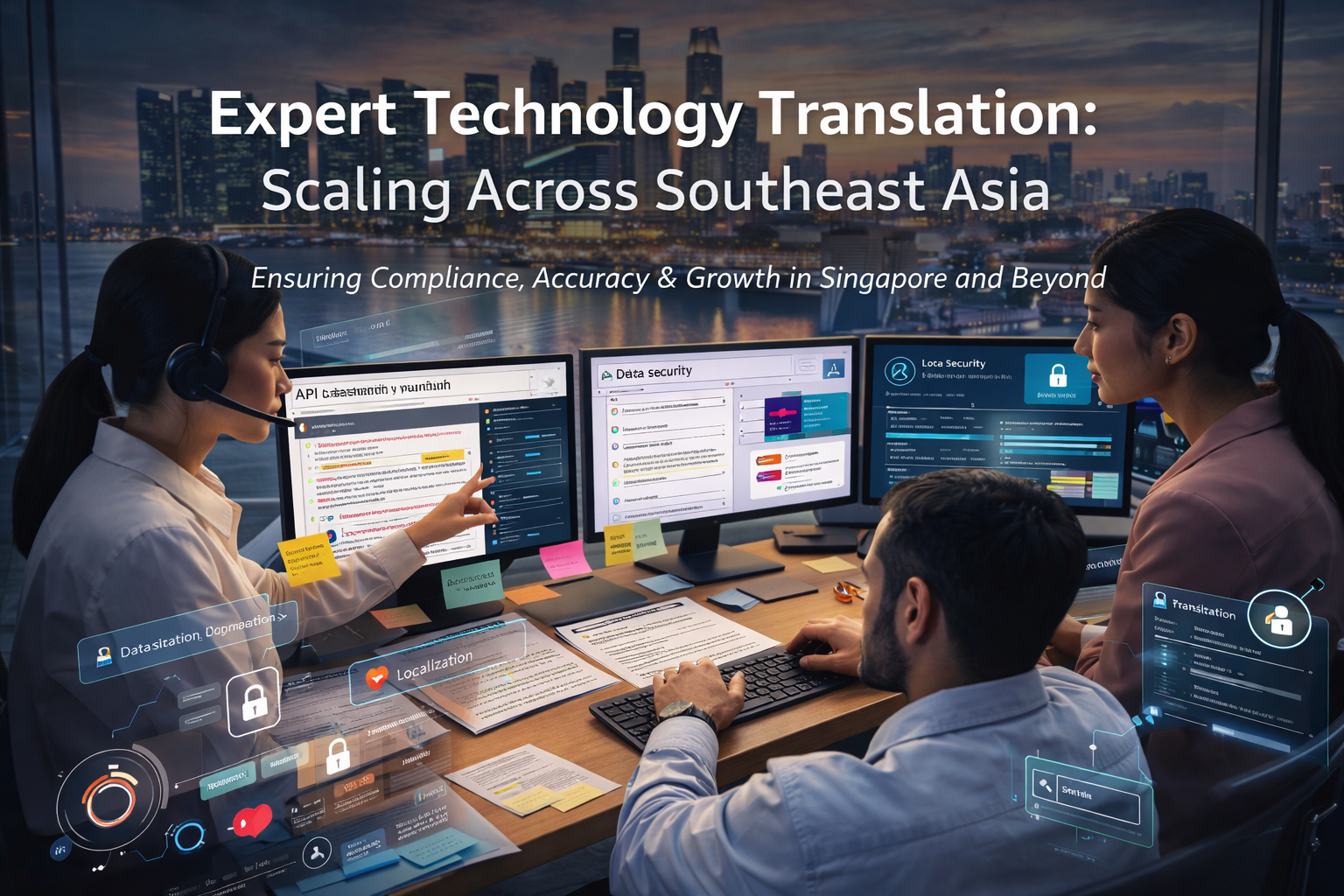
As global technology companies look toward Southeast Asia for growth, Singapore consistently emerges as the ideal entry point. With its advanced regulatory systems, international workforce, and thriving digital economy, it serves as a strategic gateway to a region of over 680 million people.
However, one critical factor is often underestimated: expert technology translation.
Based on the insights from the original guide , this blog explores why translation is not just a linguistic task, but a core business function that directly impacts compliance, product performance, and long-term scalability.
The Hidden Challenge of Expansion
Singapore may appear straightforward for international tech companies due to its widespread use of English. However, as highlighted on page 2 of the document, the country is also a bridge to diverse Southeast Asian markets, including Indonesia, Vietnam, Thailand, and the Philippines—each with distinct languages, scripts, and regulatory frameworks.
The real challenge arises when companies treat translation as a post-development activity. This leads to:
-
Increased regulatory risk
-
Product inconsistencies
-
Reduced trust among local users and regulators
Markets can easily distinguish between products built for them and those adapted as an afterthought.
What Is Expert Technology Translation?
Expert technology translation refers to specialised services that convert:
-
Technical documentation
-
Software interfaces
-
Regulatory submissions
-
Engineering and compliance records
…into target languages while maintaining technical precision, regulatory alignment, and cultural relevance (page 3).
Unlike general translation, which focuses on language alone, expert translation addresses risk, functionality, and compliance.
Legal and Compliance Requirements
In Singapore, translation is often a legal necessity rather than a choice.
According to the Strategic Goods (Control) Act (page 1):
-
Companies must provide English translations of trade records within 14 days upon request by Singapore Customs
-
Non-compliance is a legal offence
Additionally:
-
Translation providers handling sensitive data are classified as Data Intermediaries under Singapore’s PDPA
-
Strict requirements apply for data protection, encryption, and access control
Regulatory bodies such as HSA and MAS also require controlled vocabulary alignment, meaning even accurate translations can be rejected if they do not match expected terminology (page 4).
General vs Expert Translation: A Critical Distinction
The document clearly differentiates between general and expert translation (page 3):
-
General Translation → Focuses on linguistic accuracy
-
Expert Translation → Focuses on risk management, compliance, and technical accuracy
A mistranslated API instruction, unclear UI message, or incorrect regulatory term can lead to:
-
Compliance failures
-
Product malfunctions
-
Legal liabilities
Expert translation operates across three layers: conceptual understanding, regulatory alignment, and functional correctness.
The Real Cost of Translation Decisions
One of the most important insights from the document appears in the comparison table (pages 4–5):
-
General translation may appear cheaper initially
-
But it often leads to delays, regulatory issues, and costly rework
-
Expert translation reduces long-term costs by preventing errors early
The key takeaway:
The real cost of translation becomes visible at the worst possible moment—during audits, product launches, or regulatory submissions.
Types of Technology Translation Services
The diagram on page 5 outlines seven key categories:
-
Regulatory Document Translation – Required for submissions to authorities such as HSA, MAS, and Customs
-
Software & Application Localisation – Covers UI elements, scripts, and user interactions
-
Technical Documentation Translation – Includes manuals, APIs, and engineering specifications
-
Legal & Contractual Translation – Ensures enforceable meaning across jurisdictions
-
Patent & Intellectual Property Translation – Precision-critical for IP protection
-
Cybersecurity & Compliance Documentation – Aligns with frameworks such as MAS TRM
-
Marketing & Content Localisation – Adapts messaging while preserving technical accuracy
Each category has unique risks and requirements, making specialised expertise essential.
Key Challenges in Technology Translation
The guide highlights several challenges that companies must address:
Terminology Precision Gap
Technical terms may appear similar but have different operational meanings (page 10).
Text Expansion
Languages like Indonesian and Vietnamese can expand text by 200–300%, affecting UI design (page 10).
Script-Level Complexity
Languages such as Thai (no word spacing) and Arabic (right-to-left) require structural UI changes (page 10).
Regulatory Vocabulary Specificity
Using non-standard terminology can delay approvals (page 11).
Data Sovereignty Risks
Cloud-based translation tools may violate data protection laws if not properly configured (page 11).
Consistency Across Updates
Without translation memory systems, terminology drift can create compliance risks (page 11).
When Translation Errors Become Business Risks
Translation errors can directly impact product performance and compliance.
Examples from page 13 include:
-
Ambiguous UI messages causing incorrect user actions
-
Misinterpreted API documentation leading to system errors
-
Poorly translated cybersecurity policies creating audit failures
Additionally, machine translation without domain expertise can lead to 30–40% accuracy degradation, making expert human review essential.
Choosing the Right Translation Partner
Selecting a translation partner is a strategic decision that affects your entire product lifecycle.
The document outlines four key pillars:
1. Regulatory Credibility
Certifications such as ISO 17100 and ISO 9001 demonstrate quality and reliability (page 15).
2. Data Security & IP Protection
Standards like ISO 27001 or SOC 2 ensure secure handling of sensitive data (page 16).
3. Domain Technical Expertise
Translators must understand your specific industry and technology (page 17).
4. Quality Assurance Processes
A structured workflow—Translate → Edit → Proof (TEP)—and back-translation for critical content ensures accuracy (page 17).
The evaluation matrix (pages 18–19) further recommends assessing providers based on performance, not just cost.
Localisation as a Competitive Advantage
Singapore’s technology ecosystem is highly competitive, with over 80,000 tech companies (page 14).
In such an environment, localisation quality becomes a key differentiator. Successful companies:
-
Design products for local markets from the start
-
Integrate cultural and linguistic intelligence
-
Build trust with regulators and users
Products that are properly localised are remembered—and trusted.
Translation as Long-Term Infrastructure
One of the strongest conclusions of the document (page 22) is that translation should be treated as long-term infrastructure, not a one-time task.
Companies that adopt this approach benefit from:
-
Faster regulatory approvals
-
Reduced rework and costs
-
Consistent documentation
-
Improved compliance
A well-maintained translation system becomes a scalable asset that evolves with each product update.
Final Thoughts
Expanding into Singapore and Southeast Asia offers tremendous opportunity—but also significant complexity.
The companies that succeed are those that go beyond technology and focus on adaptation—across languages, regulations, and cultures.
Expert technology translation sits at the center of this transformation. It is not just about communication; it is about ensuring that your product works, complies, and succeeds in new markets.
The real question is simple:
Is your translation strategy building a long-term asset—or accumulating hidden risk?
Categories
Read More
"Global Executive Summary Artificial Intelligence (AI) in Insurance Market: Size, Share, and Forecast CAGR Value The global artificial intelligence (AI) in insurance market was valued at USD 6.44 billion in 2024 and is expected to reach USD 63.27 billion by 2032 During the forecast period of 2025 to 2032 the market is likely to grow at a CAGR of 33.06%, primarily...

Easy and Trusted WGU Principles-of-Management Exam Prep for Fast Results Many students feel confused before WGU Principles-of-Management exams. They study many books but still feel unsure. This wastes time and energy. Good Principles of Management at Western Governors University (IAC1) certification exam preparation material helps fix this problem in a simple way. It...

Executive Summary Anti-Counterfeit Packaging Market : The global Anti-counterfeit Packaging market size was valued at USD 169.35 billion in 2024 and is expected to reach USD 443.89 billion by 2032, at a CAGR of 20.10% during the forecast period Anti-Counterfeit Packaging Market research report is generated with the best and advanced tools of collecting,...
A new growth forecast report titled Recommendation Engine Market Size, Share, Trends, Industry Analysis Report: By Type, Deployment (Cloud and On-Premise), Organization, Application, End User, and Region (North America, Europe, Asia Pacific, Latin America, and Middle East & Africa) – Market Forecast, 2025–2034 introduced by Polaris Market Research represents conclusive...
Introduction Money plays a role in almost every decision we make, from buying groceries to planning for retirement. Yet many young people step into adulthood without the knowledge or skills to manage their finances. Financial literacy is more than just understanding numbers—it’s the ability to make informed decisions that shape a secure future. For teens in particular, learning...