


How to Optimize Your Crunchbase Profile for AI Search Engines (2026 Guide)
In today’s AI-first world, visibility isn’t just about ranking on Google anymore. It’s about being understood, verified, and cited by AI systems like ChatGPT, Perplexity, and Google’s AI Overviews.
If your company isn’t recognized as a trusted entity in these systems, it effectively doesn’t exist—no matter how polished your website or how strong your funding story is.
This shift has given rise to a new discipline: Generative Engine Optimization (GEO). And at the center of this transformation sits an often-overlooked platform: Crunchbase.
The New Reality: If AI Can’t Find You, You Don’t Exist
Consider this: a startup raises millions, gets featured in top publications, and builds a high-end website. Yet when investors ask AI tools about the company, the response is vague—or worse, nonexistent.
The problem isn’t visibility in the traditional sense. It’s entity recognition.
AI doesn’t just scan web pages anymore. It asks:
-
What is this company?
-
Is it verified?
-
How does it connect to other known entities?
If your company lacks a structured, credible presence in the knowledge graph, it becomes invisible.
From Keywords to Entities: The Evolution of SEO
Traditional SEO focused on:
-
Keywords
-
Backlinks
-
Page rankings
Modern AI search focuses on:
-
Entities (companies, people, products)
-
Relationships between entities
-
Verified data sources
This is where Crunchbase becomes essential.
Think of your website as your house. Your Crunchbase profile is the public deed that proves ownership. Without it, AI systems have no reliable reference point.
Why Crunchbase Is Critical for AI Visibility
Crunchbase plays multiple roles in modern search:
1. It Validates Legitimacy
AI systems use Crunchbase to confirm that your company is real, funded, and active.
2. It Provides Structured Data
Crunchbase organizes information in a format that AI models can easily parse.
3. It Builds E-E-A-T Signals
Experience, Expertise, Authority, and Trustworthiness are reinforced through:
-
Founder profiles
-
Funding rounds
-
Industry classification
4. It Anchors You in the Knowledge Graph
Crunchbase connects your company to the broader ecosystem—investors, competitors, and markets.
In fact, companies with optimized Crunchbase profiles are cited 3–4 times more often in AI-generated answers.
What Is Generative Engine Optimization (GEO)?
GEO is the practice of structuring your content so AI systems can:
-
Understand it
-
Summarize it
-
Cite it accurately
Unlike traditional SEO, which targets clicks, GEO targets inclusion in AI responses.
The goal is simple:
When someone asks AI about your industry, your company should be part of the answer.
Step-by-Step: How to Optimize Your Crunchbase Profile
Step 1: Claim and Verify Your Profile
Start with the basics:
-
Claim your company profile
-
Verify it using your company email
-
Update founding date and funding details
Unverified profiles often receive low-confidence signals, meaning AI may ignore them entirely.
Step 2: Write a Factual 60-Word Summary
This is the most important part of your profile.
AI models frequently quote this section directly, so it must be:
-
Clear
-
Factual
-
Specific
Ideal format:
-
What your company does
-
When it was founded
-
Where it is based
-
How much funding it has raised
-
Who it serves
Avoid marketing language. Words like “revolutionary” or “cutting-edge” are often filtered out as noise.
Instead of:
“A leading AI platform transforming industries…”
Write:
“A software company that develops AI-powered analytics tools for mid-market healthcare providers.”
Step 3: Choose 3–5 Precise Categories
Many founders make the mistake of adding too many categories.
AI systems use categories to classify companies into comparison groups. Too many categories dilute your positioning.
Focus on:
-
Specific industries
-
Clear use cases
-
Relevant technology areas
For example:
-
Enterprise Software
-
Healthcare
-
Artificial Intelligence
-
SaaS
Avoid overly broad labels like “Technology” or “Big Data.”
Step 4: Link Founder Profiles and Verify Funding
Your founders are critical trust signals.
Make sure:
-
Each founder has a complete Crunchbase profile
-
Past companies, exits, and education are listed
-
Current roles include start dates
Funding data should include:
-
Exact dates
-
Amounts raised
-
Lead investors
-
Press coverage links
Incomplete funding data can make your company appear unverified.
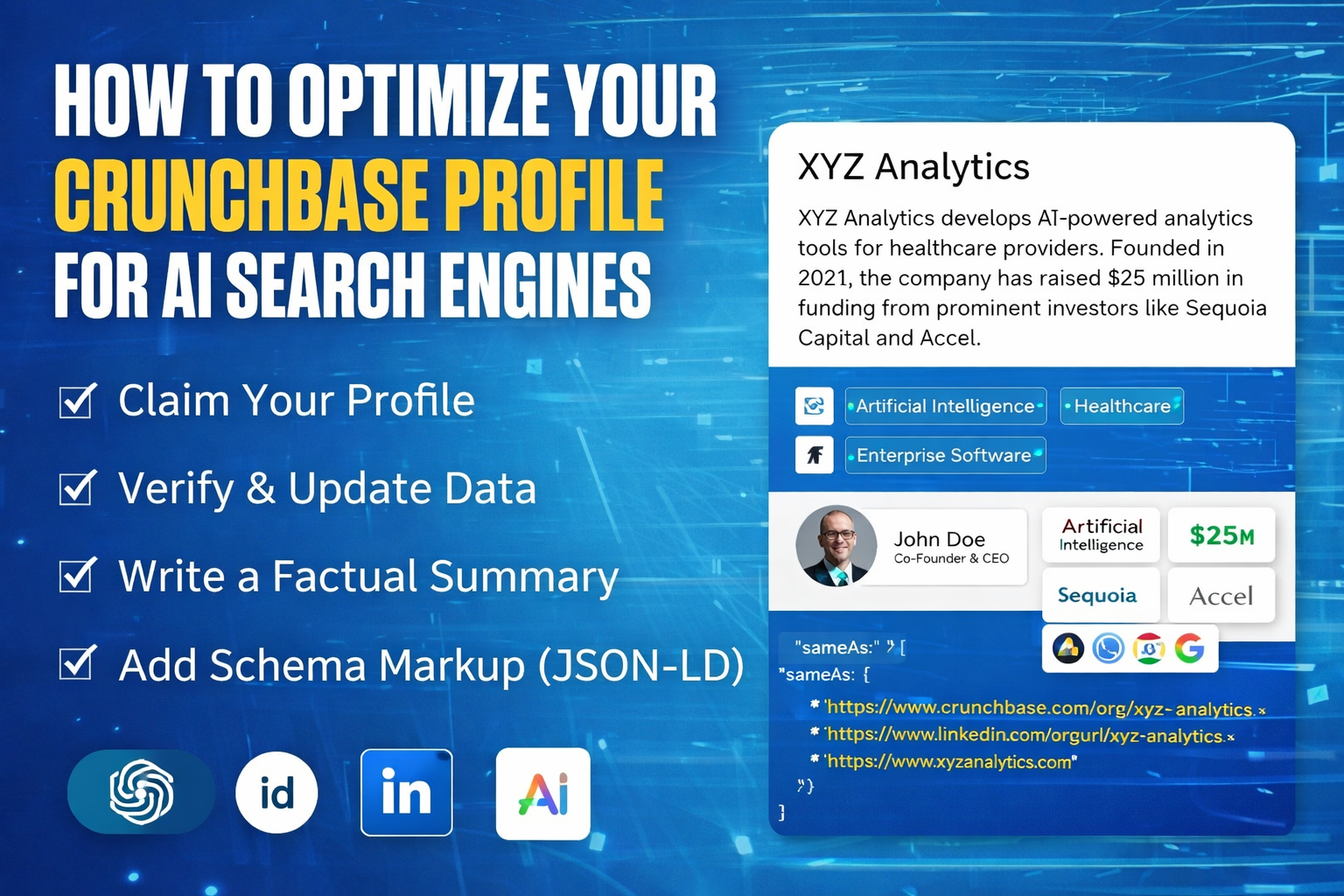
Step 5: Implement Schema Markup (JSON-LD)
This is the technical layer that connects your website to your Crunchbase profile.
Using sameAs schema, you tell search engines that:
-
Your website
-
Your Crunchbase profile
-
Your LinkedIn page
…all represent the same entity.
This improves your chances of appearing in:
-
Knowledge panels
-
AI-generated summaries
-
Entity-based search results
How AI Models Evaluate Your Company
AI systems don’t rely on a single source. They look for consistency across multiple signals.
They evaluate:
Experience
-
Founder history
-
Previous exits
Trustworthiness
-
Verified funding
-
Investor credibility
Consistency
-
Matching data across platforms
If your information is scattered or inconsistent, AI becomes uncertain—and defaults to ignoring you.
Advanced GEO Strategies for AI Visibility
1. Use the Summary Snippet Technique
Keep your summary between 40–60 words.
Why?
-
Too short: lacks context
-
Too long: gets truncated or misinterpreted
This range is optimal for AI citation.
2. Structure Content Like Questions
AI models are trained on Q&A patterns.
Instead of generic headings:
-
“Products”
-
“About Us”
Use:
-
“What does the company do?”
-
“Who are the founders?”
-
“How much funding has been raised?”
This makes your content easier to extract and reuse.
3. Format for AI Readability
AI prefers:
-
Short paragraphs (2–4 sentences)
-
Bullet points
-
Specific numbers and dates
-
Clear subject-verb-object sentences
Avoid long, dense blocks of text.
How Often Should You Update Your Profile?
Freshness is a key signal.
Minimum:
-
Quarterly updates
Ideal:
-
Monthly reviews
Immediate updates:
-
New funding rounds
-
Executive hires
-
Product launches
-
Acquisitions
A profile that hasn’t been updated in over a year signals inactivity.
Beyond Search: The Predictive Advantage
Crunchbase is no longer just a directory—it’s becoming a predictive platform.
AI models use it to:
-
Identify emerging startups
-
Predict funding success
-
Recommend companies to investors
A well-optimized profile increases your Trend Score, making you more visible to:
-
Venture capitalists
-
Corporate buyers
-
AI-powered discovery tools
The 5 Most Common Mistakes
-
Incomplete Funding Data
Missing investors, dates, or links reduces credibility -
Promotional Language Overload
Buzzwords reduce AI trust -
Abandoned Founder Profiles
Weakens expertise signals -
Stale Information
Signals inactivity -
No Schema Connection
Breaks entity linking between platforms
Fixing these issues can dramatically improve your visibility.
Your Crunchbase Profile Is Now Critical Infrastructure
In 2026, your Crunchbase profile carries more weight than your homepage for AI discovery.
This is a fundamental shift:
-
SEO is no longer about ranking pages
-
It’s about being recognized as an entity
Your profile is not marketing fluff—it’s technical infrastructure.
Final Thoughts
AI search is rewriting the rules of visibility.
To succeed, you must:
-
Think like a knowledge graph
-
Structure your data for machines
-
Prioritize credibility over creativity
The good news?
The effort required is small—but the impact is massive.
Start today:
-
Claim your profile
-
Write a factual summary
-
Verify your data
-
Connect your ecosystem
Because in the AI era, the companies that are understood are the ones that win.
Categories
Read More
In the fast-paced digital world, businesses need mobile applications that are not only functional but also innovative, engaging, and tailored to their unique needs. Kilobytes Technologies has earned a reputation for delivering cutting-edge mobile app development projects that combine creativity, technology, and user-centric design to drive business growth Mobile App Development Company In...

Ever heard of a game that's both infuriating and incredibly rewarding? A rhythm-based platformer where one wrong move sends you spiraling back to the beginning? Then you've likely stumbled upon the captivating (and often frustrating) world of "Geometry Dash." It’s a game that tests your reflexes, memory, and patience like no other. Let’s dive into the simple-yet-challenging world of...

According to the latest report published by Data Bridge Market Research, the Oncology Imaging Software Market CAGR Value The global Oncology Imaging Software Market size was valued at USD 4.44 billion in 2025 and is expected to reach USD 6.80 billion by 2033, at a CAGR of 5.5% during the forecast period Oncology Imaging Software...

The landscape of attainable performance is shifting faster than anyone predicted. For years, the conversation around classic muscle was dominated by six-figure HEMI convertibles and ultra-rare COPO specials, pushing the dream of owning a V8 coupe further away from the average enthusiast. But in 2026, a quiet correction has settled over the market. While the blue-chip icons continue their march...

Un nouveau Défi de Création d’Équipe vient de débarquer sur EA Sports FC 26 : la carte National Pride de Mateo Chávez. Ce latéral gauche mexicain, formé au Club Deportivo Guadalajara, se distingue par un profil moderne où la projection offensive et l’agressivité défensive cohabitent. À seulement 18 900...
