


BSc Aviation vs BSc Aeronautics Which Course is Better for Your Aviation Career?
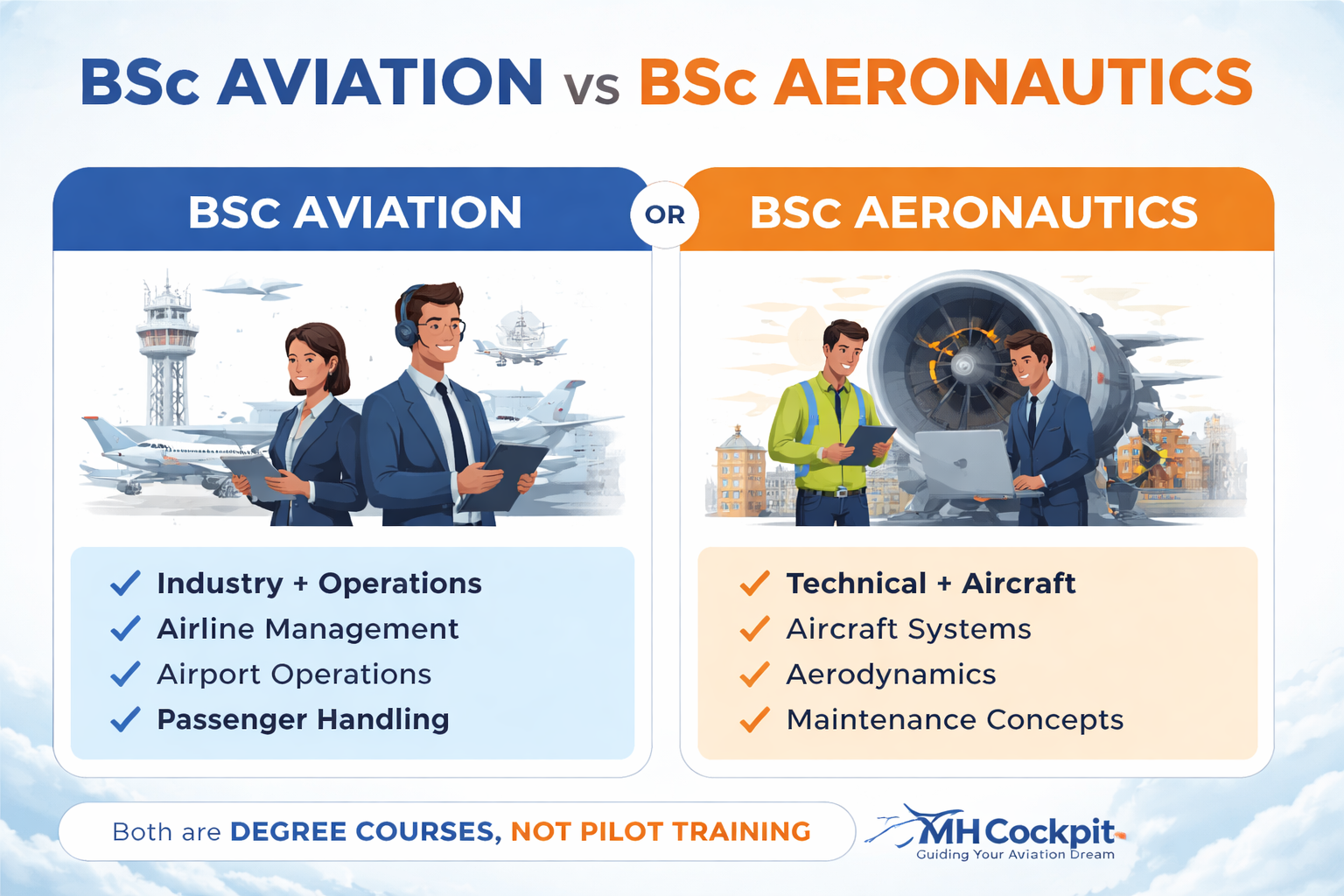
Choosing the right course in aviation can be confusing, especially when options like BSc Aviation and BSc Aeronautics sound very similar. Many students assume both lead to the same career path, but in reality, they focus on completely different areas of the aviation industry.
If you’re planning to build a career in aviation, understanding this difference early can save you time, money, and confusion.
What is BSc Aviation?
BSc Aviation is a 3-year undergraduate degree that focuses on the operational and industry side of aviation.
In this course, you’ll learn how the aviation system works as a whole. Subjects typically include:
- Airline operations
- Airport management
- Aviation safety
- Air navigation basics
- Meteorology
The focus here is not on aircraft design or deep technical knowledge, but on how airlines and airports function in real-world scenarios.
Career scope after BSc Aviation
After completing this course, students usually move into:
- Airline operations roles
- Airport ground staff and management
- Customer service and passenger handling
- Aviation logistics and coordination
This course is ideal for students who are interested in working in the aviation industry but not in technical or engineering roles.
What is BSc Aeronautics?
BSc Aeronautics, on the other hand, is more focused on the technical side of aviation, especially related to aircraft.
In this course, you’ll study:
- Aircraft systems
- Aerodynamics
- Aircraft engines
- Basic maintenance concepts
Compared to BSc Aviation, this course is more technical, but still not as advanced as a full engineering degree like B.Tech Aeronautical Engineering.
Career scope after BSc Aeronautics
Students can explore roles such as:
- Technical support roles in aviation
- Maintenance-related fields
- Aircraft systems and inspection roles
This course is better suited for students who are interested in how aircraft work rather than how the aviation industry operates.
Key Differences (Simple Breakdown)
- BSc Aviation → Industry + operations focused
- BSc Aeronautics → Technical + aircraft focused
Both courses are valuable, but they lead to different types of careers.
Important Clarification
One of the biggest misconceptions students have is:
“These courses will make me a pilot”
This is not true.
Both BSc Aviation and BSc Aeronautics are degree programs only. They do not include flying training and do not replace a Commercial Pilot License (CPL).
If your goal is to become a pilot, you will still need to go through:
- DGCA exams
- Flying training (200 hours)
- CPL certification
These degrees can act as a backup or additional qualification, but they are not mandatory for pilot training.
Which Course Should You Choose?
The decision depends entirely on your interest:
- If you like management, airport operations, and airline systems → go for BSc Aviation
- If you’re interested in aircraft, engines, and technical concepts → go for BSc Aeronautics
There is no “better” course. It’s about choosing what aligns with your career goals.
Why Choosing the Right Guidance Matters
Many students pick courses based only on names or marketing, and later realize it doesn’t match their actual career goals. This is very common in aviation.
Instead of guessing, it’s always better to understand:
- What each course leads to
- What the industry actually demands
- What path fits your long-term goal
This is where platforms like MH Cockpit can be useful. They focus on helping students understand aviation careers clearly, not just pushing a course.
They guide students on:
- Choosing between aviation degrees and pilot training
- Understanding real career paths
- Avoiding common mistakes
As of now, they have tie-ups with around 9 colleges across India, which gives students more flexibility in choosing the right option.
Final Take
Both BSc Aviation and BSc Aeronautics are good courses, but they serve different purposes.
👉 Choose based on your interest, not just the course name
👉 Understand the career path before committing
👉 Don’t assume it leads directly to becoming a pilot
If you make the right choice early, your journey in aviation becomes much smoother.
الأقسام
إقرأ المزيد
According to TechSci Research report, “UAE Tire Market - By Region, Competition, Forecast & Opportunities, 2020–2030”, the UAE tire market was valued at USD 308.1 million in 2024 and is projected to reach USD 455.2 million by 2030, growing at a CAGR of 6.82% during the forecast period. This growth reflects the dynamic expansion of the UAE’s...

Global Executive Summary Scintillators Market: Size, Share, and Forecast The global scintillators market size was valued at USD 586.95 million in 2024 and is projected to reach USD 890.59 million by 2032, with a CAGR of 5.35% during the forecast period of 2025 to 2032. To gain meaningful market insights and thrive in this competitive market place, Scintillators Market survey...

Top VPNs for Netflix 2025 Facing Netflix's regional blocks? Your favorite shows might be unavailable abroad. While the platform aggressively targets VPN connections, select providers still bypass restrictions securely. Our rigorous 2025 evaluation tested over 78 services under real-world streaming conditions. Here’s what performed best for unlocking global libraries: NordVPN dominates...

Streetwear continues to shape modern fashion by blending comfort with bold self-expression. One brand that has quickly gained recognition in this space is Spider Clothing. Known for its creative designs and strong visual identity, Sp5der Clothing has become a popular choice for those who want something different from traditional fashion. At the center of this trend is...

The eClinical Solutions Market is experiencing rapid transformation as clinical research organizations, pharmaceutical companies, and biotechnology firms increasingly adopt digital technologies to streamline clinical trials. According to Polaris Market Research, the global eClinical solutions market is poised for substantial growth through 2034, driven by technological advancements, regulatory...