Boosting Work Zone Safety with AFADs: Smart, Efficient, and Protective
Work zones are among the most dangerous environments for both drivers and road workers. Every year, thousands of crashes occur in construction areas, often caused by distracted driving and poor visibility. To address these risks, transportation agencies are increasingly adopting Automated Flagger Assistance Devices (AFADs) — a smart solution that enhances safety, efficiency, and traffic control.
At Transportation Solutions & Lighting, advanced portable traffic signals and AFAD systems are designed to protect workers, reduce hazards, and maintain smooth traffic flow.
What Are AFADs?
Automated Flagger Assistance Devices (AFADs) are portable, remotely operated traffic control systems that eliminate the need for flaggers to stand in active traffic lanes.
Instead of being exposed to moving vehicles, a trained operator can control the device from a safe location, such as inside a vehicle or behind a barrier.
Types of AFADs
-
STOP/SLOW Paddle AFADs
Motorized STOP/SLOW signs mounted on trailers or carts, remotely controlled. -
Red/Yellow Lens AFADs with Gate Arm
Operate like compact traffic signals. A red light and gate arm stop vehicles, while a flashing yellow warns drivers.
Both systems comply with Manual on Uniform Traffic Control Devices standards and are widely used by transportation departments and contractors.
Why AFADs Matter for Work Zone Safety
AFADs are more than just convenient — they are lifesaving tools.
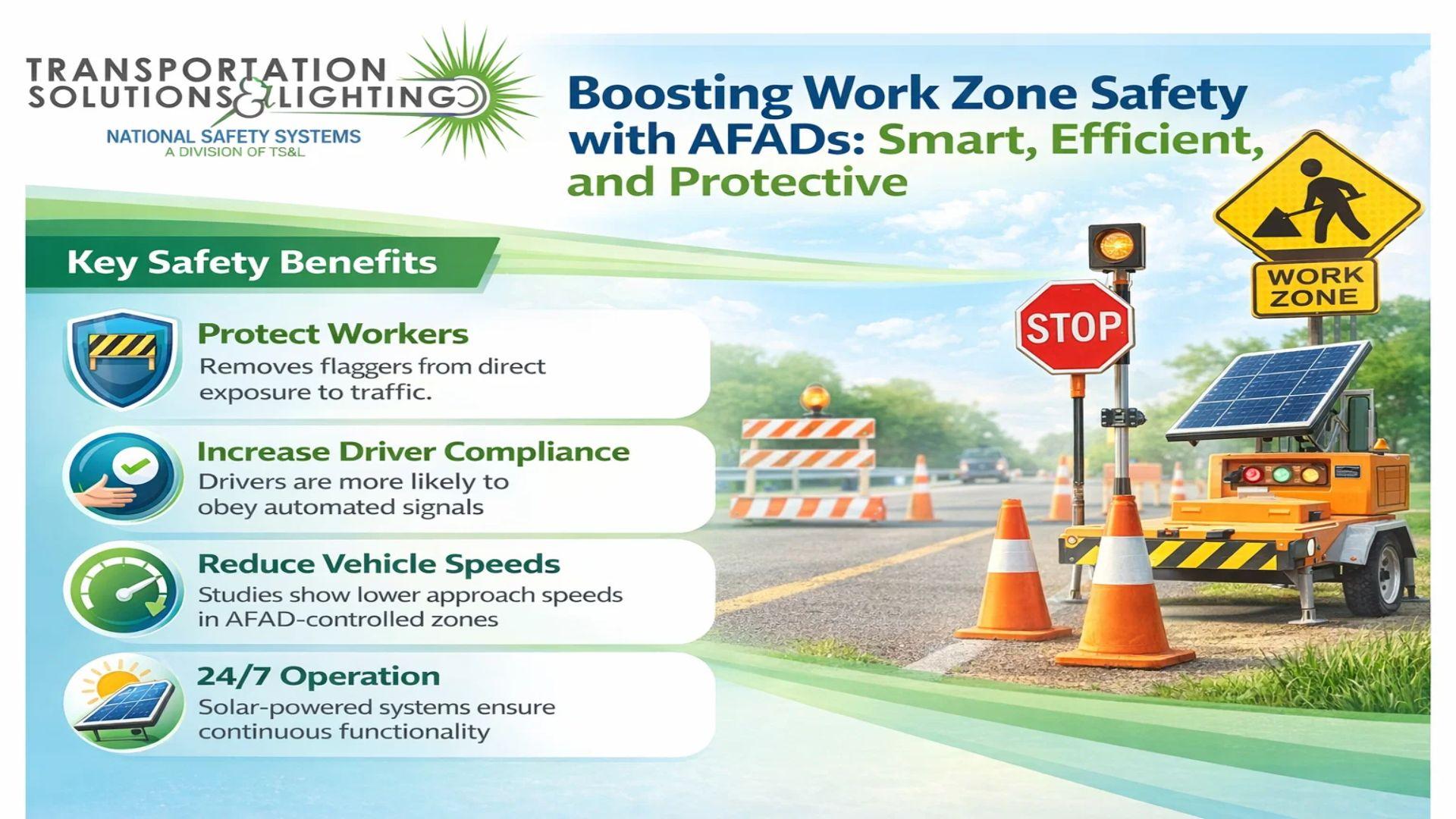
Key Safety Benefits
-
Protect Workers
Removes flaggers from direct exposure to traffic. -
Increase Driver Compliance
Drivers are more likely to obey automated signals than manual instructions. -
Reduce Vehicle Speeds
Studies show lower approach speeds in AFAD-controlled zones. -
24/7 Operation
Solar-powered systems ensure continuous functionality.
As work zone incidents continue to rise, AFADs provide a critical layer of protection and reliability.
Regulatory Standards and Best Practices
AFAD deployment is governed by strict guidelines under MUTCD Section 6E.04.
Important Requirements
-
Crashworthiness
Must comply with NCHRP 350 / AASHTO standards. -
Use Case
Ideal for short-term, single-lane, two-way traffic control projects. -
Human Oversight
Must always be operated by a trained flagger. -
Traffic Volume
Commonly used on roads with up to 8,000 vehicles per day. -
Proper Placement
Must follow standard spacing, taper, and signage rules.
Correct usage ensures both compliance and maximum safety.
Benefits of AFADs for Contractors and Agencies
1. Enhanced Safety
Workers stay out of active traffic, significantly reducing risk.
2. Cost Efficiency
Fewer on-site personnel are required, lowering labor costs.
3. Improved Traffic Flow
Consistent signals reduce confusion and delays.
4. Flexibility
Trailer-mounted and solar-powered units allow quick deployment.
5. Increased Public Trust
High-visibility signals improve driver awareness and compliance.
Common AFAD Use Cases
AFADs are widely used in:
-
Bridge maintenance on rural highways
-
Utility work with temporary lane closures
-
Emergency repairs after storms
-
Construction site haul road intersections
These systems are especially valuable in regions with high traffic variability and short-term projects.
TS&L’s AFAD and Traffic Signal Solutions
Transportation Solutions & Lighting provides industry-leading solutions, including:
-
Solar-powered trailers for reliable operation
-
Crashworthy, standards-compliant designs
-
Remote-controlled systems for safe operation
-
24/7 support and rapid deployment services
👉 Learn more about their solutions:
-
TS&L Portable Traffic Signals
-
TS&L Blue Light Tower
Integrating AFADs with Other Safety Systems
For maximum effectiveness, AFADs should be combined with:
-
LED-enhanced warning signage
-
Solar lighting for night visibility
-
Camera monitoring systems for remote supervision
This integrated approach ensures complete work zone safety.
Final Thoughts
Automated Flagger Assistance Devices are rapidly becoming the standard for modern work zones. By improving safety, increasing compliance, and streamlining operations, AFADs are transforming how traffic is managed in construction environments.
With trusted solutions from Transportation Solutions & Lighting, contractors and agencies can ensure safer worksites and more efficient project execution.
👉 Explore more:
Frequently Asked Questions (FAQs)
1. What is an AFAD used for?
AFADs are used to control traffic in work zones, especially for temporary lane closures and construction areas.
2. Are AFADs better than human flaggers?
Yes, AFADs improve safety by removing workers from traffic and increasing driver compliance with signals.
3. Do AFADs require human operation?
Yes, they must always be operated by a trained flagger, even though they are automated.
4. Where can AFADs be used?
They are typically used on two-lane roads, construction zones, utility projects, and emergency repair sites.
5. Are AFADs compliant with regulations?
Yes, they are fully compliant with MUTCD standards when used correctly.
Categorii
Citeste mai mult
Investing in a robust home or business defense framework does not mean you have to buy brand-new equipment every time technology advances. Many property owners move into spaces already equipped with physical security hardware or hold onto legacy control panels that are still functional. Activating professional alarm monitoring existing system setups allows you to maximize your past hardware...

Planning a major wedding celebration requires careful coordination of design elements, floral themes, and financial limits. Flowers are generally the most impactful visual components across both ceremony spaces and dining reception rooms. Choosing highly versatile, beautiful blossoms ensures couples can establish magnificent setups without experiencing massive, stressful bills. This...

The Airport RFID System Market is witnessing significant growth as airports and airlines increasingly adopt advanced technologies to improve operational efficiency, baggage handling accuracy, passenger experience, and security management. Radio Frequency Identification (RFID) technology has become an essential component of modern airport infrastructure, enabling real-time tracking of baggage,...

Melbourne, Australia – As Victoria introduces stronger commercial passenger vehicle reforms to improve passenger safety, transparency, and service quality, Maxi Cab Melbourne is reinforcing its commitment to delivering dependable, comfortable, and customer-focused transport services across Melbourne. The latest government initiatives encourage higher standards throughout the taxi...

As a leading force in the market research space, Emergen Research is excited to announce the debut of its comprehensive research content series. The report provides accurate insights into key financial metrics such as pricing, production capacity, market value, gross revenue, and profitability. Its primary objective is to deliver a comprehensive understanding of market size, revenue growth, and...