DGCA’s New Proposal: Opening the Pilot Dream to Commerce & Arts Students Opportunity or Illusion
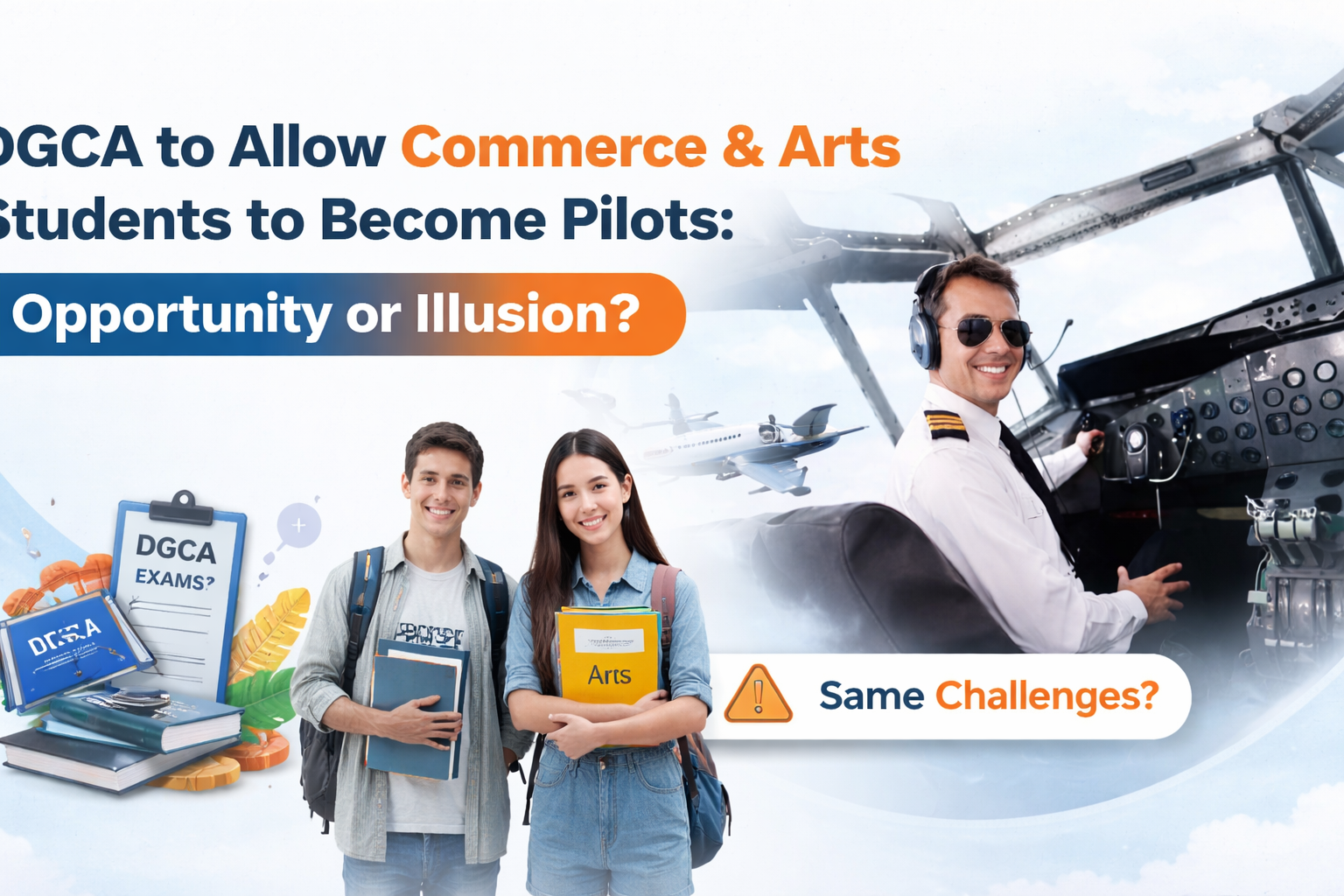
Recently, there’s been a lot of discussion around the possibility of DGCA allowing commerce and arts students to pursue a pilot career without Physics and Maths in Class 12. On the surface, it sounds like a game-changing move. For years, PCM has been a barrier for many students who had the passion but not the subject combination.
But if you look a little deeper, this change is more about accessibility than simplicity.
What This Means for Aspiring Pilots
If this proposal becomes official, more students will be able to directly enter the aviation pathway without going through alternatives like NIOS to complete Physics and Maths later.
For many, that removes:
- Extra time
- Additional exam pressure
- Confusion about eligibility
So yes, in terms of entry, this is definitely a positive step.
But Here’s the Reality No One Talks About
Becoming a pilot is not just about eligibility. Even today, students from commerce backgrounds can become pilots by completing the required subjects later.
The real challenge begins after you enter training.
Pilot training includes subjects like:
- Air Navigation
- Meteorology
- Technical General
These aren’t “easy” subjects. They require:
- Logical thinking
- Basic physics understanding
- Numerical application
Removing PCM from eligibility doesn’t remove these concepts from the syllabus.
Why This Could Be a Double-Edged Sword
While the change may increase the number of aspiring pilots, it may also lead to:
- Students entering without proper academic preparation
- Difficulty in clearing DGCA exams
- Increased training delays
- Financial strain due to repeated attempts
In short, the barrier shifts from before entry → during training.
What Actually Matters More Than Your Stream
Whether you come from PCM, Commerce, or Arts, your success in aviation will depend on:
- How strong your fundamentals are
- How well you understand DGCA subjects
- How early you get clarity on the pilot journey
This is where most students struggle — not because of their stream, but because they don’t have proper guidance.
The Missing Piece: Structured Guidance
A common mistake many students make is jumping into flying training without understanding the full roadmap:
- CPL (Commercial Pilot License)
- Type Rating
- Airline Preparation
This lack of clarity often leads to delays of 1–2 years.
That’s why having the right mentorship from the beginning becomes critical.
Institutes like MH Cockpit focus on building this clarity early. Instead of just pushing students into training, they help them understand:
- DGCA subjects from the ground level
- The complete career pathway
- What airlines actually expect
This kind of approach becomes even more important if eligibility rules become more flexible.
So, Is This a Good Move?
Yes — from an opportunity standpoint.
More students will be able to pursue their dream without being blocked at the school level. That’s a big win.
But no — it’s not a shortcut.
The difficulty of becoming a pilot remains the same:
- DGCA exams are still there
- Flying hours are still required
- Airline selection is still competitive
Final Perspective
This change, if implemented, will open doors — but it won’t make the journey easier.
If anything, it will highlight an important truth:
👉 Becoming a pilot is less about your stream and more about your preparation.
Students who:
- Build strong fundamentals
- Understand the process early
- Get proper guidance
will always have an advantage, regardless of their background.
Conclusion
DGCA’s move could reshape how students enter aviation, but success in this field will still depend on knowledge, discipline, and planning.
For aspiring pilots, the focus should not just be on “Can I enter?” but on “Am I prepared for what comes next?”
Because in aviation, entry is just the beginning — what really matters is how well you navigate the journey ahead.
Categorias
Leia Mais
Ready-to-Eat (RTE) Meals Market: Convenience Meets Growth The global Ready-to-Eat (RTE) Meals Market is experiencing robust expansion fueled by shifting consumer lifestyles, urbanization, and an increasing demand for convenient, nutritious meal solutions. Valued at USD 161.3 billion in 2025, the market is projected to grow to USD 225.3 billion by 2033, registering a CAGR of 4.4%...

When you imagine your dream home, you envision elegance, comfort, and a location that defines exclusivity. Prestige Nautilus Worli offers precisely that – an ultra-luxury residential landmark in the heart of Worli Mumbai Location, designed for those who desire a premium lifestyle. This upcoming masterpiece by Prestige Group brings you the perfect blend of space, comfort, and modern...

The Aqua Partners event in Monopoly Go runs from April 8 at 1PM EST to April 13 at 4PM EST, giving you four days to team up with friends and complete up to four partnership builds. Each build requires a combined 80,000 points with your partner, earned by spinning the roulette wheel using Aqua Partners tokens. You'll unlock five milestone rewards per partnership on the way to the grand total,...
"Executive Summary Ureteral Stents Market Size and Share Analysis Report The global ureteral stents market size was valued at USD 455.44 million in 2025 and is expected to reach USD 726.99 million by 2033, at a CAGR of 6.02% during the forecast period This Ureteral Stents Market research report guides the management of a firm in planning. For the same,...
In today’s digital-first economy, businesses often invest heavily in professional web development expecting guaranteed online success. A visually appealing, technically sound website is a strong starting point—but surprisingly, many websites still fail to perform even after being built by experts. This raises an important question: why do some websites fail despite expert web...