


Manual vs Electronic Edge Finder Tool Explained for Beginners
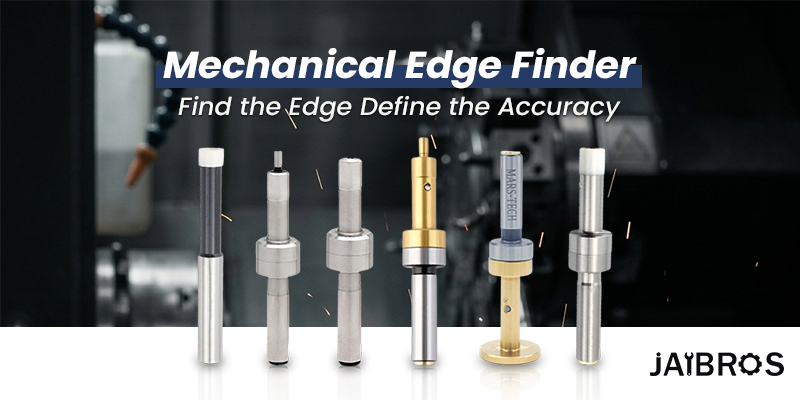
Understand how manual and electronic edge finder tools work and which one is best for CNC machining accuracy.
Which Edge Finder Tool Is Better: Manual or Electronic?
The better edge finder tool for CNC was once a very subjective question. Manufacturers are extremely concerned about the quality of their machinery and the precision of their machined parts. It is critical for manufacturers to locate the edge of their workpieces accurately to set their zero points before they begin machining. Without proper zero point location, there is little chance that the finished parts will be within the specified tolerances.
Both types of edge finding tools are used to accurately position the workpiece edge with respect to the machine spindle. The two types of edge finding tools are widely used on traditional milling machines, vertical machining centers and other CNC machine setups.
It is common for machinists to question which type of tool is best for their application, manual or electronic edge finder tool?
Understanding the Role of Edge Finding in CNC Machining
Before discussing the comparison, it is important to understand why edge finding is necessary. In CNC machining, the machine must know the exact location of the workpiece before it begins cutting. Without proper alignment, even a high-precision cnc tool may produce inaccurate results.
An Edge Finder Tool allows machinists to detect the edge of the material and set the correct coordinate system. This process is commonly used during setup in milling operations and machining centers.
The tool works by touching the edge of the workpiece while the spindle rotates. Once the edge is detected, the operator can set the machine zero point accurately. This ensures consistent machining and reduces the chances of errors.
What Is a Manual Edge Finder?
A manual edge finder is one of the most commonly used alignment tools in traditional machining setups. It is a simple mechanical device that works based on physical contact between the rotating tip and the workpiece edge.
When the spindle rotates, the tip of the tool remains centered. As the tool touches the workpiece edge, the tip suddenly moves off-center, indicating that the edge has been located.
Many machinists still prefer the Edge Finder Tool in manual form because of its simplicity and reliability. It does not require batteries or electronic components, which makes it durable and easy to maintain.
Manual finder tools are often used in workshops where machinists rely on traditional setup techniques. They are also commonly used as a CNC edge finder tool for milling machines when operators prefer direct visual feedback.
What Is an Electronic Edge Finder?
An electronic edge finder uses sensors and electronic circuits to detect contact with the workpiece. Instead of relying on visual movement, the tool provides a signal such as a light indicator or beep when the edge is detected.
This type of Edge Finder Tool is designed for modern CNC machines where quick and accurate setup is required. The electronic signal helps the operator identify the exact contact point more easily.
In high-precision machining environments, electronic finder tools are often preferred because they reduce human error and improve repeatability. They are widely used as an edge finder for vmc machines where precision and efficiency are critical.
Electronic models are especially helpful when machining complex components where setup time must be minimized.
Key Differences Between Manual and Electronic Edge Finders
1. Accuracy
Accuracy is one of the most important factors when selecting finder tools. Manual tools rely on the operator’s ability to visually detect the moment when the tip shifts from its center position.
Electronic models, however, provide a direct signal when the tool touches the workpiece. Because of this automated detection, the Edge Finder Tool in electronic form can offer slightly higher precision and repeatability.
2. Ease of Use
Manual tools require some level of experience. Beginners may take time to recognize the exact moment when the tool tip shifts.
Electronic models are easier to use because the machine provides a clear signal. This makes them suitable for operators who are new to CNC machining or working in high-speed production environments.
Many machinists consider electronic versions to be more user-friendly finder tools.
3. Setup Time
Setup time is an important factor in production environments. Manual tools may take slightly longer because the operator must carefully watch the tool while it rotates.
Electronic tools can speed up the process by providing instant feedback. In high-volume production, this small time saving can significantly improve productivity.
For industries using advanced cnc tool systems, faster setup often leads to better workflow efficiency.
4. Durability
Manual finder tools are usually made of hardened steel and have very few components. Because of this simple design, they are extremely durable and can last for many years with minimal maintenance.
Electronic versions contain circuits, batteries, and sensors. While they are still reliable, they require occasional maintenance and battery replacement.
This makes manual models more suitable for rough workshop environments.
5. Cost
Cost is another important consideration. Manual tools are typically much more affordable than electronic ones.
Electronic finder tools offer advanced features and greater convenience, but they come at a higher price. Companies must decide whether the increased efficiency justifies the investment.
In many small workshops, machinists still prefer traditional Edge Finder Tool designs due to their affordability and reliability.
Choosing the Right Tool for Your CNC Machine
The decision between manual and electronic finder tools depends on several factors, including machining requirements, operator experience, and production volume.
Manual tools are ideal for:
-
Small workshops
-
Traditional milling machines
-
Operators experienced in manual setup
Electronic tools are better for:
-
High-precision CNC environments
-
High production volume
-
Automated machining setups
In vertical machining centers, an edge finder for vmc is commonly used to ensure accurate workpiece alignment before starting complex machining programs.
Why Finder Tools Are Essential in CNC Machining
Finder tools play a critical role in machining accuracy. Without proper edge detection, the machine cannot correctly locate the workpiece.
Accurate edge detection ensures:
-
Precise part dimensions
-
Reduced setup errors
-
Better machining consistency
-
Improved productivity
For this reason, many machinists consider the Edge Finder Tool an essential accessory in any CNC workshop.
Conclusion
Both manual and electronic finder tools have their own advantages. Manual tools are simple, affordable, and highly durable, making them suitable for traditional machining environments. Electronic tools, on the other hand, offer greater convenience and improved precision, especially in modern CNC setups.
The best choice depends on the specific requirements of the workshop. In high-production environments where speed and accuracy are critical, electronic tools may provide better efficiency. However, manual models remain a reliable option for many machinists.
Regardless of the type used, an Edge Finder Tool remains one of the most important tools for achieving accurate machining results. Proper workpiece alignment ensures that CNC operations run smoothly and that finished components meet the required quality standards.
About Jaibros
Jaibros is a trusted supplier of high-quality cutting tools and machining accessories designed for modern manufacturing industries. The company provides a wide range of reliable cnc tool solutions that support precision machining in CNC and VMC operations. With a focus on performance and durability, Jaibros continues to help machinists and manufacturers achieve better productivity and accuracy in their machining processes.
FAQs
1. What is an Edge Finder Tool used for?
It is used to locate the exact edge of a workpiece so that machinists can set the correct zero point before machining.
2. What is the difference between manual and electronic edge finders?
Manual tools rely on visual movement of the tip, while electronic tools use sensors to signal contact with the workpiece.
3. Are electronic edge finders more accurate?
Electronic tools can provide higher repeatability and easier detection compared to manual models.
4. Can an edge finder be used in VMC machines?
Yes, an edge finder for vmc is commonly used to locate workpiece edges during CNC setup.
5. Why are finder tools important in CNC machining?
Finder tools help ensure accurate alignment, which improves machining precision and reduces setup errors.
Categorias
Leia Mais
The Biometrics as a Service (BaaS) Market is witnessing significant growth as organizations increasingly adopt cloud-based biometric authentication solutions to enhance security and streamline identity verification processes. The market was valued at USD 4.43 billion in 2025 and is projected to reach USD 17.10 billion by 2032, growing at a CAGR of 18.41% during the forecast period from 2026 to...

The Automotive Seat Heater Market has emerged as a rapidly expanding segment of the passenger comfort systems landscape. As per MRFR analysis, increasing consumer demand for enhanced in‑vehicle comfort, broader adoption of heated seating in premium and mid‑segment vehicles, and rising awareness of cold‑climate amenities are driving significant aftermarket and OEM growth opportunities. In...

Link building looks simple when explained fast, but the real work feels uneven and slightly messy most days because nothing really moves in a clean line. You fix pages, adjust content, wait again, and then still nothing happens for a while, which honestly gets frustrating after some time passes. That delay is usually where people start looking at link building agencies, hoping someone...

Introduction Urgent care centers across the United States are experiencing rapid growth, but with that growth comes increasing administrative pressure. Clinics are expected to deliver fast, affordable care while also managing insurance verification, coding compliance, payer rules, claim submissions, and patient collections. For many providers, balancing clinical efficiency with financial...

The global epoxy composites market size was valued at USD 40.23 billion in 2024 and is expected to reach USD 80.76 billion by 2032, at a CAGR of 9.10% during the forecast period. The global business landscape is undergoing a transformation, with industries increasingly leaning on deep research and actionable insights to make strategic decisions. One segment seeing...