


Why Clipping Campaigns Help Brands Stay Visible Longer
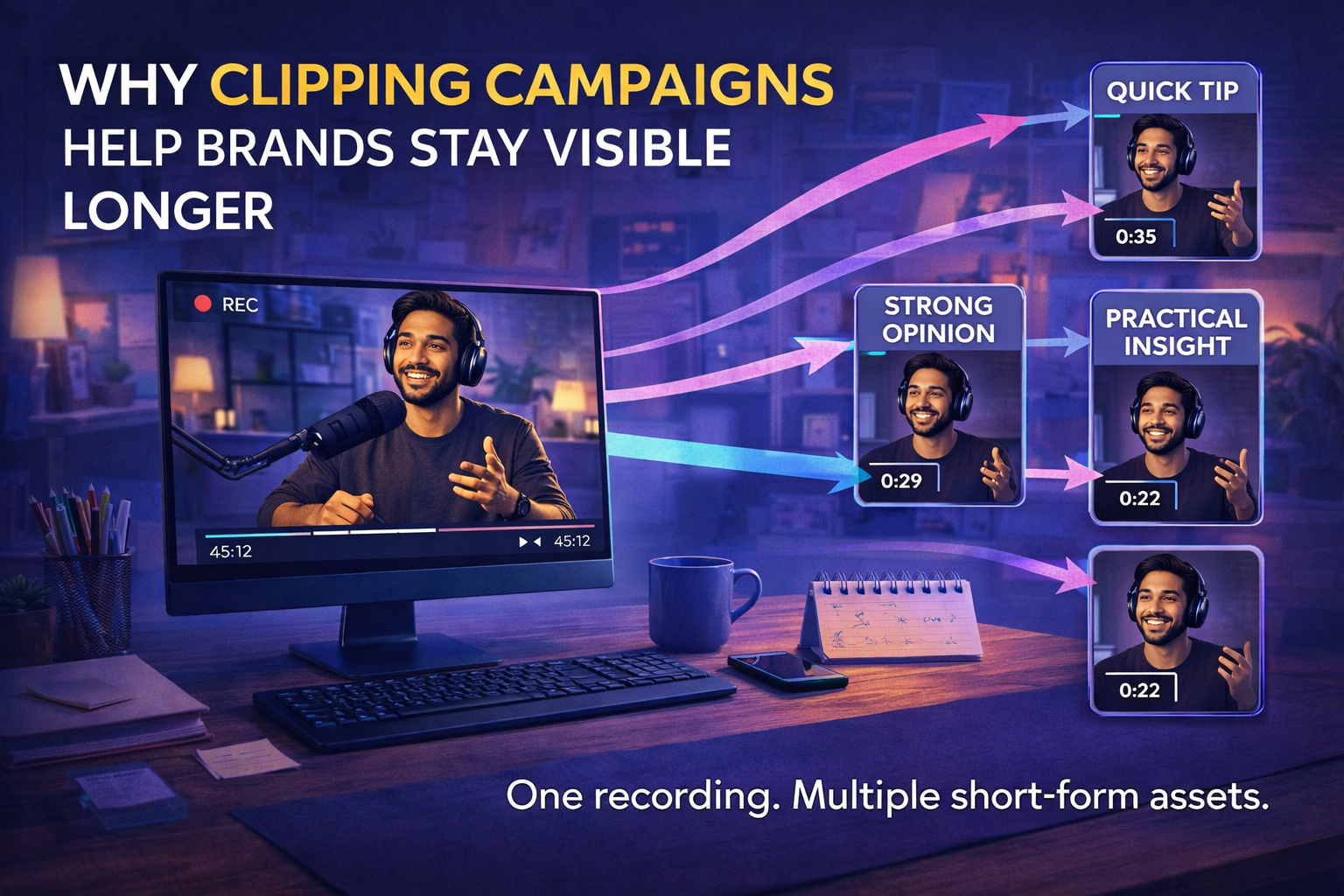
Most brands do not have a content problem.
They have a distribution problem.
That is the part many teams miss. They spend time recording webinars, founder interviews, podcasts, demos, and educational videos, but once the full version goes live, most of the value inside that content disappears too quickly. A few people watch the full upload, maybe one extra clip gets posted, and then the team moves on to the next thing.
That is where clipping campaigns become useful.
A clipping campaign helps a brand take one long-form recording and turn it into multiple short-form assets that can be published over time. Instead of expecting one upload to create all the attention, the brand creates several smaller touchpoints that keep the original idea active for longer.
That may sound simple, but it changes the content system in a big way.
Because visibility online rarely comes from one moment. It usually comes from repeated exposure, useful touchpoints, and content that keeps showing up after the original release.
Why long-form content loses momentum too fast
Long-form content still matters.
A good podcast episode can build authority. A webinar can educate. A founder interview can create trust. A detailed video can explain something better than a short post ever could.
But long-form content often has a short attention window.
That is not always because the content is weak. In many cases, the original piece is strong. The problem is that most people do not discover brands by starting with a full 40-minute recording. They usually discover them through smaller moments first.
A quick takeaway.
A short opinion.
A practical clip.
A memorable quote.
A useful answer to a common problem.
Without those smaller entry points, even strong long-form content fades faster than it should.
That is why so many brands feel like they are making useful content without getting enough visibility from it. The content may be good, but the surrounding distribution is too thin.
What clipping campaigns actually do
Clipping campaigns create a structure around reuse.
Instead of treating one long-form recording as one finished asset, the team treats it as a source for several smaller content opportunities. That one source can become multiple short-form assets, each designed to keep the idea alive across different posts, formats, and days.
A strong clipping campaign can produce:
- practical tip clips
- short educational moments
- opinion-led snippets
- teaser videos
- quote-based content
- summary clips
- social-ready edits for different platforms
That means one webinar can create several posts instead of one.
One podcast episode can support a full week of short-form distribution.
One founder interview can become multiple discovery moments instead of a single upload that disappears too fast.
That is why clipping campaigns are not just about “cutting videos shorter.”
They are about extracting more value from material that already exists.
Why this helps brands stay visible longer
Visibility breaks when the content rhythm breaks.
That happens a lot. A team publishes something strong, then disappears while working on the next big thing. A few days pass. Then a week. Then the team tries to restart the content engine again.
That stop-start pattern is common because every post feels like it requires a new idea, a new shoot, a new edit, and a new push.
Clipping campaigns reduce that pressure.
Once the long-form source exists, the team already has material it can keep using. That makes the publishing rhythm easier to sustain. Instead of constantly asking, “What do we make next?” the team can ask, “What else can we pull from this recording?”
That one change makes visibility more realistic.
And realistic visibility matters more than occasional bursts of activity.
A brand that stays in front of its audience through smaller, useful moments will usually outperform a brand that appears only when a major upload goes live.
Why repeated exposure matters more than one great post
A lot of content strategies fail because they depend too heavily on one post doing all the work.
That almost never happens.
People rarely remember a brand after seeing one isolated clip or one full-length upload. They remember brands after seeing them several times in useful, relevant, well-timed ways.
That is what clipping campaigns support.
One short-form clip introduces the brand.
Another clip reinforces it.
A third gives a useful takeaway.
A fourth builds familiarity around the same person, same message, or same offer.
That repeated visibility creates recall. And recall is what helps brands stay relevant in busy feeds.
This is one reason more teams are investing in structured clipping campaigns instead of relying on random short-form posting. They want the same recording to produce multiple meaningful touchpoints instead of one brief spike and then silence.
That is a smarter use of content.
Why smaller teams benefit the most
Large brands can sometimes survive inefficient content workflows.
Smaller teams usually cannot.
A lean business, founder-led company, consultant, or agency often has limited time and limited production capacity. That means every recording needs to stretch further. There is less room for waste, less room for silence between posts, and less room for content systems that depend on constant fresh filming.
That is why clipping campaigns are especially useful for:
- B2B brands
- agencies
- founders
- podcasters
- consultants
- educators
- service businesses
These groups often already create useful source material. The real opportunity is not always in making more content. It is in making existing content work harder.
If one podcast episode can create six short clips, that helps.
If one webinar can support multiple publishing days, that helps.
If one founder conversation can be turned into a repeatable short-form system, that helps even more.
That is leverage.
And smaller teams need leverage more than anyone.
Why random posting is not the same thing
Some teams already post clips, but they do it without a larger plan.
A clip goes out because someone had time to cut it.
Another appears later with no real connection to the first.
Then nothing happens for a while.
Then the team scrambles again.
That is not really a campaign.
It is patchwork.
A clipping campaign works better because it creates a sequence. The clips come from the same source and support a more deliberate rhythm. That rhythm is what helps a brand stay present online instead of constantly disappearing between content pushes.
That difference matters because random activity may create noise, but structured repetition creates recognition.
And recognition is what helps content keep working over time.
Why one recording should do more work
One of the biggest mistakes brands make is underestimating how much useful material sits inside one long recording.
A single interview might include:
- one strong opinion
- one practical tip
- one memorable quote
- one good teaser
- one short lesson
- one answer that solves a common audience problem
The same is true for webinars, training sessions, demos, panels, and podcast episodes.
Yet many teams extract only one small piece, if that.
That creates unnecessary waste. The team already invested time into planning, recording, editing, and publishing the source content. A clipping campaign simply helps that investment go further.
That is why the goal should not always be “make more.”
Sometimes the better move is “get more from what already exists.”
Why this also improves consistency
Consistency is one of the hardest parts of content marketing.
Not because people do not understand its value.
Because most workflows make consistency difficult.
If every new post depends on a new content shoot, a new idea, and a new editing cycle, the schedule becomes fragile. The team gets busy, priorities shift, and the calendar falls apart.
Clipping campaigns make consistency easier because they reduce how often the team has to start from zero. Once the source is created, multiple assets can come from it. That gives the team more room to stay active without burning energy on nonstop production.
That is a major advantage.
Because the brand that can stay visible steadily usually has the better long-term content position.
Final thoughts
Clipping campaigns help brands stay visible longer because they turn one recording into several chances for discovery.
They make long-form content more useful after the full upload goes live. They improve consistency, reduce waste, and help teams keep showing up without relying on constant new shoots.
That is what makes them valuable.
Not just more clips.
A better system for keeping good content active for longer.
And for most brands, that is the real win. Not creating more for the sake of it, but building a workflow where one strong recording can keep working across multiple days, formats, and audience touchpoints instead of fading after a single release.
Nach Verein filtern
Read More
"Global Demand Outlook for Executive Summary Laser Sensors Market Size and Share The global laser sensors market size was valued at USD 862.49 million in 2024 and is projected to reach USD 2150.80 million by 2032, with a CAGR of 12.10% during the forecast period of 2025 to 2032.For a constantly increasing business growth and maximum return on investment (ROI), market research report...

What if every quotation, invoice, proposal, letter, and official document your business sends could instantly look more professional, credible, and memorable? That is the power of custom letterhead printing. In a competitive business environment, tiny details can create enormous differences. Your customers may not consciously analyse your letterhead, but they notice when a document looks...

According to the latest report published by Data Bridge Market Research, the Airport Duty-free Liquor Market The global airport duty-free liquor market size was valued at USD 8.18 billion in 2024 and is projected to reach USD 19.40 billion by 2032, with a CAGR of 11.40% during the forecast period of 2025 to 2032. In addition to the insights on market scenarios such as market value,...

" According to the latest report published by Data Bridge Market Research, the Surgical Robots Market CAGR Value The global surgical robots market size was valued at USD 6.12 billion in 2024 and is expected to reach USD 23.02 billion by 2032, at a CAGR of 18.00% during the forecast period The persuasive Surgical Robots Market report explains...

The global Solid Under-Eye Masks Market is projected to grow from USD 0.8 billion in 2026 to USD 1.7 billion by 2036, expanding at a 7.5% CAGR during the forecast period. Growth is being driven by rising demand for targeted eye-area skincare, increasing adoption of reusable beauty tools, growing sustainability awareness, and the integration of preventive eye care into...
