GEO vs SEO: Understanding the Future of Search Optimization
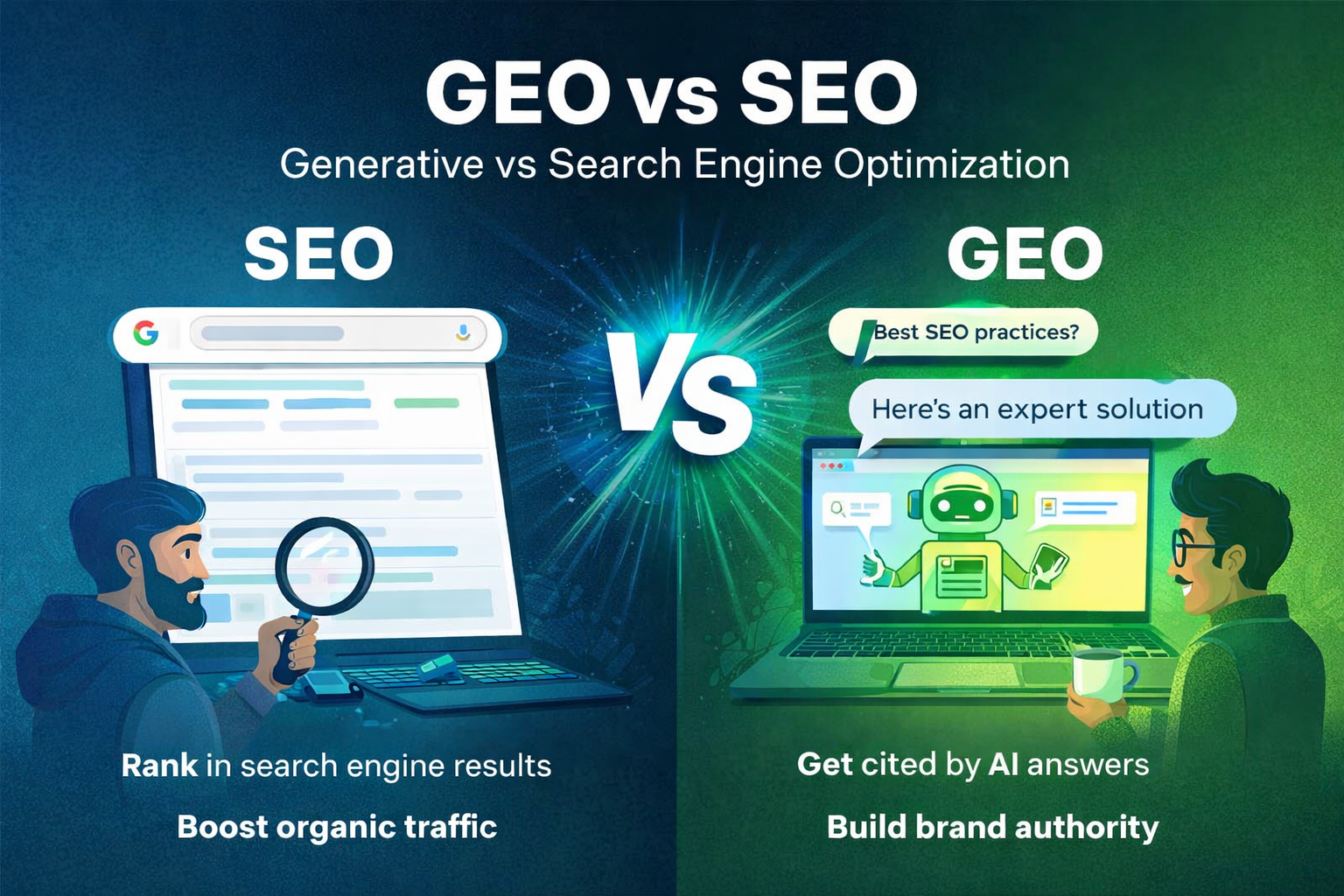
The search landscape is changing faster than ever.
For years, businesses relied on Search Engine Optimization (SEO) to rank higher on Google, attract traffic, and grow online visibility. But now, AI-powered search tools like ChatGPT, Google AI Overviews, Copilot, and Perplexity are reshaping how users find information.
Welcome to the era of Generative Engine Optimization (GEO).
If you’re wondering whether SEO is still relevant—or how GEO changes digital marketing—this guide breaks down everything you need to know about GEO vs SEO, how they differ, and why your strategy needs both.
What Is SEO?
Search Engine Optimization (SEO) is the process of improving your website’s visibility in traditional search engines like Google and Bing.
Its goal is simple:
Rank higher in search engine results pages (SERPs) so users click through to your website.
SEO strategies typically include:
Keyword Optimization
Targeting phrases users type into search engines.
Backlink Building
Earning links from reputable websites to improve authority.
Technical SEO
Optimizing site speed, mobile responsiveness, indexing, and crawlability.
Content Optimization
Creating relevant, high-quality pages aligned with user intent.
SEO has been the foundation of digital marketing for over two decades—and it remains critical today.
What Is GEO?
Generative Engine Optimization (GEO) is the process of optimizing content for AI-powered search and answer engines.
Instead of ranking as a blue link in Google search results, GEO helps your content appear in:
- ChatGPT-generated answers
- Google AI Overviews
- Perplexity citations
- Microsoft Copilot results
- Other AI search assistants
In GEO, the objective is not just to rank—it’s to become the source AI platforms trust and cite.
GEO vs SEO: The Core Difference
While both GEO and SEO aim to increase visibility, they operate differently.
SEO Focuses On:
- Ranking web pages in traditional search engines
- Driving clicks to websites
- Optimizing for search engine algorithms
GEO Focuses On:
- Getting cited in AI-generated responses
- Building authority and trust signals
- Structuring content for machine understanding
GEO vs SEO Comparison Table
| Factor | SEO | GEO |
|---|---|---|
| Search Platform | Google, Bing | ChatGPT, Perplexity, AI Overviews |
| Visibility Type | Ranked links in SERPs | Citations in AI-generated answers |
| Optimization Goal | Traffic and rankings | AI visibility and mentions |
| Key Signals | Keywords, backlinks, metadata | Authority, entities, structure |
| User Behavior | Click-through to website | Zero-click answer consumption |
Why GEO Matters More Than Ever
AI search is fundamentally changing user behavior.
Users increasingly prefer:
- Instant answers over browsing multiple websites
- Conversational search experiences
- Personalized AI-generated responses
Google’s own AI Overviews now answer a growing share of search queries directly—without users clicking through to websites.
This means:
Brands that optimize only for SEO may lose visibility in AI-driven search environments.
Is SEO Dead?
Absolutely not.
But SEO alone is no longer enough.
Traditional search still drives substantial traffic and remains a critical channel for discoverability. However:
- AI-generated search results are reducing click-through rates
- More searches end without a website visit
- AI assistants are becoming the first touchpoint for research
The smartest strategy today is not SEO vs GEO.
It’s:
SEO + GEO together
SEO gets you found in search engines.
GEO gets you cited in AI answers.
How GEO Works
Generative engines do not rank content the same way search engines do.
Instead, they evaluate:
Authority
Is your brand a trusted expert on the topic?
Entity Recognition
Does AI understand who your company, authors, and products are?
Structured Data
Can AI easily parse your content and metadata?
Relevance to User Intent
Does your content directly answer the question being asked?
Content Clarity
Is your content written in a format AI can summarize and cite?
Proven GEO Optimization Strategies
Here’s how to optimize your content for AI search.
1. Target Search Intent, Not Just Keywords
Traditional SEO often emphasizes exact-match keywords.
GEO prioritizes question-based and intent-driven content.
Instead of stuffing keywords, structure content around real user questions like:
- What is GEO?
- How does GEO work?
- Why is GEO important for SEO?
This makes your content more likely to match conversational AI queries.
2. Write for AI Readability
AI models prefer content that is easy to parse and summarize.
Best practices include:
- Short paragraphs
- Clear subheadings
- Bullet points
- Concise explanations
- Direct answers early in sections
Avoid fluff and unnecessary complexity.
3. Implement Structured Data / Schema Markup
Schema helps AI systems understand your content contextually.
Recommended schema types include:
- FAQ Schema
- How-To Schema
- Organization Schema
- Article Schema
- Product Schema
Structured data improves machine readability and can enhance both SEO and GEO.
4. Build Brand Authority
Authority matters more in GEO than ever before.
Ways to strengthen authority:
- Publish expert-led content
- Earn mentions from trusted sites
- Acquire backlinks from .edu/.gov/high-authority domains
- Showcase author credentials
- Update content regularly
AI platforms are more likely to cite sources they perceive as authoritative.
5. Optimize for Conversational Search
Voice search and AI chat interfaces use natural language queries.
Instead of optimizing only for:
“GEO optimization”
Also optimize for:
“How do I optimize my website for AI search engines?”
Long-tail, conversational phrases improve GEO performance.
The Future of Search: What Comes Next
The rise of GEO is only the beginning.
Here are major trends shaping the future:
Voice Search Integration
As voice assistants improve, conversational queries will increase.
Optimization will shift toward natural-language answers.
Multimodal AI Search
AI systems are beginning to analyze:
- Images
- Videos
- Infographics
- Audio
Future GEO strategies will require multimedia optimization.
Personalized AI Search Results
AI engines will increasingly tailor responses based on:
- User behavior
- Preferences
- Location
- Context
This will make relevance and audience segmentation even more important.
Can Small Businesses Compete in GEO?
Yes.
In fact, GEO can level the playing field.
Unlike traditional SEO—where large brands dominate due to domain authority—GEO often rewards:
- Expertise
- Clear answers
- Topical authority
- Well-structured niche content
Smaller brands can outperform larger competitors by publishing highly specialized, authoritative content.
Measuring GEO Success
Unlike SEO, GEO success isn’t just about rankings.
Key GEO metrics include:
- AI citation frequency
- Brand mentions in AI tools
- AI referral traffic
- Visibility in AI Overviews
- Share of voice in generative search
New tools are emerging to help brands track these metrics across AI platforms.
GEO + SEO: The Winning Strategy
The best digital marketing strategy today combines both.
Use SEO For:
- Traditional rankings
- Organic traffic
- Search engine discoverability
Use GEO For:
- AI-generated answer visibility
- Brand authority building
- Future-proofing against search evolution
Together, they create a comprehensive search visibility strategy.
Final Thoughts
Search is evolving from:
“10 blue links”
to
“1 AI-generated answer”
That shift changes everything.
Brands that adapt early to GEO will gain a major competitive advantage as AI search becomes mainstream.
The future belongs to businesses that understand this reality:
SEO gets you ranked. GEO gets you referenced.
To stay visible in tomorrow’s search ecosystem, you need both.
Conclusion
GEO is not replacing SEO—it is expanding it.
Traditional search optimization remains valuable, but AI-powered search experiences are creating a new layer of visibility that brands cannot ignore.
By combining:
- Strong SEO fundamentals
- GEO-focused authority building
- AI-readable content structure
- Conversational optimization
you can future-proof your digital presence and remain discoverable no matter how search evolves.
Categorias
Leia mais
The Pokémon TCG Pocket series is taking a bold step forward with the launch of the Mega Rising expansion, a collection that blends nostalgia with innovation by integrating mega evolutions into the digital card game universe. This new set is poised to revolutionize gameplay strategies, featuring powerful Mega Gyarados, Mega Blaziken, and Mega Altaria cards that are set to make a...

HelloDumps offers the latest GAQM ISO_ISMS_Fnd exam questions with 90 days of free updates. Trusted study material, instant access, and a 25% OFF deal to help you pass quickly. Clear Your GAQM ISO_ISMS_Fnd Exam Faster – Get 25% OFF on HelloDumps! Don’t waste hours searching for reliable study material. HelloDumps gives you verified ISO_ISMS_Fnd exam questions designed to...

Card Customization and Currency In Pokémon TCG Pocket, players can enhance their cards with vibrant flair cosmetics, adding a new layer of customization for both display and gameplay. To customize your cards, you'll need two key resources: shinedust and duplicate cards. Shinedust serves as the fundamental currency required to craft and apply different flair effects. You can earn...

In the UK’s transport sector, the CPC Transport Manager plays a crucial role in keeping goods operators compliant, organised, and running safely. Any business using vehicles above 3.5 tonnes must have someone who holds the Certificate of Professional Competence, and this requirement is taken seriously by the DVSA and the Traffic Commissioners. Their oversight ensures that operators meet...

Constant ringing in the ears can feel exhausting. Whether it’s a soft buzzing at night or a loud ringing during the day, tinnitus can affect sleep, focus, mood, and overall quality of life. If you’ve been searching for a natural solution, you’ve likely come across Audizen. But what exactly is it? Does it really work? And most importantly — is it worth your...