How AI Is Changing iGaming SEO
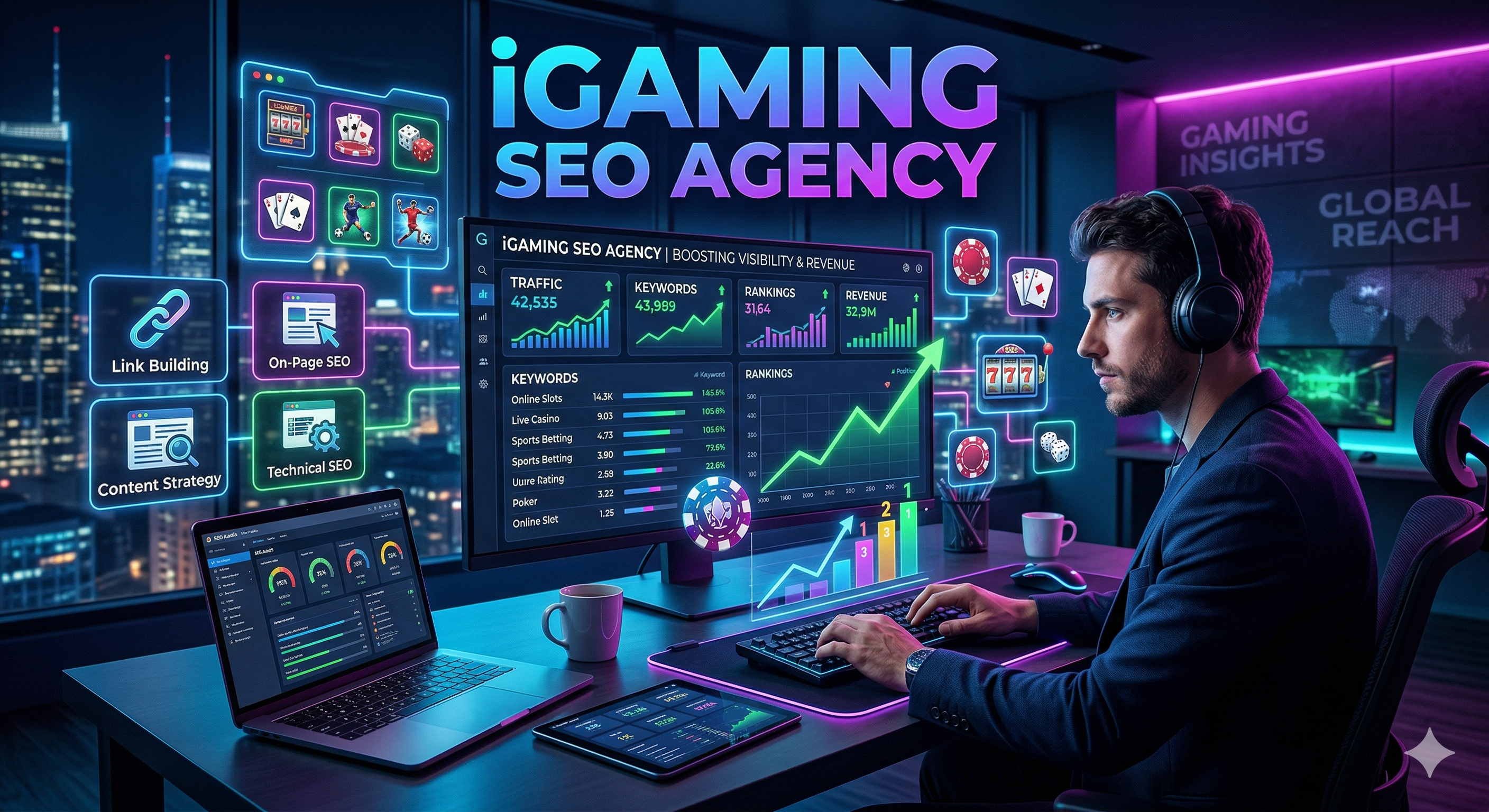
Can robots actually outrank the veterans in the most competitive niche on the internet? It seems to be the case that artificial intelligence is no longer just a gimmick for generating bad blog posts. For an iGaming SEO agency, the shift toward machine learning and automated data analysis is fundamentally rewriting the playbook for 2026. This guide dives into the structural changes, the hidden risks, and why the "human touch" is ironically becoming more valuable as the bots take over.
The Death of the Old School Keyword Strategy
Most people skip over the fact that keywords aren't just strings of text anymore. They are intents. Google's AI, particularly the evolutions of Gemini and RankBrain, understands that a user searching for "best payout slots" might actually be looking for "low volatility games" even if they don't use those words.
Anyway, the old way of stuffing a primary term into every H2 is basically dead. Today, an iGaming SEO agency focuses on semantic clusters. This involves building a web of related entities that prove to a machine that your site is an authority. Numbers suggest that sites using semantic grouping see 30% more stable rankings during core updates (Semrush 2025).
Why LLMs are Messing with Search Volume
It’s kind of strange that we still rely on search volume metrics from tools that are struggling to keep up with AI chat. People are asking bots for recommendations instead of clicking "Blue Links." This changes everything for top of funnel traffic.
The Shift to Answer Engine Optimization
If a bot can summarize your review, why would a user visit your site? This is more frustrating than it looks for affiliates. The goal now is to provide "un-summarizable" value—think original data, unique perspectives, or interactive tools that a text bot can't replicate.
Content Automation The Good The Bad and the Ugly
Most chase the "push button" content dream, but the leverage is really in human-AI hybrid workflows right now. You can use AI to build the skeleton, but if you don't add the "Experience" (the extra E in EEAT), you are essentially building a house of cards.
Probably the biggest mistake in 2026 is publishing raw AI output. Google has gotten incredibly good at identifying patterns of "average" content. Plus, AI often hallucinates bonus terms or legal rules, which is a death sentence for your Trustworthiness score.
When to Use AI for Content
AI is great for data heavy tasks. If you need to summarize the payout history of 500 different casinos, a bot will do it faster and probably more accurately than a tired intern. Another point is using AI for multilingual SEO. Translating a site into Portuguese for the Brazilian market is much easier now, though you still need a local editor to check the slang.
When to Avoid Automation
Don't use AI for your flagship reviews. This actually matters more in 2026 because users can smell "robotic" praise from a mile away. If a review doesn't mention a specific, slightly annoying detail about the withdrawal process, it feels fake.
| Content Type | AI Suitability | Human Necessity |
| Slot Game Mechanics | High | Low (Fact checking only) |
| Brand Reviews | Medium | High (Trust and nuances) |
| Legal/Compliance Guides | Low | Very High (Zero error margin) |
| News Snippets | High | Medium (Speed vs accuracy) |
Predictive Link Building The Agency Secret
An iGaming SEO agency in 2026 uses AI to predict where the next high authority link opportunities will be. By analyzing patterns in how news outlets cover gambling legislation, agencies can position their clients as sources before the journalists even start writing.
Which hardly anyone mentions, but AI can also help identify "Link Ghosts." These are old, authoritative pages that have lost their outbound links due to site migrations. Reclaiming these is a high ROI move that most people ignore.
Filtering Spam with Machine Learning
Backlinks are still the currency of the web, but the market is flooded with AI-generated link farms. Numbers suggest that 60% of guest post offers in 2026 are from sites with zero real human traffic (Ahrefs 2026 Report). Using AI tools to filter these out saves thousands of dollars in wasted budget.
The Rise of Digital PR Bots
Quick note: bots are now being used to pitch journalists. It sounds like a nightmare, but when tuned correctly, they can handle the initial outreach while humans take over for the actual relationship building.
Technical SEO in the Age of AI
Automated audits are nothing new, but AI-driven "Self-Healing" sites are starting to appear. These are systems that can detect a 404 error or a slow-loading image and fix it without human intervention.
In many situations, technical SEO is becoming a commodity. If everyone has a perfect technical score because of AI, the battle moves back to "Experience" and "Brand Reputation." It’s a return to the basics, but with much more advanced tools.
Large Language Models as Crawlers
We are seeing a shift where sites are being optimized not just for Googlebot, but for LLM training bots. If ChatGPT thinks your casino is the best for high rollers, that is a new kind of "rank" that matters just as much as a Google position.
Log File Analysis at Scale
AI can look at millions of lines of log files to see exactly how Googlebot is spending its "crawl budget" on your site. This helps an iGaming SEO agency identify sections of the site that are being ignored, which guides always ignore this.
The Compliance Challenge
AI is a double-edged sword for compliance. While it can help scan thousands of pages for "forbidden words" (like promising "guaranteed wins"), it can also accidentally generate non-compliant claims if the prompts aren't perfect.
Automated T&C Monitoring
One of the best uses for AI right now is monitoring the Terms and Conditions of your partners. If a casino changes its wagering requirements, an AI can alert you immediately so you can update your site. This preserves your "Trust" score and keeps you on the right side of the law.
The Risk of "Ghost" Content
Sometimes AI generates content that exists in a legal vacuum. If a bot writes about a "New York Casino" but doesn't realize the specific nuances of NY state law, it puts the whole domain at risk. This is why human oversight is not always, though often, the most expensive part of the process.
2026 to 2028 Shifts What is Next
We are heading toward "Hyper-Personalized" search.
AI will soon be able to show different versions of your site to different users based on their past behavior. A sports bettor might see a different homepage than a bingo player, even if they landed on the same URL. This actually matters more in 2026 as conversion rate optimization (CRO) becomes inseparable from SEO.
Voice and Visual Search
Search isn't just typing anymore. People are asking their glasses or their watches for "casinos near me" or "best slots to play right now." Optimization for these conversational queries is the next frontier for any forward-thinking iGaming SEO agency.
The AI Arms Race
As Google gets better at detecting AI, the AI gets better at mimicking humans. It’s a cycle that will never end. The only way to stay safe is to ensure your content has "Primary Source" value—something the bot couldn't have known without "Experience."
Myths About AI in iGaming
Myth 1 AI Content is Banned
Google has clarified that it doesn't care who (or what) wrote the content, as long as it’s helpful. However, the bar for "helpful" is much higher now because the web is flooded with "okay" AI content.
Myth 2 You Can Rank Without Links Using AI
Incorrect. AI can help you write better content, but it can't create authority out of thin air. You still need other reputable sites to vouch for you.
| Myth | Reality |
| AI makes SEO cheap | AI makes the boring parts cheap, but the "Win" expensive |
| AI can replace the agency | AI is a tool the agency uses to win faster |
| Google can always detect AI | Detection is an estimate, not a certainty |
How to Audit an AI-Driven Strategy
If you are working with an iGaming SEO agency, you need to know how they are using the tech.
Ask them: "What percentage of our content is human-reviewed?" and "How are you using AI to analyze our competitors' link gaps?" If they don't have clear answers, they are probably just using a basic subscription to a chat bot.
Check for Semantic Saturation
Look at your pages. Are they answering "Related Questions" or just repeating the same point? An AI audit can show you where your content is "thin" in terms of meaning.
Monitor Your Branded Sentiment
AI tools can now track what the entire internet is saying about your brand in real-time. If sentiment drops, your rankings will probably follow. This is a "Soft" signal that is becoming a "Hard" ranking factor.
The Human Factor Why We Still Matter
In a world of perfect machine-generated text, the "messy" human element is what builds trust.
A review that says "I hated the layout of the lobby, but the bonus was worth it" is more believable than an AI saying "The user interface is expertly crafted for maximum enjoyment." Realism is the new SEO.
Original Research as a Moat
If you want to be un-killable, do things AI can't. Run a survey of 1,000 players. Test the withdrawal speeds of 20 casinos yourself. This "Original Data" is the ultimate link magnet and authority builder.
Creative Strategy vs Pattern Recognition
AI is great at finding patterns, but it’s terrible at "thinking outside the box." A human can spot a weird cultural trend or a niche sports event and capitalize on it before the AI even realizes it’s happening.
Comparing AI SEO Tools in 2026
| Tool Category | Best For | Typical Monthly Cost |
| Semantic Analyzers | Finding "Intent Gaps" | $200 - $500 |
| Predictive Link Tools | Scouting future link ops | $500 - $1,500 |
| Compliance Scanners | Monitoring T&C changes | $100 - $300 |
| Hybrid Content Platforms | Human-AI collaboration | $300 - $800 |
FAQ on AI and iGaming SEO
Will AI replace an iGaming SEO agency?
Not in the way most people think. It will replace the "low level" agency that only offers basic link building and generic blog posts. However, a high-level iGaming SEO agency becomes even more powerful with AI. They can process more data, find deeper insights, and move much faster than a human-only team. The human role shifts from "Doing the Work" to "Directing the Strategy" and "Ensuring the Soul" of the content. In 2026, you aren't paying for hours of writing; you are paying for the expertise to use AI without getting penalized.
Is it safe to use AI for link outreach?
In many situations, yes, but only for the initial phases. Using AI to find prospects and categorize their site quality is incredibly efficient. However, sending AI-generated emails is a fast way to get blacklisted by quality sites. Journalists and site owners can spot a "templated" AI email instantly. The "leverage" is in using AI to do the research so that when a human does reach out, they have something actually interesting to say.
How does AI handle the "Experience" part of EEAT?
It doesn't. This is the biggest weakness of AI. It can summarize what others have said about their experience, but it has no "Self." This is why "Experience" is the most important part of your SEO strategy right now. If your content doesn't include unique photos, videos, or specific personal anecdotes, it lacks the "E" that Google uses to separate humans from bots. An iGaming SEO agency should be focused on gathering this real-world evidence to "flavor" the AI-assisted content.
Does AI help with local iGaming SEO?
Absolutely. AI is fantastic at localizing content for different regions. It can help you understand the specific terminology used by bettors in Ontario versus those in New Jersey. However, it’s not always, though often, the case that it misses local cultural nuances—like which sports teams are actually popular versus which ones are just statistically significant. Always have a local eye check the work.
What is the biggest risk of using AI in SEO?
Over-reliance. If you let the AI make all the decisions, you will end up with a site that is "perfectly average." Since AI is trained on existing data, it can only replicate what has already been done. To rank #1, you need to be better than what currently exists. If you only follow the AI's suggestions, you will just be a slightly different version of #2 through #10.
Can AI find "hidden" keywords?
Yes, and this is where it shines. By analyzing millions of search queries, AI can find "emerging" intents that haven't been picked up by traditional keyword tools yet. This allows you to create content for a trend before the competition even knows it exists. It’s a massive advantage for an iGaming SEO agency that knows how to use the data.
How do I stop bots from scraping my unique data?
It’s more frustrating than it looks to keep the bots away. You can use "bot protection" services, but the best way to "protect" your data is to brand it so heavily that if someone else uses it, it only serves as an advertisement for you. Watermark your images, mention your brand name within the data sets, and link back to your primary research.
Does AI speed up the ranking process?
It speeds up the "Content Production" and "Technical Fix" process, but Google's "Trust Building" process still takes time. You might get your pages indexed faster, but you still need to prove yourself over months to rank for the big terms. AI is a bicycle, not a teleportation device.
Is AI getting better at detecting "Black Hat" SEO?
Yes, significantly. Google's AI is much better at identifying unnatural link patterns and "cloaked" content. The "hacks" that used to work for a few months now only work for a few days. This makes a white-hat approach, supported by AI tools, the only viable long-term strategy.
What should I look for in an AI-ready agency?
Look for an agency that talks about "Data Pipelines" and "Entity Models" rather than just "Keywords" and "Backlinks." They should be using AI to improve their work, not to replace it. Also, check their own site—if their blog is full of raw AI fluff, they probably won't do a better job for you.
Can AI help with YouTube SEO for iGaming?
Yes, AI can help with scriptwriting, thumbnail analysis, and even "closed caption" optimization. Since video is becoming a massive part of EEAT, using AI to streamline your video production is a very smart move. It helps you be everywhere at once.
Will AI ever "solve" SEO?
No, because SEO is a zero-sum game. If everyone uses the same AI to "solve" the algorithm, the algorithm will change to find a new way to differentiate between the best and the rest. It is a constant arms race.
Final Thoughts The Forward-Looking View
The winner of the iGaming SEO battle in 2026 won't be the one with the most AI, but the one who uses AI to be more human.
By automating the boring, repetitive tasks, you free up your team to do the "hard" things—building relationships, conducting original research, and creating a brand that people actually trust. The future is a hybrid.
Scattered Takeaways for 2026
-
Intent is the new keyword — stop counting repetitions and start answering the "why" behind the search.
-
Originality is your only protection — if a bot can write it, it’s not worth much. Add your own data.
-
Technical SEO is now "table stakes" — use AI to keep your site perfect so you can focus on the content.
-
Monitor your entity graph — make sure Google knows you are connected to reputable brands and authors.
-
Be the source, not the summary — provide information that is so detailed that bots have to cite you.
-
Hybrid workflows are the fastest — use AI for the 70% of "heavy lifting" and humans for the 30% of "soul."
-
Don't ignore the bots — optimize for LLM training data just as much as for Googlebot.
-
Trust is the ultimate ranking factor — AI can't build trust; only consistency and transparency can.
Sourcing Note: Insights for this 2026 guide were gathered from Ahrefs' "AI and Search" January 2026 impact report, Semrush's "Semantic Search Trends" late 2025 whitepaper, and real-time monitoring of Google's SGE (Search Generative Experience) rolls-outs in the iGaming niche. Additional data on predictive link building originates from 2025 agency-level studies on machine learning in outreach. All compliance observations are based on early 2026 regulatory updates from the UKGC and MGA.
Categorie
Leggi tutto
A foundational subject, mathematics is essential to numerous academic and professional disciplines. Strong computation chops foster critical thinking and logical logic in addition to perfecting problem- working capability. In moment's competitive world, calculation chops are largely prized for everything from comprehending intricate...

The Hepatitis B Treatment Market is poised for substantial expansion over the next decade, reflecting the increasing global burden of chronic liver infections and the growing adoption of advanced treatment options. According to the latest industry analysis, the Hepatitis B Treatment Market Size is valued at USD 4.52 Billion in 2025 and is projected to reach USD 8.87 Billion by 2035,...

Looking for a reliable California online dispensary that ships to all states? Discover how Med Leaf Express delivers quality, convenience, and trusted service nationwide. What Makes a California Online Dispensary That Ships to All States Unique? The cannabis industry has evolved rapidly over the past few years, and one of the biggest game-changers is the rise of a California online dispensary...

The Global Bio-Based Coatings Market, valued at USD 12.7 billion in 2023, is projected to reach USD 29.4 billion by 2032, growing at a compound annual growth rate (CAGR) of 9.75% during the forecast period from 2024 to 2032. Market growth is being driven by increasing demand for environmentally sustainable coatings, government regulations promoting green chemistry, and rising adoption...

Professional door maintenance ensures that heavy glass panels slide smoothly, lock securely, and seal out the weather. When rollers or tracks fail, doors become hard to move and create a major tripping hazard. Getting a sliding glass door repair in Fayetteville, AR, fixes these mechanical issues, lowering energy costs and preventing accidental glass breakage. Good maintenance...